

Previous Year Questions 2026
Q1. Read the given source carefully and answer the questions that follow: [4 Marks]
FLOODS
Basic safety precautions to be taken :
- Listen to radio/TV for the latest weather bulletins and flood warnings. Pass on the information to others.
- Make a family emergency kit which should include a portable radio/transistor, torch, spare batteries, a first aid box along with essential medicines, ORS, dry food items, drinking water, matchboxes, candles and other essential items.
- Keep a hurricane lamp, ropes, rubber tubes, an umbrella and a bamboo stick in your house. These could be useful.
- Keep your cash, jewellery, valuables, important documents, etc. in a safe place.
- If there is a flood, move along with your family members and cattle to safe areas like relief camps, evacuation centres, elevated grounds where you can take shelter.
- Turn off power and gas connections before leaving your house.
During Floods
- Don't enter flood waters; it could be dangerous.
- Don't allow children to play in or near flood waters.
- Stay away from sewerage lines, gutters, drains, culverts, etc.
- Be careful of snakes; snakebites are common during floods.
- Stay away from electric poles and fallen power lines to avoid electrocution.
- Don't use wet electrical appliances; get them checked before use.
- Eat freshly cooked and dry food. Always keep your food covered.
- Use boiled and filtered drinking water.
- Keep all drains and gutters near your house clean.
- Stagnation of water can breed vector/water-borne diseases. In case of sickness, seek medical assistance.
- Use bleaching powder and lime to disinfect the surroundings.
(a) Suggest one precaution before using water after floods. [1 Mark]
Ans:
- Boil the water before drinking to kill harmful germs.
- Drink only filtered water to ensure safety.
- Disinfect the water using appropriate chemical purifiers.
- Use clean and covered containers to store drinking water.
(Any one point to be explained)
(b) Mention any two measures related to protection of food items during floods. [1 Mark]
Ans:
- Eat only freshly cooked and completely dry food.
- Always keep your food tightly covered to prevent contamination.
(c) Suggest two actions to be taken before leaving the house during a flood warning. [2 Marks]
Ans:
- Listen to the radio or television for the latest weather bulletins and flood warnings.
- Make a family emergency kit containing essential survival items.
- Pass on the correct information to others in your neighbourhood.
- Keep your cash, jewellery, valuables, and important documents in a secure place.
- Move along with your family members and cattle to safe areas like relief camps or elevated grounds.
- Turn off power and gas connections before leaving your house to prevent accidents.
(Any Two points to be explained)
Q2. In which Indian state is 'Bamboo drip irrigation' system used? [1 Mark]
(A)Himachal Pradesh
(B)Kerala
(C) Rajasthan
(D) Meghalaya
Ans: (D)
Explanation: Meghalaya extensively uses the traditional bamboo drip irrigation system to carefully channel water from streams and natural springs using connected bamboo pipes. This method is highly effective in the hilly terrain.
Q3. Arrange the location of the following dams of India from North to South and choose the correct option: [Marks: 1]
I. Pravara
II. Salal
III. Koyna
IV. Gandhi Sagar
Options:
(A) II, IV, III, I
(B)II, IV, I, III
(C)III, II, IV, I
(D)III, IV, II, I
Ans: (B)
Explanation: The correct geographical sequence of the given dams from North to South is Salal (Jammu and Kashmir), Gandhi Sagar (Madhya Pradesh), Pravara (Maharashtra), and Koyna (Maharashtra).

Q18. Read the given source and answer the questions that follow : [4 Marks]
Sardar Sarovar Project
Sardar Sarovar Dam has been built over the Narmada river in Gujarat. This is one of the largest water resources projects of India covering four states - Maharashtra, Madhya Pradesh, Gujarat and Rajasthan. The Sardar Sarovar Project would meet the requirement of water in drought prone and desert areas. Sardar Sarovar Project will provide irrigation facilities to 18.45 lakh hectare of land, covering 3112 villages in 15 districts of Gujarat. It will also irrigate 2,46,000 hectare of land in the strategic desert districts of Barmer and Jalore in Rajasthan and 37,500 hectare in the tribal hilly tract of Maharashtra through lift. About 75% of the command area in Gujarat is drought prone while entire command in Rajasthan is drought prone. Assured water supply will soon make this area drought proof.
(a) Why is Sardar Sarovar Project considered important for Gujarat ? [1 Mark]
Ans: The Sardar Sarovar Project is highly important for Gujarat because it provides extensive irrigation facilities to 18.45 lakh hectares of agricultural land, covering 3112 villages across 15 districts in the state.
(b) Why is Sardar Sarovar Project designed to cover four states ? [1 Mark]
Ans:
- The project is specifically designed to meet the crucial water requirements of drought-prone and desert areas across all four participating states.
- It aims to provide widespread irrigation facilities to agricultural lands in Gujarat, Rajasthan, and Maharashtra.
(c) In what ways does this project promote sustainability ? [2 Marks]
Ans:
- It provides essential drinking water facilities to the drought-prone areas, ensuring long-term water availability.
- It irrigates massive areas of agricultural land, which guarantees food security for a growing population.
- It generates hydroelectric energy, which is a highly renewable and clean source of power.
- It facilitates the natural recharge of groundwater, thereby supporting sustainable water management practices.
Q18. Read the given source carefully and answer the questions that follow :
Pradhan Mantri Krishi Sinchayee Yojana
Floods have not only devastated life and property but also caused extensive soil erosion. Sedimentation also meant that the flood plains were deprived of silt, a natural fertilizer, further adding on to the problem of land degradation. It was also observed that the multipurpose projects induced earthquakes, caused water-borne diseases and pests and pollution resulting from excessive use of water. Irrigation has also changed the cropping pattern of many regions with farmers shifting to water intensive and commercial crops. This has great ecological consequences like salinisation of the soil. Pradhan Mantri Krishi Sinchayee Yojana has been started which ensures access to some means to protective irrigation for all agricultural farms in the country, thus bringing much desired rural prosperity. Some of the broad objectives of this programme are to enhance the physical access of water on the farm and expand cultivable area under assured irrigation (har khet ko pani), improve on farm water, use efficiency to reduce wastage and increase availability both in duration and extent, irrigation and other water saving technologies (per drop more crop) and introduce sustainable water conservation practices, etc.
(a) Explain the role of floods in land degradation. [1 Mark]
Ans:
- Floods wash away the fertile top layer of soil, causing severe soil erosion.
- Floods also cause heavy sedimentation, which deprives flood plains of beneficial silt (a natural fertiliser), further accelerating land degradation.
(b) How has irrigation changed cropping pattern ? [1 Mark]
Ans:
- Farmers are increasingly shifting towards water-intensive crops due to the availability of irrigation.
- There is a major shift towards commercial cropping rather than traditional subsistence farming.
(c) Explain any two objectives of the 'Pradhan Mantri Krishi Sinchayee Yojana'. [2 Marks]
Ans:
- To enhance the physical access of water directly on the agricultural farm.
- To expand the cultivable area under assured irrigation coverage (Har Khet Ko Pani).
- To improve on-farm water use efficiency in order to reduce overall wastage.
- To introduce sustainable and long-lasting water conservation practices.
- To reduce the wastage of water and increase the efficiency of irrigation by adopting drip and sprinkler systems.
- To promote irrigation and other modern water-saving technologies (Per Drop More Crop).
Previous Year Questions 2025
Q1: Match Column I with Column II and choose the correct option: (1 Mark)
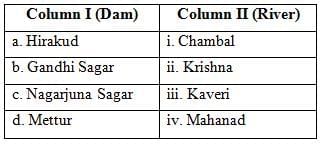
(a)a-iv, b-i, c-iii, d-ii
(b) a-i, b-ii, c-iv, d-iii
(c)a-iv, b-i, c-ii, d-iii
(d) a-i, b-ii, c-iii, d-iv
Ans: (c)
Explanation: The dams and their respective rivers are correctly matched as follows:
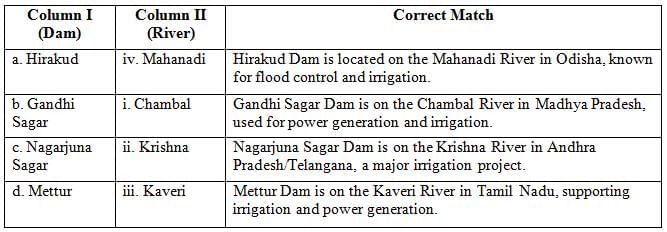
Correct Matches:
a-iv (Hirakud Dam is located on the Mahanadi River)
b-i (Gandhi Sagar Dam is located on the Chambal River)
c-ii (Nagarjuna Sagar Dam is located on the Krishna River)
d-iii (Mettur Dam is located on the Kaveri River)
Since each dam perfectly corresponds to the river named above, option (c) is the correct choice.
Q2: Choose the correct option regarding major states involved in the Krishna-Godavari issue: (1 Mark)
(a) Karnataka, Kerala, and Tamil Nadu
(b) Maharashtra, Karnataka, and Andhra Pradesh
(c)Gujarat, Maharashtra, and Madhya Pradesh
(d)Jharkhand, Andhra Pradesh, and Odisha
Ans: (b)
Explanation: The Krishna-Godavari water dispute primarily involves the states of Maharashtra, Karnataka, and Andhra Pradesh. The conflict began when Maharashtra decided to divert water at Koyna for a multipurpose project. This action was strongly opposed by both Karnataka and Andhra Pradesh as it directly reduced their rightful share of the river water.
Q3: Match Column I with Column II and choose the correct option: (1 Mark)
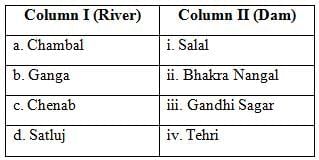
(a)a-ii, b-iii, c-i, d-iv
(b) a-ii, b-iii, c-iv, d-i
(c)a-iii, b-iv, c-i, d-ii
(d)a-iii, b-iv, c-ii, d-i
Ans: (c)
Explanation: The correct pairing of rivers with their corresponding dams is shown below:
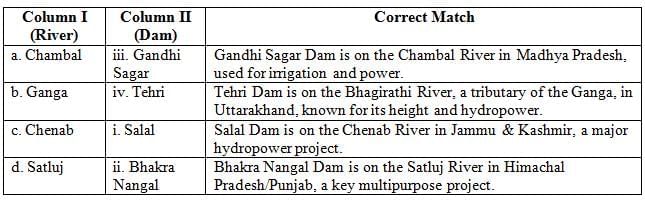
Correct Matches:
- a-iii (The Chambal River pairs with the Gandhi Sagar Dam)
- b-iv (The Ganga River pairs with the Tehri Dam)
- c-i (The Chenab River pairs with the Salal Dam)
- d-ii (The Satluj River pairs with the Bhakra Nangal Dam)
These correct matchings confirm that option (c) is the right choice.
Q4: Choose the correct option of the states that have been majorly benefitted by the Sardar Sarovar Dam. (1 Mark)
Options:
(a)Rajasthan, Gujarat, Punjab, and Haryana
(b) Maharashtra, Madhya Pradesh, Gujarat, and Rajasthan
(c) Maharashtra, Madhya Pradesh, Telangana, and Andhra Pradesh
(d) Madhya Pradesh, Rajasthan, Karnataka, and Chhattisgarh
Ans: (b)
Explanation: The Sardar Sarovar Dam, constructed on the Narmada River, supplies vital irrigation and drinking water across four major states: Maharashtra, Madhya Pradesh, Gujarat, and Rajasthan. It has been especially beneficial in providing reliable water to arid parts of Rajasthan, such as the Barmer and Jalore districts, making option (b) correct.
Q5:How has the overuse of underground water created a serious crisis in many parts of India? Explain with examples in the context of sustainable development. (5 Marks)
Ans: The overuse of underground water has created a severe environmental and economic crisis in many parts of India. The main impacts on sustainable development are:
- Declining water table: The extensive use of private wells and tube wells for agricultural irrigation has rapidly lowered groundwater levels. Farmers are extracting water much faster than nature can recharge it, causing a long-term decline.
- Threat to food security: While heavy groundwater extraction may increase short-term crop output, it drastically reduces water availability for future farming seasons. This ultimately threatens sustained food production for a growing population.
- Urban water stress: Many modern urban housing societies rely heavily on private pumps and deep borewells. This widespread groundwater extraction in cities severely depletes the local water table, making the domestic water supply highly fragile.
- Industrial pressure: Industries continuously withdraw large amounts of fresh water for manufacturing. They also sometimes discharge untreated chemical effluents, which reduces the quantity of usable fresh water and worsens overall scarcity.
- Need for management: To tackle these massive problems, government programmes such as the Jal Jeevan Mission and Atal Bhujal Yojana actively promote water conservation, improved recharge structures, and better water management at the local community level.
Q6: How have industrialization and urbanization impacted water supply? Explain. (3 Marks)
Ans: Rapid industrialisation and urbanisation have placed immense pressure on fresh water resources in the following ways:
- Higher industrial demand: Industries require massive volumes of fresh water for manufacturing processes and cooling systems. As the number of industries grows, the overall demand for water increases significantly.
- Water pollution: Industrial chemical effluents and untreated domestic wastes are frequently discharged into rivers and groundwater. This severely contaminates the water, reducing the amount of safe water available for other uses.
- Urban over-extraction: Rapid urban expansion and a higher standard of living lead to intense groundwater pumping by colonies and housing societies. This continuous extraction causes a rapid depletion of local water tables.
Q7: Explain any three aims of Jal Jeevan Mission (JJM). (3 Marks)
Ans: The Jal Jeevan Mission (JJM) is a crucial government initiative. Its three main aims are:
- Assured water supply: To provide every rural household with a functional piped water connection that consistently supplies safe and clean drinking water.
- Adequate service level: To ensure a minimum supply of 55 litres of water per person per day, which is sufficient to comfortably meet basic domestic and sanitation needs.
- Long-term functionality: To actively maintain the infrastructure so that tap connections remain fully functional over time through proper local community management and regular upkeep.
Q8: Choose the correct option to fill the blank.
An artificial lake built in the 11th century for water conservation is: (1 Mark)
(a) Sambhar Lake
(b)Wular Lake
(c)Bhopal Lake
(d) Chilka Lake
Ans: (c)
Explanation: Bhopal Lake was constructed in the 11th century and was considered one of the largest artificial lakes of its time. It was specifically built with advanced techniques to conserve and store rainwater for local use.
Q9: Match Column I with Column II and choose the correct option: (1 Mark)
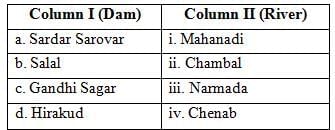
(a) a-ii, b-i, c-iv, d-iii
(b)a-iii, b-iv, c-i, d-ii
(c) a-iii, b-iv, c-ii, d-i
(d) a-i, b-iii, c-iv, d-ii
Ans: (c)
Explanation: The correct matching of the major dams with their respective rivers is shown below:
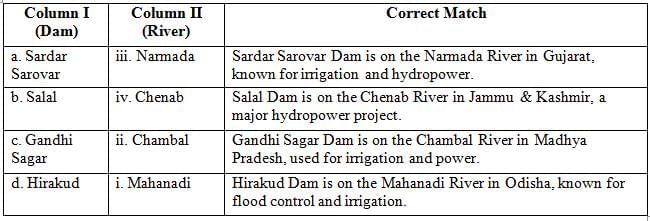
Therefore, option (c) is the correct choice.
 | Get additional INR 200 off today with EDUREV200 coupon. | Avail Offer |
Previous Year Questions 2024
Q1: Which one of the following is the irrigation system in Meghalaya? (CBSE 2024)
(a)To irrigate land only during rainy season.
(b) To use large volumes of water for irrigation.
(c)To remove water from soil.
(d) To use bamboo drip irrigation system.
Ans: (d)
Explanation: In Meghalaya, farmers extensively use a traditional bamboo drip irrigation system. Clean water from streams and natural springs is carefully channelled through connected bamboo pipes directly to individual agricultural plots. This age-old method highly suits the hilly terrain and conserves water while supplying it efficiently to the crops.
Previous Year Questions 2023
Q2: In which of the following States Tungabhadra Dam is located? (2023)(a) Tamil Nadu
(b) Kerala
(c) Andhra Pradesh
(d) Karnataka
Ans: (d)
Explanation: The Tungabhadra Dam is constructed across the Tungabhadra River and is geographically located in the state of Karnataka. Hence, option (d) is the correct answer.
Q3: Read the given source and answer the questions that follow: (2023)
RAINWATER HARVESTING
Many thought that, given the disadvantages and rising resistance against the multi-purpose projects, the water harvesting system was a viable alternative, both socio-economically and environmentally. In ancient India, along with the sophisticated hydraulic structures, there existed an extraordinary tradition of water harvesting systems. People had in-depth knowledge of rainfall regimes and soil types and developed wide-ranging techniques to harvest rainwater, groundwater, river water and flood water in keeping with the local ecological conditions and their water needs. In hill and mountainous regions, people built diversion channels like the 'guls' or 'kuls' of the Western Himalayas for agriculture. 'Rooftop rainwater harvesting' was commonly practised to store drinking water, particularly in Rajasthan. In the floodplains of Bengal, people developed inundation channels to irrigate their fields. In arid and semi-arid regions, agricultural fields were converted into rain-fed storage structures that allowed the water to stand and moisten the soil like the 'khadins' in Jaisalmer and 'Johads' in other parts of Rajasthan.
(i) Why is water harvesting system a viable alternative?
(ii) Describe the process of 'rooftop rainwater harvesting.'
(iii) Mention any two methods adopted by ancient India for water conservation.
Ans:
(i) Viable alternative: Water harvesting is a highly practical alternative because it is both socio-economically beneficial and environmentally friendly. It effectively helps communities collect and store local water, reduces heavy dependence on large dams, and supports local livelihoods without causing massive ecological damage.
(ii) Rooftop rainwater harvesting: This process involves capturing pure rainwater that falls on house roofs, directing it through pipes or gutters into underground storage structures or tanks (tankas), and using it as a highly sustainable source of drinking and household water. This method was widely practised in arid areas like Rajasthan.
(iii) Ancient conservation methods: Two major traditional methods used in ancient India are building diversion channels such as 'guls' or 'kuls' in the Western Himalayas for agricultural irrigation, and creating rain-fed storage structures like 'khadins' and 'johads' in arid and semi-arid regions for efficiently conserving rainwater.
Also read: Worksheet: Water Resources |
Previous Year Questions 2022
Q4: Which one of the following factors is mainly responsible for declining water level in India? (2022)(a) Irrigation
(b)Industrialisation
(c)Urbanisation
(d) Over-utilisation
Ans: (d)
Explanation: The over-utilisation of water, especially underground water, is primarily responsible for the rapidly declining water levels across India. Excessive pumping for intensive agricultural irrigation, rising domestic needs, and heavy industrial use withdraws water much faster than the natural recharge rate, causing water tables to fall dangerously low.
Previous Year Questions 2019
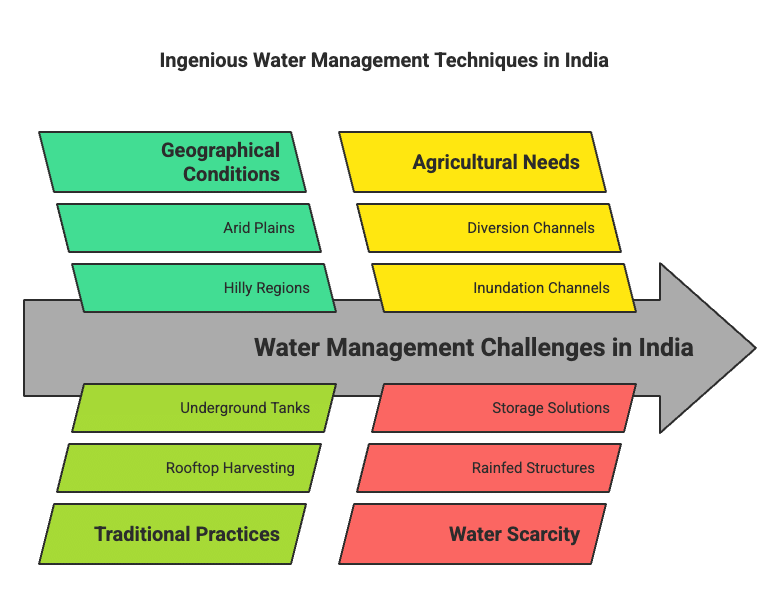
Q5: How are traditional rainwater harvesting methods being carried out to conserve water resources in different regions? Explain with examples. (2019 C)Ans: Traditional rainwater harvesting methods are practiced uniquely across various regions in India to conserve water effectively:
- Hilly regions: In the Western Himalayas, people traditionally built intricate diversion channels such as 'guls' or 'kuls' to carry stream water directly to their fields for agricultural irrigation.
- Rajasthan: 'Rooftop rainwater harvesting' was widely used to collect rainwater falling on roofs. This water was carefully stored in large underground tanks called 'tankas' to provide a reliable source of drinking water.
- Floodplains of Bengal: People created effective inundation channels to guide natural floodwater from rivers directly into their agricultural fields for efficient irrigation.
- Arid and semi-arid regions: Agricultural land was intelligently converted into storage structures that allowed rainwater to stand and moisten the soil. Prominent examples include 'khadins' in Jaisalmer and 'johads' in other parts of Rajasthan. Furthermore, places such as Bikaner, Phalodi, and Barmer used deep underground tanks for storing drinking water.
Q6: "Archaeological and historical records show that from ancient times we have been constructing sophisticated hydraulic structures in India." Substantiate the statement by giving three pieces of evidence. (2019 C)
Ans: Historical and archaeological records provide strong evidence of sophisticated hydraulic structures in ancient India:
- Sringaverapura (1st century B.C.): Located near Allahabad, this ancient site featured a highly advanced water harvesting system designed to efficiently divert and utilize the floodwaters of the river Ganga for irrigation.
- Mauryan Empire: During the reign of Chandragupta Maurya, there was extensive and well-planned construction of dams, large lakes, and massive irrigation works to support agriculture.
- Ancient tanks and lakes: Clear evidence of sophisticated irrigation structures is found at historical sites like Kalinga, Nagarjunakonda, Bennur, and Kolhapur. Other notable examples include the 11th-century Bhopal Lake (one of the largest artificial lakes of its time) and the 14th-century tank constructed at Hauz Khas, Delhi.
Q7: "Water scarcity may be an outcome of large and growing population in India." Analyse the statement. (Delhi 2019)
Ans: A large and rapidly growing population significantly contributes to widespread water scarcity in the following ways:
- Increased domestic demand: A larger population directly increases the daily demand for fresh water used in essential activities like drinking, cooking, washing, and proper sanitation.
- Higher agricultural needs: To feed a massive growing population, much higher food production is required. This drastically raises the demand for water for agricultural irrigation, which heavily stresses existing water resources.
- Over-exploitation of groundwater: Densely populated areas constantly over-exploit underground water to meet their vast needs. This leads to a rapid decline in water tables and increases the risk of severe pollution, reducing both the quantity and quality of available safe water.
Q8: "Multi-purpose projects and large dams have been the cause of many new social movements." Highlight the concerns related to such movements. (2019)
Ans: Multi-purpose projects and large dams have sparked several powerful social movements due to the following major concerns:
- Displacement of local communities: Building large dams requires flooding extensive areas, which leads to the forced displacement of local communities. Movements such as the Narmada Bachao Andolan and protests against the Tehri Dam arose because displaced people often received highly inadequate rehabilitation and compensation.
- Social inequality: These large projects typically favour wealthy landowners and commercial agriculture, while marginal farmers and landless groups lose their livelihoods and do not receive fair benefits, thereby increasing social inequality.
- Ecological damage: Serious ecological concerns include the massive submergence of forests, the permanent loss of fertile farmland, drastic changes in river ecology, soil salinisation, and severely reduced livelihood options for local people living downstream.
Q9: "Urbanisation has added to water scarcity." Support the statement with arguments. (Al 2019)
Ans: Rapid urbanisation has significantly worsened the problem of water scarcity through the following factors:
- High domestic consumption: Urban areas have extremely dense populations and a modern lifestyle that results in a much higher per-capita demand for fresh water compared to rural areas.
- Groundwater depletion: Many urban housing societies, colonies, and commercial buildings independently extract groundwater using deep borewells. This continuous and heavy pumping rapidly lowers the local water tables.
- Industrial pollution: Cities are major hubs for industries that not only consume massive quantities of fresh water but also regularly discharge untreated chemical effluents into nearby rivers and groundwater, rendering the available surface water completely unfit for human use.
Q10: "The dams that were constructed to control floods have triggered floods." Analyse the statement. (2019)
Ans: While large dams are initially built to control floods, they can sometimes trigger or significantly worsen flooding due to the following reasons:
- Excessive sedimentation: Dams unnaturally trap sediment flowing in the river. Over time, this causes heavy sedimentation in the reservoir, which drastically reduces its water storage capacity.
- Sudden water release: During periods of exceptionally heavy rainfall, reservoirs may become completely full. The sudden mismanagement or necessary release of massive volumes of water from these dams can cause severe downstream flooding.
- Ecological disruption: Dams heavily fragment river habitats, negatively affect aquatic life, and completely change natural floodplain dynamics. Poor long-term planning and a lack of environmental safeguards can therefore make dams a major factor in flood risks rather than a complete solution.
Q11: "Water harvesting system is an effective measure to reduce the problem of water scarcity." Justify the statement. (Al 2019)
Ans: Rainwater harvesting is a highly effective measure to reduce water scarcity because it captures and carefully stores rainwater that would otherwise run off and be completely wasted. By building tanks, embankments, or using traditional methods, communities can successfully recharge groundwater and secure water for dry periods. Successful methods used in India include:
- Building guls or kuls in the Western Himalayas for effective agricultural irrigation.
- Practicing rooftop rainwater harvesting and storing pure water in underground tankas in Rajasthan.
- Constructing rain-fed storage structures like khadins in Jaisalmer and johads in other parts of Rajasthan.
- Creating inundation channels in the vast floodplains of West Bengal to irrigate fields.
- Using extensive rainwater collection systems in Meghalaya and implementing compulsory provisions for rainwater harvesting in modern urban housing developments.
Q12: How has Shillong solved the problem of acute shortage of water ? (2019)
Ans: Shillong has effectively addressed its acute water shortage by extensively practicing rooftop rainwater harvesting. Almost every household in the city has a built-in rooftop rainwater harvesting structure, which fulfills a highly significant portion of their total domestic water requirement. Additionally, in the broader region of Meghalaya, streams and natural springs are tapped, and water is efficiently transported using the traditional bamboo drip irrigation system.
Q13: How has Tamil Nadu solved the problem of acute shortage of water? (2019)
Ans: Tamil Nadu has successfully tackled the widespread problem of acute water shortage by making rooftop rainwater harvesting structures legally compulsory for all houses across the entire state. Strict legal provisions are actively in place to heavily punish defaulters. This proactive measure has greatly improved local groundwater availability and helped address severe water shortages.
 | Attention! Sale expiring soon, act now & get EduRev Infinity at 40% off! | Claim Offer |
Previous Year Questions 2018
Q14: Explain any three reasons for which the multi-purpose projects and large dams have come under great scrutiny and opposition in the recent years. (CBSE 2018)Ans: Multi-purpose projects and large dams have faced immense scrutiny and strong opposition recently due to the following reasons:
- Altered river flow: Regulating rivers and building massive dams drastically changes their natural flow and severely reduces sediment movement. This leads to heavy sedimentation at the bottom of the reservoir and creates much poorer conditions for riverine habitats.
- Impact on aquatic fauna: Large dams heavily fragment rivers, creating massive physical obstructions. This makes it extremely difficult for aquatic animals to migrate, severely affecting their natural breeding and spawning patterns.
- Ecological and social disruption: The creation of large reservoirs on floodplains permanently submerges existing vegetation and fertile soil, which then slowly decomposes and alters the local ecology. Furthermore, the massive scale of submergence displaces local communities and destroys traditional livelihoods downstream.
Previous Year Questions 2017
Q15: Water scarcity in most cases is caused by over-exploitation, excessive use and unequal access to water among different social groups." Explain the meaning of statement with the help of examples. (CBSE 2016-17)Ans: Water scarcity is often a man-made crisis driven by the following critical factors:
- Over-exploitation: The extensive and highly unregulated use of tube wells and private borewells for agricultural irrigation extracts groundwater much faster than nature can replenish it. This severely lowers the long-term water availability.
- Excessive use: In modern urban centres, wasteful water use and a complete lack of recycling drastically increase the daily demand. This careless consumption reduces the overall long-term availability of fresh water.
- Unequal access: Water resources are often unfairly distributed. Wealthier households or large-scale farmers usually secure abundant water through private infrastructure (like deep borewells), while poor and marginalised groups consistently struggle with highly inadequate and irregular supplies.
Q16: What is rainwater harvesting?
Or
How is rainwater harvesting carried out in semi-arid regions of Rajasthan? Explain. (CBSE 2016-17)
Ans:
(a) Rainwater Harvesting: It is a highly effective technique used to systematically capture, store, and utilize rainwater to increase groundwater recharge. This is actively achieved by building simple structures such as dug wells, percolation pits, and small check dams.
(b) Methods in Semi-arid Rajasthan:
- In arid and semi-arid regions, agricultural fields are traditionally converted into rain-fed storage structures. These structures carefully allow rainwater to stand and slowly percolate into the ground to moisten the soil. Prominent examples include khadins in Jaisalmer and johads in other parts of Rajasthan.
- In dry towns like Bikaner, Phalodi, and Barmer, almost all traditional houses had large underground tanks called tankas built inside their courtyards to safely store harvested rainwater for drinking purposes.
Also read: Worksheet: Water Resources |
Previous Year Questions 2015
Q17: "India has a monsoon type of climate, even then it faces water scarcity in many parts of the country". Elucidate the given sentence by providing some examples.OR
What is water scarcity? Write the main reasons for water scarcity. (CBSE 2015)
Ans: Water scarcity refers to a severe situation where there is a sheer shortage of adequate fresh water to meet the basic needs of people, either due to limited quantity or highly poor quality. Despite receiving ample rainfall from monsoons, India faces severe water scarcity due to the following main reasons:
- Uneven rainfall distribution: There is a huge spatial and temporal variation in natural rainfall. Some regions receive heavy rain while others remain completely dry, leading to severe seasonal and regional water shortages.
- Over-exploitation of groundwater: The extensive and rapid use of private wells and tube wells by farmers for intensive agriculture depletes underground water reserves much faster than they can naturally recharge.
- Growing population: A rapidly increasing population constantly drives up the demand for fresh water for daily domestic use, proper sanitation, and large-scale food production.
- Industrialization and urbanization: Expanding industries and densely populated urban cities consume massive volumes of water. Additionally, the reckless discharge of untreated industrial and domestic waste severely pollutes rivers and lakes, making the available fresh water entirely unfit for human use.
Previous Year Questions 2012
Q18: How has intensive industrialisation and urbanisation posed a great pressure on existing fresh water resources in India? Explain with two examples for each. (CBSE 2012)Ans: Intensive industrialisation and urbanisation have placed immense pressure on fresh water resources in India in the following ways:
Impact of Industrialisation:
- High water consumption: A rapidly growing number of industries require massive volumes of fresh water for their daily manufacturing processes and heavy cooling systems, drastically increasing the overall demand.
- Water pollution: Many industries irresponsibly discharge untreated chemical effluents directly into rivers and groundwater, causing severe qualitative scarcity by making the water highly toxic and completely unsafe for use.
- Groundwater depletion: Rapidly expanding urban populations heavily rely on private pumps and deep borewells to meet their daily needs. This continuous and heavy extraction leads to a sharp decline in local water tables.
- Domestic waste generation: Large urban centres naturally generate enormous amounts of raw sewage and domestic waste. Without proper treatment facilities, this waste often heavily contaminates nearby water sources, adding further pressure on the highly limited fresh water supply.
: