

Frédéric Sorrieu Vision of World
In 1848, Frédéric Sorrieu, a French artist, created a series of prints depicting his vision of a world composed of democratic and social Republics.
 The Dream of Worldwide Democratic and Social Republics - The Pact Between Nations, a print prepared by Frédéric Sorrieu, 1848.
- The first print shows people from Europe and America of all ages and social classes marching in a procession, paying tribute to the Statue of Liberty, symbolising freedom and enlightenment.
- Liberty is portrayed as a female figure holding the torch of Enlightenment and the Charter of the Rights of Man.
- The scene includes shattered symbols of absolutist institutions, representing the overthrow of oppressive regimes.
- Different nations are depicted through flags and national costumes, with the United States and Switzerland leading the procession.
- France, Germany, Austria, and other nations follow, reflecting the aspirations for nationhood and democracy prevalent in 1848.
- Christ, saints, and angels observing from above symbolise fraternity among nations.
- Nationalism emerged in the 19th century, leading to the rise of nation-states and the decline of multi-national empires in Europe.
- Nation-states were based on a shared sense of common identity, culture, language, or history, while centralised power and defined territorial control developed later with the rise of modern states.
- This common identity is forged through struggles and shared experiences, which shape the concept of nation-states and nationalism in Europe.
 The Storming of Bastille
The French Revolution & the Idea of a Nation
- The concept of nationalism emerged prominently during the French Revolution in 1789.
- France was a complete territorial state ruled by an absolute monarch before the revolution.
- The French Revolution brought significant political and constitutional changes transferring sovereignty from the monarchy to French citizens.
- The revolution emphasized that the people, not the monarchy, would form the nation and determine its fate.
- French revolutionaries implemented various measures to foster a shared identity among the French populace.

- Notions like la patrie (the fatherland) and le citoyen (the citizen) promoted a united community with equal rights under a constitution.
- Symbols of national unity were introduced, such as the tricolor flag replacing the royal standard.
- The Estates General transformed into the National Assembly, elected by active citizens.
- New customs like hymns, oaths, and commemorations emphasized national pride.
- A centralized administration was established with uniform laws, currency, and language across the nation.
- Napoleon, extending French influence, introduced reforms like the Napoleonic Code, promoting equality and property rights.
- Under Napoleon, administrative reforms were implemented across regions under French control, simplifying divisions and abolishing feudal systems.
- French rule received mixed reactions in conquered territories, initially welcomed but later met with resistance due to increased taxation and lack of political freedom.
The Making of Nationalism in Europe
- In the mid-eighteenth century, Europe was not composed of nation-states as we recognize them today.
- Regions like Germany, Italy, and Switzerland were fragmented into kingdoms, duchies, and cantons with their own rulers and territories.
- Eastern and Central Europe were under autocratic monarchies where diverse peoples lived without a shared identity or culture.
- The Habsburg Empire, ruling over Austria-Hungary, was a mosaic of varied regions and peoples.
- It encompassed regions like the Tyrol, Austria, the Sudetenland, Bohemia, Lombardy, Venetia, Hungary, Galicia, and Transylvania.
- People within the empire spoke different languages and belonged to distinct ethnic groups.
- The diversity within the empire hindered the development of a sense of political unity.
- Various groups were loyal to the emperor but did not share a common identity or culture.
- The idea of nationalism and nation-states began to evolve due to the lack of shared identity among diverse groups.
- People began to identify with the concept of a nation and sought political unity through commonalities.
- These movements laid the foundation for the eventual formation of nation-states.

 | Get additional INR 200 off today with EDUREV200 coupon. | Avail Offer |
The Aristocracy and the New Middle Class
- Socially and politically, a landed aristocracy was the dominant class on the continent.
- The members of this class shared a common way of life cutting across regional divisions.
- They owned estates both in the countryside and in towns.
- French was often spoken in diplomacy and high society.
- Family connections were often maintained through marriages.
- Although powerful, the aristocracy was a numerically small group.
- The majority of the population consisted of the peasantry.

- In Western Europe, land was mainly farmed by tenants and small owners, while in Eastern and Central Europe, vast estates were worked by serfs.
- Industrial production and trade led to the growth of towns and the emergence of commercial classes in Western Europe and parts of Central Europe.
- Industrialization began in England in the late 18th century but occurred later in France and parts of Germany.
- New social groups emerged, including a working-class population and middle classes comprising industrialists, businessmen, and professionals.
- In Central and Eastern Europe, these groups were smaller in number until the late 19th century.
- Ideas of national unity gained popularity among the educated, liberal middle classes after aristocratic privileges were abolished.
 French Aristocrats
What did Liberal Nationalism Stand for?
- Liberal Nationalism in early 19th-century Europe was closely linked with liberalism, which emphasizes freedom and equality.
- Liberalism, rooted in the Latin word "liber" for free, symbolized liberty for individuals and equality under the law for the burgeoning middle classes.
- Politically, liberalism advocated for governance based on consent, marking a shift from autocracy and clerical privileges towards constitutional government and parliamentary representation.
- Nineteenth-century liberals prioritized private property rights and the concept of government by the people through elected representatives.

- However, equal treatment before the law did not always translate to universal suffrage, as seen in early democratic experiments like revolutionary France where only property-owning men could vote.
- Throughout the 19th and early 20th centuries, movements emerged advocating for equal political rights for women and non-propertied men.
- Economically, liberalism supported free markets by opposing state-imposed restrictions on the movement of goods and capital.
- In the German-speaking regions during the early 19th century, the emergence of a customs union, the Zollverein, aimed to streamline trade by abolishing tariffs and reducing the number of currencies.
- The Zollverein, initiated by Prussia and joined by other German states, facilitated economic growth by allowing the free flow of goods, people, and capital, reinforced by the development of a railway network.
- This economic nationalism further bolstered broader nationalist sentiments, promoting economic exchange and national unity.
- They introduced measures and practices that could foster this collective identity, such as the concepts of la Patrie (the fatherland) and le citoyen (the citizen).
- The revolutionaries also declared that it was the French nation's mission to help other peoples of Europe become nations, thus promoting the idea of nationalism.
- Through these efforts, the French revolutionaries aimed to establish a strong and united French nation.
A New Conservatism after 1815
- After Napoleon's 1815 defeat, European governments leaned towards conservatism, aiming to uphold traditional institutions like the monarchy, the Church, social hierarchies, property, and family.
- Conservatives recognized that modernization could benefit traditional institutions, making state power more robust through advancements like a modern army, efficient bureaucracy, a dynamic economy, and the end of feudalism.
- The Congress of Vienna in 1815, involving powers like Britain, Russia, Prussia, and Austria, sought to reverse many changes brought by Napoleon, restoring the Bourbon dynasty in France and establishing new states to contain French expansion.
- Prussia and Austria gained territories, while Russia and Prussia acquired parts of Poland and Saxony, respectively, with the primary goal of reinstating overthrown monarchies and establishing a conservative European order.
- Post-1815 conservative regimes were autocratic, suppressing dissent and instituting censorship to quell challenges to autocratic rule, despite liberal ideals from the French Revolution persisting and inspiring movements like advocating for press freedom.
Try yourself: Which of the following countries did not attend the Congress of Vienna 1815?
Switzerland did not attend the Congress of Vienna. The Congress of Vienna was a meeting of the "Big Four" countries of Austria, Prussia, Russia, and Britain, which took place from 1814 to 1815. The countries met to create a settlement called the Treaty of Vienna.
The Congress of Vienna marked the beginning of conference diplomacy in international relations. The balance of power negotiated at the Congress of Vienna remained relatively stable for almost 100 years, until World War I began in 1914.
The Revolutionaries
- In 1815, secret societies were formed in many European states to train revolutionaries and spread their ideas. Revolutionary opposed monarchical forms, and fight for liberty and freedom.
- Most of these revolutionaries also saw the creation of nation-states as a necessary part of this struggle for freedom.
- The Italian revolutionary Giuseppe Mazzini, born in Genoa in 1805, founded two more underground societies, first, Young Italy in Marseilles.

- Secondly, he founded Young Europe in Berne, whose members were like-minded young men from Poland, France, Italy, and the German states.
- Following his model, secret societies were set up in Germany, France, Switzerland, and Poland.
- Mazzini's relentless opposition to monarchy and his vision of democratic republics frightened the conservatives.
- Metternich described him as 'the most dangerous enemy of our social order'.
Also read: Extra Questions: The Rise of Nationalism in Europe |
The Age of Revolutions: 1830-1848
- The period from 1830 to 1848 was known as "The Age of Revolutions."
- In Europe, as conservative governments sought to strengthen their power, ideas of liberalism and nationalism became linked with revolutionary movements.
- These revolutions occurred in various European regions like the Italian and German states, parts of the Ottoman Empire, Ireland, and Poland.
- The revolutions were primarily led by liberal nationalists from the educated middle-class elite, including professors, schoolteachers, clerks, and members of the commercial middle classes.
- The first major uprising happened in France in July 1830, where the Bourbon monarchy was overthrown by liberal revolutionaries who established a constitutional monarchy headed by Louis Philippe.
- The July Revolution in France inspired a similar movement in Brussels, leading to the separation of Belgium from the United Kingdom of the Netherlands.
- The Greek War of Independence ignited nationalist sentiments across Europe, as Greece had been under Ottoman rule since the 15th century.
- Revolutionary nationalism in Europe fueled the Greek struggle for independence that began in 1821, supported by exiled Greeks and sympathizers from Western Europe.
- Prominent figures like Lord Byron supported the Greek cause, emphasizing Greece's importance as the cradle of European civilization.
- Lord Byron organized financial aid and joined the conflict, ultimately passing away in 1824 due to illness.
- The Treaty ofConstantinople in 1832 officially recognized Greece as an independent nation.
 Revolutionaries in Berlin in March 1848, waving the revolutionaries flags
The Romantic Imagination and National Feeling
- Nationalism didn't just arise from wars and territorial expansion; culture also played a crucial role in shaping the idea of the nation.
- Art, poetry, stories, and music played an instrumental role in expressing and shaping nationalist sentiments.
- Romanticism was a cultural movement that aimed to cultivate a unique form of nationalist emotion.
- Romantic artists and poets critiqued the exaltation of reason and science, focusing instead on emotions, intuition, and mystical feelings.
- They sought to establish a sense of shared collective heritage and a common cultural past as the foundation of a nation.
- German philosopher Johann Gottfried Herder emphasized discovering true German culture among the common people.
- The essence of the nation (volksgeist) was promoted through folk songs, poetry, and dances.
- Collecting and preserving folk culture was vital for the project of nation-building.
- Emphasis on vernacular language and local folklore aimed at connecting with large illiterate audiences.
- Polish language and culture were suppressed after the Russian occupation, but efforts to revive national feelings persisted.
- Karol Kurpinski used music and operas to celebrate the national struggle, elevating folk dances as nationalist symbols.
- Language became a weapon of national resistance in Poland, with clergy using Polish for religious purposes against Russian dominance.
Try yourself: Choose the correct nationality of the artist Frederic Sorrieu who visualised in his painting a society made up of Democratic and Social Republic.
Artist Frederic Sorrieu who visualised in his painting a society made up of Democratic and Social Republic was of french nationality.
Hunger, Hardship and Popular Revolt
- The 1830s in Europe were marked by severe economic difficulties.
- Population growth led to a surplus of job seekers and a shortage of jobs.
- Rural residents moved to cities, living in overcrowded slums.
- Local producers faced tough competition from cheap English goods due to industrialization.
- Textile production, mainly in homes or small workshops, faced competition from mechanized English production.

- Peasants in regions with powerful aristocracies suffered from feudal obligations.
- Rising food prices and poor harvests worsened poverty in both urban and rural areas.
- In 1848, food shortages and unemployment triggered unrest in Paris, leading to Louis Philippe's ousting.
- A Republic was declared, suffrage was extended to adult males, and the right to work was guaranteed.
- National workshops were established to provide employment.
- In 1845, weavers in Silesia revolted against contractors who exploited them by reducing payments.
- Weavers demanded higher wages, leading to clashes with the contractor and eventual military intervention.
- The conflict resulted in the death of eleven weavers.
 | Attention! Sale expiring soon, act now & get EduRev Infinity at 40% off! | Claim Offer |
1848: The Revolution of the Liberals
- Occurred alongside uprisings of impoverished, unemployed, and hungry peasants and workers across Europe.
- In 1848, a revolution led by the educated middle classes was unfolding.
- In France, events in February led to the abdication of the monarch and the establishment of a republic with universal male suffrage.
- In countries like Germany, Italy, Poland, and the Austro-Hungarian Empire, liberal middle-class individuals demanded constitutionalism and national unification.
- They sought to establish a nation-state based on parliamentary principles, including a constitution, freedom of the press, and freedom of association.
- In Germany, various political groups composed of professionals, businessmen, and successful artisans convened in Frankfurt to form an all-German National Assembly.
- On May 18, 1848, 831 elected representatives gathered in Frankfurt to draft a constitution for a German nation with a monarch subject to parliamentary oversight.

- King Friedrich Wilhelm IV of Prussia rejected the terms offered by the assembly, aligning with other monarchs to oppose the elected body.
- The parliament faced increasing opposition from the aristocracy and military, losing support from workers and artisans.
- The parliament, dominated by the middle class, eventually disbanded after troops intervened.
- Political rights for women were a divisive issue within the liberal movement despite active female participation in political activities.
- Women were not granted suffrage during the Assembly elections and were only allowed as observers in the visitors' gallery at the Church of St Paul.
- Conservative forces suppressed liberal movements in 1848, leading to a realization among monarchs that concessions to liberal-nationalist revolutionaries were necessary to prevent cycles of revolution and repression.
- Following 1848, autocratic monarchies in Central and Eastern Europe began implementing changes witnessed in Western Europe before 1815, such as the abolition of serfdom and bonded labor.
- The Habsburg rulers granted more autonomy to Hungarians in 1867 as part of the reforms.
Try yourself: What were the reasons for economic hardships in Europe in the 1830s?
The economic hardships in Europe during the 1830s were primarily due to rapid population growth, leading to migration from rural areas to cities. This caused overcrowding, unemployment, and poor living conditions. While some competition from England existed, the key issues were social and demographic factors, not a decrease in population or lack of labor supply, nor simply lack of industrialization.
The Making of Germany and Italy
Germany - Can the Army be the Architect of a Nation?
- After 1848, nationalism in Europe shifted away from democracy and revolution.
- Nationalist feelings were often manipulated by conservatives to strengthen state power and gain political control.
- Germany and Italy underwent a process of unification as nation-states.
- German middle-class individuals in 1848 attempted to unite the German confederation into a nation-state through an elected parliament.
- However, this liberal effort was suppressed by the monarchy, military, and Prussian landowners (Junkers).
- Prussia then took the lead in the movement for national unification, led by Otto von Bismarck.
- Through three wars in seven years (against Austria, Denmark, and France), Prussia emerged victorious, finalizing the unification process.
- In January 1871, King William I of Prussia was declared German Emperor in Versailles.
- The nation-building process in Germany highlighted the dominance of Prussian state power.
- The new German state focused on modernizing currency, banking, legal, and judicial systems, setting an example for the rest of Germany.

Italy Unified
- Italy, like Germany, had a history of political fragmentation.
- Italians were spread across different states and empires.
- Italy was divided into seven states, with only Sardinia-Piedmont ruled by an Italian princely house.
- The north was under Austrian Habsburg rule, the center under the Pope, and the south under Bourbon kings of Spain.
- The Italian language had various regional variations.
- Giuseppe Mazzini aimed for a unified Italian Republic and created Young Italy for this cause.
- Failed uprisings led to Sardinia-Piedmont taking the lead in unification under King Victor Emmanuel II.
- Cavour, a key figure, orchestrated a diplomatic alliance with France to defeat Austria and unify Italy.
- In 1860, armed volunteers led by Garibaldi helped unify Italy, with Victor Emmanuel II becoming king in 1861.
- Despite unification, many Italians were unaware of liberal-nationalist ideas, with high illiteracy rates among the masses.
Also read: Extra Questions: The Rise of Nationalism in Europe |
The Strange Case of Britain
- The nation-state model in Britain evolved gradually rather than through sudden change.
- Prior to the 18th century, there wasn't a unified British identity; people identified more with their ethnic backgrounds like English, Welsh, Scot, or Irish.
- As England grew in wealth and power, it exerted influence over the other nations in the British Isles.
- The English Parliament, after gaining power from the monarchy in 1688, played a crucial role in forming a nation-state with England as its core.
- TheAct of Union in 1707 between England and Scotland led to the creation of the 'United Kingdom of Great Britain', consolidating English influence over Scotland.
- Scotland's unique culture and political institutions faced suppression as a British identity emerged, leading to the marginalization of Scottish traditions.
- In Ireland, deep divisions between Catholics and Protestants existed, with English support aiding Protestant dominance over a predominantly Catholic nation.
- Rebellions against British control, like the one led by Wolfe Tone and the United Irishmen in 1798, were quashed, eventually leading to Ireland's inclusion in the United Kingdom in 1801.
- A new British identity was constructed, emphasizing English culture and symbols like the Union Jack and the English language, relegating older nations to subordinate roles in the union.
 Map: Unification of Germany
Try yourself: Who played the leading role in the unification of Germany?
Otto Von Bismarck played a crucial role in the unification of Germany through his strategic use of wars and diplomacy. His leadership transformed many independent German states into a unified country, making him a significant figure in history.
Visualising the Nation
- Artists in the 18th and 19th centuries personified nations by representing them as female figures.
- The chosen female form symbolized the nation as a personification, not a specific real-life woman.
- Female allegories, such as Marianne in France and Germania in Germany, were created to embody the nation.
- During the French Revolution, Liberty, Justice, and the Republic were depicted using symbols like the red cap, broken chain, blindfolded woman with weighing scales.
- Marianne, symbolizing France, was associated with the red cap, tricolour, and cockade, with statues erected in public places as a symbol of unity.
- Germania, symbolizing Germany, wore a crown of oak leaves to represent heroism in visual representations.
- These allegorical figures were used on coins, stamps, and public monuments to instill a sense of national identity.
Nationalism and Imperialism
- Nationalism evolved from an idealistic sentiment to a narrow creed by the late 1800s.
- Nationalist groups grew intolerant and war-ready, while major European powers exploited these sentiments for imperialism.
- The Balkans, encompassing various modern countries, experienced heightened nationalist tensions post-1871.
- Under Ottoman control, the Balkans saw the rise of romantic nationalism and the empire's decline.

- Balkan nations sought independence based on historical claims, leading to conflicts and power rivalries.
- European powers like Russia, Germany, England, and Austro-Hungary vied for control over the Balkans, sparking wars.
- Intense competition over trade, colonies, and military strength culminated in the outbreak of World War I in 1914.
- Colonized nations globally began resisting European dominance, fostering anti-imperial movements.
- These movements aimed to establish independent nation-states, driven by collective national unity and opposition to imperialism.
- Unique varieties of nationalism emerged worldwide, emphasizing the natural organization of societies into nation-states.
Short Answer Type Questions
Q 1. Explain liberalism in political and economic fields prevailing in Europe in the 19th century.
The term 'liberalism' derives from the Latin root 'Liber', meaning free. It was an ideology that stood for freedom for the individual and equality of all before the law.
Politically, liberalism stood for:
(a) Constitution.
(b) A representative government ruling by consent.
(c) A parliamentary system.
(d) Right to vote and get elected granted to property-owning men.
(e) End of the privileges of aristocracy and the clergy. Drawback of liberalism was that it did not grant equal rights to men and women, women had to struggle for their political rights.
Economically, liberalism stood for:
(a) Freedom of markets.
(b) End of state restrictions on movement of goods and capital.
(c) A customs union or Zollverein was formed by Prussia in 1834, which many German states joined.
(d) This union reduced the number of currencies from over thirty to two and abolished tariff barriers.
(e) A network of railways led to great mobility and gave an impetus to national unity. It boosted economic nationalism.
Q 2. How did Romanticism seek to develop a particular form of nationalist sentiment during 18th century? Explain.
OR
"Culture played an important role in creating the idea of the nation in Europe." Support the statement with examples.
Romanticism referred to a cultural movement that sought to develop a particular form of national sentiment.
Romanticism Movement
- Romantic artists and poets generally criticized the glorification of reason and science.
- They focussed on emotions, intuition and mystical feelings. Their effort was to create a sense of a shared collective heritage, a common cultural past as the basis of a nation.
- Some German Romantics like Johann Gottfried Herder thought that through folk songs, folk poetry and folk dance, the true spirit of the nation could be popularized. He claimed that true German culture was to be discovered among the common people.
Q 3. In which year was the unification of Italy completed? Mention two features of the unification movement.
The unification of Italy took place from 1859-1870.
Two features of the unification movement are:
(a) Italian unification was the social and political movement that agglomerated different states of the Italian peninsula into the single state of Italy in the 19th Century.
(b) After the fall of the Roman Empire Italy gradually developed into a system of the city-state.
Unification of Italy
Q 4. Why were the 1830s called the years of great economic hardship in Europe? Give any three reasons.
The 1830s were the years of great economic hardship in Europe due to the following reasons:
(a) There was an enormous increase in population all over Europe.
(b) There were more seekers of jobs than employment.
(c) People migrated from rural areas to the cities to live in overcrowded slums.
(d) There was stiff competition between the products of small producers and products imported from England where goods were made by machines as industrialization had already taken place there.
Q 5. Explain any three reasons for the nationalist upsurge in 19th-century Europe.
Reasons for the Nationalist upsurge in the 19th-Century Europe:
(a) Oppression of people under absolute rulers.
(b) Liberal ideas spread by well-known philosophers and leaders.
(c) The French Revolution inspired the people to fight for freedom. The slogan 'Liberty, Equality and Fraternity' became the clarion call for the common people.
Q 6. Explain the role of language in developing nationalist sentiments in Europe.
- At that time most of the people were illiterate. They were able to understand only vernacular regional or simple language. Thus, vernacular or regional language carried out the modern nationalist message to a large audience easily.
- The message of nationalist sentiment was conveyed most effectively in the vernacular language. Folklore, folk tales and the activities concerned with vernacular language gave the feeling of nationalism and tied the people by the thread of national love and honour.
Q 7. "Italy had a long history of political fragmentation". Support the statement by giving any three points.
The reasons are as follows:
(a) Italians were scattered over several dynastic states as well as the multinational Habsburg Empire.
(b) During the middle of the 19th century, Italy was divided into seven states, of which only one state - Sardinia - Piedmont - was ruled by an Italian princely house.
(c) The north was under Austrian Habsburgs, the center was ruled by the Pope and the southern regions were under the domination of the Bourbon kings of Spain.
Q 8. Explain how Ireland got incorporated into the United Kingdom in 1801? What were the symbols of this new British nation?
The population of Ireland was divided into two categories - Catholics and Protestants. The British helped the Protestants to dominate the large Catholic population. Catholics opposed that suppression under the leadership of Wolfe Tone and his United Irishmen but they failed. At last, Ireland was forcibly incorporated into the United Kingdom in 1801. The symbols of new British Kingdom (Nation) was - the British flag, i.e., Union Jack, the national anthem, i.e., God Save the King, and the English language was actively promoted. Finally, the Irish people were forced to live as subordinate in their own country.
Long Answer Type Questions
Q 1. After 1817 why was the Balkan region the most serious source of nationalist tension in Europe? Explain giving four reasons.
The Balkan region was a source of tension because of the following reasons:
(a) The Balkan region comprised modern-day Romania, Bulgaria, Albania, Greece, Macedonia, Croatia, Bosnia-Herzegovina, Slovenia, Serbia and Montenegro, and its inhabitants were broadly called the Slavs.
(b) Large part of the Balkans was under the Ottoman Empire and the disintegration of which created an explosive situation. One by one its European subject nationalities broke away from its control and declared independence.
(c) Balkan peoples based their claims for independence or political rights on nationality and used history to prove that they were independent but subsequently subjugated.
(d) The Balkan states were fiercely jealous of each other & hoped to gain territory.
(e) Matters complicated because of intense rivalry among the European powers over trade and colonies as well as competition regarding naval and military might. This led to a series of wars in the region and finally the First World War.
Q 2. Explain any four provisions of Napoleon's Civil Code of 1804.
OR
State any three provisions of the Civil Code of 1804.
Napoleon incorporated revolutionary principles in the administrative field to make the whole system more rational and effective. His civil code of 1804 was known as the Napoleonic Code.
(a) First, he did away with all the privileges based on birth. Everyone became equal before the law. He abolished the feudal system and freed peasants from serfdom and manorial duties.
(b) He secured the right to property.
(c) Peasants, artisans, workers and new businessmen found newfound freedom as guild restrictions were removed in towns as well.
(d) Uniform laws, standardized weights and measures, a common national currency facilitated the movement and exchange of goods and capital from one region to another.
Q 3. How was the Habsburg Empire a patchwork of many different regions and people in Europe? Explain.
- In mid-eighteenth century Europe, there were no 'nation-states' as we know them today. Eastern and Central Europe were under autocratic monarchies, having people of diverse ethnic groups.
- The Habsburg Empire was one such example. It ruled over Austria-Hungary, a patchwork of many different regions and peoples. It included the Alpine regions - the Tyrol, Austria, and Switzerland - as well as Bohemia, where the aristocracy was predominantly German-speaking. It also included the Italian-speaking provinces of Lombardy and Venetia.
- In Hungary, half the population spoke Magyar, while the other half spoke a variety of dialects. In Galicia, the aristocracy spoke Polish.
- Besides these three dominant groups, there also lived within the territories a mass of subject peasant peoples - Bohemians, Slovaks to the north, Slovenes in Carniola, Croats to the south, the Romans to the east in Transylvania. The only tie binding these diverse groups together was a common allegiance to the emperor.
Q 4. When did the first clear-cut expression of nationalism come in France? How did the French Revolution lead to the transfer of sovereignty from the monarchy to a body of French citizens? Explain any three measures taken by the French revolutionaries in this regard.
(a) The first clear-cut expression of nationalism came to France with the French Revolution of 1789.
(b) The French revolutionaries introduced various measures and practices which proclaimed that it was the people who would henceforth constitute the nation and shape its destiny.
(c) The ideas of la Patrie (the fatherland) and le citoyen (the citizen) emphasized the notion of a united community enjoying equal rights under a constitution. A French flag, the tricolour, was chosen to replace the royal standard.
(d) The Estates-General was elected by the body of active citizens and renamed National Assembly.
(e) A centralized administrative system was put in place and it formulated uniform laws for all its citizens.
Q 5. How has French artist, Frederic Sorrieu, visualized in his first print, of the series of four prints, his dream of a world made up of 'democratic and social republics'? Explain.
OR
Describe Frederic Sorrieu's utopian vision of the world as depicted in his painting in 1848.
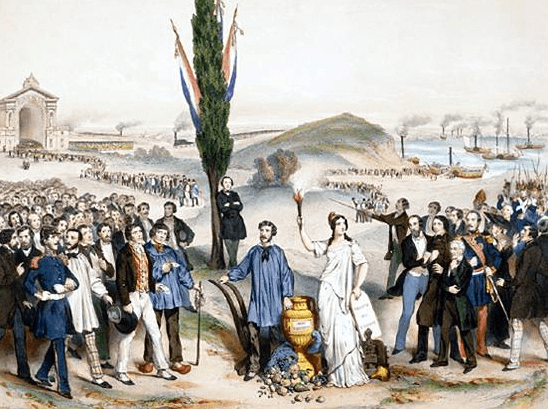 Frederic Sorrieu's Painting
The French artist, Frederic Sorrieu prepared a series of four prints visualizing his dream of the world made up of 'democratic and social republics'.
(a) His First Print showed people of Europe and America - men and women of all ages and social classes - marching in a long train, and offering homage to the Statue of Liberty as they pass by it.
(b) Liberty is of course personified as a woman, bearing the torch of Enlightenment in one hand and the charter of the Rights of Man in the other. (The artists of this time of the French Revolution portrayed Liberty as a female figure).
(c) On the earth, in the foreground of the image, lay the shattered remains of the symbols of Absolute institutions. Leading the procession, way past the Statue of Liberty, are the United States and Switzerland which were at that time already nation-states.
(d) In his print of Sorrieu, people of the world are grouped together as distinct nations, identified through their flags and national costume. France, distinguished by its tricolour flag, has just reached the statue, and she is followed by Germany with their black and gold flag. (Germany was not yet united, but in 1848, when this painting was made, it expressed the hopes of the nation.)
(e) People of Austria, kingdoms of two Sicilies, Lombardy, Poland, England, Ireland, Hungary and Russia follow in that order. From the heavens, Christ, saints and angels gaze upon the scene. They have been used to symbolize the fraternity among the nations of the world.
Q 6. Explain any four measures introduced by French revolutionaries to create a sense of collective identity among the people of France.
The French revolutionaries introduced various measures to create a sense of collective identity.
(a) The idea of la Patrie (the fatherland) and le citoyen (the citizen) emphasised the idea of a united community enjoying equal rights under the Constitution.
(b) A new French flag, the tricolour, was chosen to replace the old royal standard.
(c) The Estates-General was elected by the body of active citizens and renamed the National Assembly.
(d) New hymns were composed, oaths taken and martyrs commemorated in the name of the nation.
Q 7. Describe four stages of unification of Germany.
(a) Nationalist feelings were widespread among middle-class Germans, who in 1848, tried to unite the different regions of the German confederation into a nation-state.
(b) From then on, Prussia took on the leadership of the movement for national unification. It's chief minister (Chancellor) Otto von Bismarck, the architect of this process, carried it out, with the help of the Prussian army and bureaucracy.
German Unification
(c) Three wars were fought over a span of seven years against Austria, Denmark and France, which ended in Prussian victory and completed the process of unification.
(d) In January 1871, the Prussian King William I was proclaimed German emperor in a ceremony held at Versailles. On 18 January 1871, the new German empire headed by Kaiser Wilhelm of Prussia was proclaimed.
Q 8. How did culture play an important role in creating the idea of a nation in Europe? Explain with four examples.
The feeling of nationalism was strengthened, developed and given encouragement by art, music, literature, drama. These played a big role in it. Their contribution was equal to the heroic battles fought by heroes.
(a) The Romantics like the German philosopher Johann Gottfried Herder believed that true German culture could be discovered only among the common people - das volk.
(b) Language played a very important role in boosting nationalism. The Polish people opposed the Russian occupation and the ban on Polish language, by using it in the Churches for all religious ceremonies and for religious instruction. The Polish language became a weapon in the hands of the nationalists and no amount of Russian atrocities could stop them. Two Germans, Grimm Brothers, used stories and folktales written in German language to promote the German spirit against the domination of the French. Grimm's fairy tales became instant classics.
(c) Operas and music, like that of the Polish Karol Kurpinski, kept the national spirit alive.
(d) Folk dances like the polonaise and mazurka became national symbols.
Q 9. Mention any two economic obstacles that the liberal nationalists wanted to overcome. In what way did the Zollverein customs union of 1834 try to overcome these shortcomings?
- During the early nineteenth century, Europe was closely allied to the ideology of liberalism. In reference to economy this liberalism denotes freedom of market, fewer restrictions of state on the movement of goods and capitals. The main demand of the newly emerging middle class was to get rid of the economic problems.
- Existence of countless small principalities, different currencies, number of customs barriers created obstacles to economic exchange and growth for the new commercial classes. To sort out that problem Prussia including with most of the German states formed a customs union or Zollverein in 1834.
- The Zollverein abolished tariff barriers, reduced number of currencies, create a network of railways for fast and heavy mobility. So a single solution for all these economic problems was known by the name of Zollverein.
Q 10. What is the significance of 1848 for France and the rest of Europe? What did the liberals demand?
- With many revolts like revolts of the poor, unemployed workers and starving peasants during 1848 in Europe, the educated middle class of France also started a revolution for the abdication of the monarch and a republic based on universal male suffrage had been proclaimed.
- In other parts of Europe, men and women of the liberal middle classes combined their demands for constitutionalism with national unification. They took advantage of the growing popular unrest to push their demands for the creation of a nation state on parliamentary principles - a constitution, freedom of the press and freedom of association.
- The issue of extending political rights to women was most controversial subject matter within the liberal movement in which large number of women had participated actively.
Q 11. How did the Greek War of Independence mobilize nationalist feeling among the educated elite across Europe? Give four points.
(a) Greece was part of the Ottoman Empire since the fifteenth century. The growth of revolutionary nationalism in Europe motivated the Greeks to start a struggle for independence which began in 1821.
(b) Reaction of the struggle inspired the educated elite class of Europe and filled them, with nationalistic feeling.
(c) Greece got support from other Greeks also residing in different countries. Poets and artists lauded Greece as the cradle of European civilization and mobilized public opinion to support its struggle against a Muslim empire.
(d) English poet Lord Byron organized fund and participated in the war. Finally, in 1832 Greece was recognized as an independent nation by the Treaty of Constantinople.
Greek War of Independence
Q 12. "Till the mid-eighteenth century, there were no nation-states in Europe." Support the statement with four examples.
- During the mid-eighteenth century, there were no nation-states in Europe, Germany, Italy and Switzerland were ruled by different rulers with autonomous territories.
- Autocratic monarchies were there in the eastern and central part of Europe. These areas were occupied by different people. They did not see themselves as sharing a collective identity or common culture. They spoke different languages and belonged to different ethnic groups, like the area of Austria - Hungary included the Alpine region the Tyrol. Sudetenland and Bohemia were dominated by German-speaking people. It also included the province of Lombardy and Venetia which had Italian speaking people. In Hungary, half of the population spoke Magyar and the other half of the population spoke different dialects. In the part of Galicia, the aristocratic class spoke Polish.
- Besides these three dominant groups, a mass of subject peasant people like - Romans to the east in Transylvania, Bohemians and Slovaks to the north, Slovenes in Carniola and the Croats to the south lived within the boundary. The only tie binding those different groups together was a common allegiance to the emperor.
Q 13. What was the main objective of the Treaty of Vienna of 1815? Mention any three important features of the treaty.
The main objective of the treaty of Vienna was to nullify all the changes that had come into existence during the Napoleonic wars. The Bourbon dynasty restores its power which had been deposed during the French Revolution. To prevent the expansion of France in the future, a number of states were set up on the boundaries of France.
Treaty of Vienna
The kingdom of the Netherland including Belgium was set up in the north and Genoa including Piedmont established in the south. Prussia was given important new territories on the western frontier, while Austria was given control of northern Italy. The German confederation of 39 states which was set up by Napoleon was left untouched. Prussia was given to Russia. The main intention was behind that set up was to restore the monarchies that had been overthrown by Napoleon and create a new conservative order in Europe.
Q 14. Describe any four features of the landed aristocracy class of the European continent.
The European continent was dominated by the landed aristocratic class socially as well as politically. This landed aristocratic class was united by a common way of life that cut across regional divisions. They had their own estates and townhouses in the countryside. The families of the landed aristocratic class got married within their own class.
The landed aristocratic class
The occupation of the majority population was agriculture. Europe was divided into two major parts on the basis of occupation. The western part was served by tenants and small owners of land or small landlords. While in eastern and central Europe the pattern of landholding was characterized by the vast estate which was cultivated by serfs.
Q 15. How was the Habsburg Empire a patchwork of many different regions and peoples in Europe? Explain
- The Habsburg Empire included the Alpine regions - the Tyrol, Austria, Sudetenland and Bohemia. It also included the Italian - speaking provinces of Lombardy and Venetia.
- In Hungary, half of the population spoke Magyar while other half spoke a variety of dialects.
- In Galicia, the aristocracy spoke Polish. Besides, there also lived a mass of subject peasant people-Bohemians, Slovaks, Slovenes, Croats, and the Romans.
- The only tie binding these diverse groups together was a common allegiance to the emperor.
Short Answer Questions: The Rise of Nationalism in Europe
Q 1. What views did Giuseppe Mazzini have about Italy?
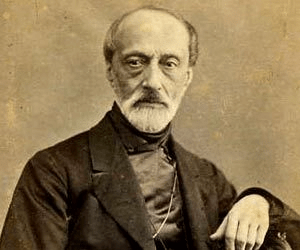
Ans: Mazzini believed that God had intended nations to be the natural units of mankind. So Italy could not continue to be a patchwork of small states and kingdoms. Italy had to be forged into a single unified republic within a wider alliance of nations. This unification from above could be the basis of Italian unity.
Q 2. What was the reaction to the Napoleonic Code?
Ans: Initially many people welcomed French armies as harbingers of liberty. But the initial enthusiasm soon turned to hostility, as it became clear that the new administrative arrangements did not go hand in hand with political freedom. Increased taxation and censorship, and forced conscription into the French armies as required to conquer the rest of Europe all seemed to outweigh the advantages of the administrative changes.
Q 3. What kind of life did the aristocrats lead?
Ans: Socially and politically, a landed aristocracy was the dominant class on the European continent. The members of this class were united by a common way of life that cut across regional divisions. They owned estates in the countryside and also townhouses. They spoke French for purposes of diplomacy and in high society. Their families were often connected by the ties of marriage. This powerful aristocracy was, however, a numerically small group.
Q 4. What was understood by the term 'liberalism'?
Ans: The term 'liberalism' derives from the Latin root liberal meaning free. For the new middle classes, liberalism stood for freedom for the individual and equality of all before the law. Politically, it emphasized the concept of government by consent. Since the French Revolution, liberalism has stood for the end of autocracy and clerical privileges, a constitution, and representative government through Parliament. Nineteenth-century liberals also stressed the inviolability of private property.
Q 5. When and why was the Zollverein formed?
Ans: In 1834, a customs union, or Zollverein was formed at the initiative of Prussia and joined by most of the German States. The union abolished tariff barriers and reduced the number of currencies from over thirty to two. The creation of a network of railways further stimulated mobility, harnessing economic interests to national unification. A wave of economic nationalism strengthened the wider nationalist sentiments growing at the time.
Q 6. How did the Treaty of Vienna (1815) come into being?
Ans: In 1815, representatives of the European powers - Britain, Russia, Prussia, and Austria - who had collectively defeated Napoleon, met at Vienna to draw up a settlement for Europe. The Congress was hosted by the Austrian Chancellor Duke Metternich.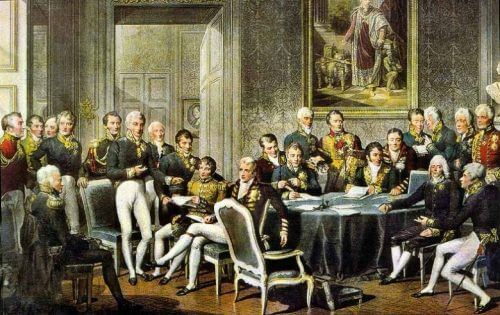 Signing of Treaty of Vienna
The delegates drew up the Treaty of Vienna of 1815 with the object of undoing most of the changes that had come about in Europe during the Napoleonic wars.
Q 7. What was the nature of conservative regimes set up in 1815?
OR
Enumerate any three features of conservative regimes set up in Europe following the defeat of Napoleon in 1815.
Ans: The conservative regimes set up in 1815 were autocratic. They did not tolerate criticism and dissent and sought to curb activities that questioned the legitimacy of autocratic governments. Most of them imposed censorship laws to control what was said in newspapers, books, plays, and songs and reflected ideas of liberty and freedom associated with the French Revolution.
Q 8. What led to the rise of the revolutionaries?
Ans: During the years following 1815, the fear of repression drove many liberal nationalists underground. Secret societies sprang up in many European states to train revolutionaries and spread their ideas. To be revolutionary at this time meant a commitment to oppose monarchical forms that had been established after the Vienna Congress and to fight for liberty and freedom. Most of these revolutionaries also saw the creation of nation-states as a necessary part of this struggle for freedom.
Q 9. Write briefly about conditions in Europe in the 1870s.
Ans: By the last quarter of the 19th Century, nationalism did not have its idealistic liberal-democratic sentiment of the first half of the century. Nationalism had become a narrow creed with limited ends. Nationalist groups were no longer trusting nor tolerant of each other. They were always at each other's throats. The major European powers manipulated the nationalist aspirations of the
subject people in Europe to further their imperialist aims. The most serious source of nationalist tension in 1871 was in the Balkans.
Q 10. What has made the Balkan a source of nationalist tension?
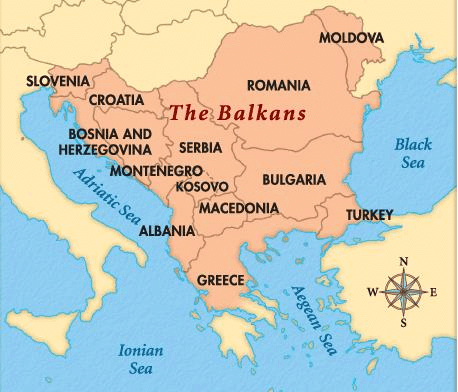
Ans: The most serious source of nationalist tension in Europe after 1871 was the area called the Balkans. The region had geographical and ethnic varieties. The Balkans included Romania, Bulgaria, Albania, Greece, Macedonia, Croatia, Bosnia-Herzegovina, Slovenia, Serbia and Montenegro. The inhabitants of the Balkan regions were called Slavs. Most of the Balkan region was under Ottoman rule. The spread of the ideas of romantic nationalism in the Balkans, together with the disintegration of the Ottoman Empire, made this region very explosive.
Q 11. How had the female figures become an allegory of the nation during the 19th century in Europe? Analyse.
Ans: In the 19th century in Europe, the female figures became an allegory of the nation in the following ways:
- The artists, in the 18th and 19th centuries in Europe, wanted to represent a country, as if it was a person. In other words, they wanted to personify the nation. Nations were represented as female figures. The female form did not belong to any particular woman in real life. It was an abstract idea, which gave the nation a concrete form. The female figure became an allegory of a nation.
- In France, the female form was given the name of Marianne, which represented the nation. Her characteristics were a red cap, the tricolor, and the cockade, drawn from those of Liberty and the Republic.
- Similarly, Germany became the allegory of the German nation. Germania wears a crown of oak leaves because oak stands for heroism.
Q 12. 'The decade of 1830 had brought great economic hardships in Europe'. Support the statement with arguments.
Ans: The first half of the nineteenth century saw an increase in population, all over Europe. There was a scarcity of jobs and few employment opportunities. Population from rural areas migrated to the cities in search of jobs. They lived in overcrowded slums. Small producers in towns faced stiff competition from imports of cheap machine goods from England. In those parts of Europe where aristocracy was strong and enjoyed enormous powers, the peasants groaned under the burden of feudal dues and taxation. The rise of food prices or a year of bad harvest added to the miseries of the common man.
NCERT Solutions: The Rise of Nationalism in Europe
Q1. Write a note on:
(a) Giuseppe Mazzini
(b) Count Camillo di Cavour
(c) The Greek war of independence
(d) Frankfurt Parliament
(e) The role of women in nationalist struggles
Ans:
(a) Giuseppe Mazzini (1805-1872)
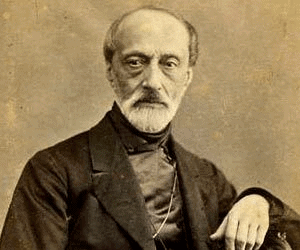
- Giuseppe Mazzini was an Italian politician and revolutionary born in Genoa in 1805.
- As a young man of 24, he was sent into exile in 1831 for attempting a revolution in Liguria. He subsequently founded two more underground societies - Young Italy in Marseilles and Young Europe in Berne.
- Mazzini believed that God has intended nations that were meant to be natural units of humanity.
- Even though he didn't reach his goals, he sparked a strong sense of love for his country and is seen as an important person in bringing Italy together. He was responsible for the growth of patriotism for a country that existed as yet only in the imagination.
(b) Count Camillo di Cavour
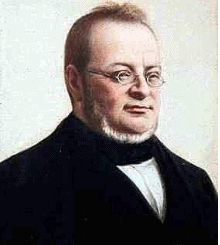 Count Camillo di Cavour
- He was the chief minister of Sardinia-Piedmont state and led the movement to unify regions of Italy.
- He was neither a revolutionary nor a democrat.
- Like many other wealthy and educated members of the Italian elite, he spoke French better than Italian.
- He formed a diplomatic alliance with France, which helped Sardinia-Piedmont defeat the Austrian forces in 1859. This consequently helped to free the northern part of Italy from the Austrian Habsburgs.
(c) The Greek War of Independence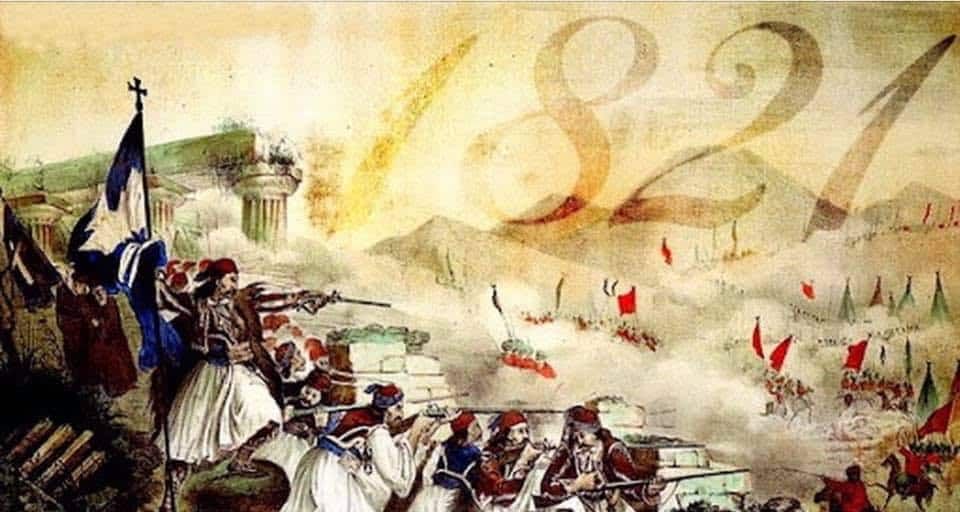 Greek war of Independence
- The Greek war of independence mobilized nationalist feelings among the educated elite across Europe.
- Greece had been part of the Ottoman Empire since the 15th Century. The growth of revolutionary nationalism in Europe sparked off a struggle for independence amongst the Greeks which began in 1821.
- The object of the struggle was to expel Turks from Europe and to establish the old Greek eastern empire. Nationalists in Greece were supported by other Greeks living in exile and many West European countries.
- Poets and artists lauded Greece as the cradle of European civilization. They mobilized public opinion to support its struggle against a Muslim empire. The English poet Lord Byron organized funds and later went to fight in the war.
- Ultimately, the Treaty of Constantinople of 1832 recognized Greece as an independent nation. Its independence was guaranteed by Russia, England and France.
(d) Frankfurt Parliament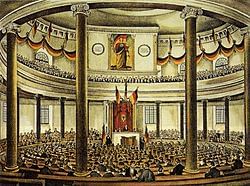 Frankfurt Parliament
- All those political associations existing in the German region whose members were middle-class professionals, businessmen and prosperous artisans, formed an all-German National Assembly.
- Their first meeting was held on May 18, 1848, at the Church of St. Paul in Frankfurt, where 831 elected members gathered.
- They created a constitution for a German nation that would be led by a king under a parliament.
- However, when they offered the crown to Friedrich Wilhelm IV, the King of Prussia, he refused it, and joined other monarchs to oppose the elected assembly.
(e) The role of women in nationalist struggles
- Artistic representations of the French Revolution show men and women participating equally in the movement.
- Liberty was personified as a woman. Liberal nationalism propounded the idea of universal suffrage, leading to women's active participation in nationalist movements in Europe.
- Women had formed their own political associations and founded newspapers. They had taken part in political meetings and demonstrations. In France, about sixty women's clubs came up in different French cities.
- The most famous was the society of Revolutionary and Republican women. One of their main demands was to have the same political rights as men had. They were, however, denied suffrage rights during the election to the Assembly.
Q2. What steps did the French revolutionaries take to create a sense of collective identity among the French people?
Ans:
- The ideas of fatherland (la Patrie) and citizen (le Citoyen) were introduced in France.
- A new French flag, the tricolour, was chosen to replace the earlier royal standard, and the Estates-General was renamed the National Assembly.
- New hymns were composed, oaths were taken and martyrs commemorated, all in the name of the nation.
- A centralized administrative system was established and uniform laws for all citizens were formulated.
- Internal customs duties were abolished, and a uniform system of weights and measures was adopted. French from Paris became the common language, with regional dialects discouraged.
- French, as it was written and spoken in Paris, became the common language of the nation. Regional dialects were discouraged. It was decided that the French nation would liberate the peoples of Europe from despotism, and help other peoples to become nations.
Q3. Who were Marianne and Germania? What was the importance of the way in which they were portrayed?
Ans:
- In the eighteenth and nineteenth centuries, artists portrayed nations as female figures. Thus the female figure became an allegory of the nation.
- In France, Marianne, a popular Christian name - underlined the idea of a people's nation. Her characteristics were drawn from those of liberty and the Republic - the red cap, the tricolor, the cockade.
- Statues of Marianne were placed in public squares, and her image appeared on coins and stamps to promote national unity.
- Similarly, Germania represented the German nation, depicted with a crown of oak leaves symbolizing heroism.
- The importance of the way in which they were portrayed was to remind the public of their national symbols of unity and to persuade them to identify with them.
Q4. Briefly trace the process of German unification.
Ans: The process of German unification is as follows:
- In 1848, the middle-class Germans tried to unite the different regions of the German confederation into a nation-state governed by an elected parliament. They were, however, repressed by the combined forces of the monarchy and the military, supported by the large landowners of Prussia.
- From then onwards, Prussia took on the leadership of the movement for national unification. Its chief minister Otto von Bismarck was the architect of this process with the help of the Prussian army and bureaucracy.
- Three wars over seven years - with Austria, Denmark and France - ended in Prussian victory and completed the process of unification.
- In January 1871, the Prussian king, William I, was proclaimed German Emperor in a ceremony held at Versailles.
Q5. What changes did Napoleon introduce to make the administrative system more efficient in the territories ruled by him?
Ans: There were several changes introduced by Napoleon in the administrative system, to make it more efficient, they are as follows:
- He established the Civil Code also known as the 'Napoleonic Code' in 1804. Due to this, privileges based on birth were abolished. The civil code also established equality before the law and secured the right to property.
- He also simplified the administrative division. There was the abolishment of the feudal system and peasants were freed from serfdom and manorial dues.
- In towns, the guild system was removed. Transport and communication systems were improved.
- Newfound freedom was thoroughly enjoyed by workers, peasants and artisans and new businessmen.
- Small-scale producers of goods began to realize that uniform laws, standardized weights and measures, and a common national currency would facilitate the movement and exchange of goods & capital from one region to another. Businessmen appreciated the benefits of uniform laws.
Q6. Explain what is meant by the 1848 revolution of the liberals. What were the political, social and economic ideas supported by the liberals?
Ans: The 1848 revolution of the liberals:
- The 1848 revolution was led by the educated middle classes along with the poor, unemployed starving peasants and workers in Europe.
- In certain parts of Europe such as Germany, Italy, Poland, and the Austro-Hungarian Empire, men and women of the liberal middle classes came together to push their demands for the creation of nation-states based on parliamentary principles.
The political, social and economic ideas supported by the liberals were:
(i) Politically, they demanded constitutionalism with national unification. They wanted the creation of a nation-state with a written constitution and parliamentary administration.
(ii) Socially, they wanted to rid society of its class-based partialities and birthrights. Serfdom and bonded labor had to be abolished.
(iii) Economically, they wanted freedom of markets and the right to property, abolition of state-imposed restrictions on the movements of goods and capital.
Q7. Choose three examples to show the contribution of culture to the growth of nationalism in Europe.
Ans: Examples of how culture contributed to the growth of nationalism in Europe:
(i) Romanticism
- A European cultural movement that aimed at developing national unity was Romanticism. It created a sense of shared heritage and a common history.
- Emotions, intuition and mystical feelings were some of the expressions used by the Romantic artists by which they tried to emphasize on national sentiments of the people.
(ii) Folk Songs, Dances, and Poetry
- These elements spread the spirit of nationalism and patriotism. As folk culture was a major part of the lives of people, it carried a message of nationalism to a large and diverse population.
- The Polish composer Karol Kurpinski celebrated and popularized the Polish nationalist struggle through his operas and music, by turning folk dances into nationalist symbols.
(iii) Language Association
- Another important factor that played a significant role was language.
Example: During the Russian occupation, the use of Polish came to be seen as a symbol of struggle against Russian dominance. In this period, the Russian language was imposed everywhere and Polish was even taken out of schools. - After the 1831 rebellion against the Russians, a large number of the polish clergy started using language as a weapon of national resistance. This was done by using the Polish language in Church gatherings and religious instructions and refused to preach Russian.
Q8. Through a focus on any two countries, explain how nations developed over the nineteenth century.
Ans: We would be taking Germany and Italy as our two examples:
(i) Germany
- Nationalist sentiments were often mobilized by conservatives for promoting state power and achieving political domination over Europe. This can be observed in the process by which Germany and Italy came to be unified as nation-states.
- Middle-class Germans tried to unite the different regions of the German Confederation, but their plans were not materialized due to the actions of large landowners called the 'Junkers of Prussia'. Three wars over seven years with Austria, Denmark, and France ended in a Prussian victory. In January 1871, the Prussian King William I was proclaimed German emperor.
- Importance was given to modernizing the currency, banking, legal and judicial systems in Germany.
(ii) Italy
- During the 1830s, Mazzini sought to unify Italy. He had formed a secret society called 'Young Italy', and it had failed. Hence, the responsibility fell on Sardinia-Piedmont under its ruler King Victor Emmanuel II, to unify Italian states through war.
- Austrian forces were defeated in 1859. Apart from Sardinia-Piedmont, a large number of volunteers had joined the cause under the leadership of Giuseppe Garibaldi. In 1860, they marched to South Italy and managed to defeat Spanish rulers. In 1861, Victor Emmanuel II was proclaimed as the king of Italy.
Q9. How was the history of nationalism in Britain unlike the rest of Europe?
Ans: The history of nationalism is Britain was different as follows:
- No British nation existed prior to the 18th century. The British Isles consisted of different ethnic groups like the English, Welsh, Scot and Irish. Each group followed its own cultural and political traditions.
- On the other side, due to the growth of wealth and the importance of power in the English state, could easily extend its influence over the other parts of the islands. National symbols like the English language, British Flag and National Anthem were promoted to identify the nationality of the nation.
- No Revolution: While in France, nationalism was developed through revolutions, in Britain, it was the result of a long-drawn-out process.
- English Parliament: While other European countries like Germany, Italy, Netherlands, Sweden, etc., had to wage wars either to gain independence or to unify their countries, Britain accomplished this objective through Parliamentary Acts.
- The British parliament played a major role in restraining the power of the monarchy in 1688, through various bloodless revolutions. England and Scotland formed an Act of Union (1707) which laid the foundation of the 'United Kingdom of Great Britain'.
- English culture mainly dominated the British nation, whereas Scotland's distinctive culture and political institutions were slowly and systematically suppressed.
- Thus, unlike the rest of Europe, nationalism came in Britain from the decisions of the people in power and not by people's desire to unite or countrywide movements.
Q10. Why did nationalist tensions emerge in the Balkans?
Ans: Nationalist tensions emerge in the Balkans because:
- One of the main reasons for the tension to emerge in the Balkans was because the people aspired to nationalism. During the 19th century, a major portion of the Balkans was under the Ottoman Empire. They tried to adopt modern techniques to make changes in the internal backwardness of the state but they did not succeed.
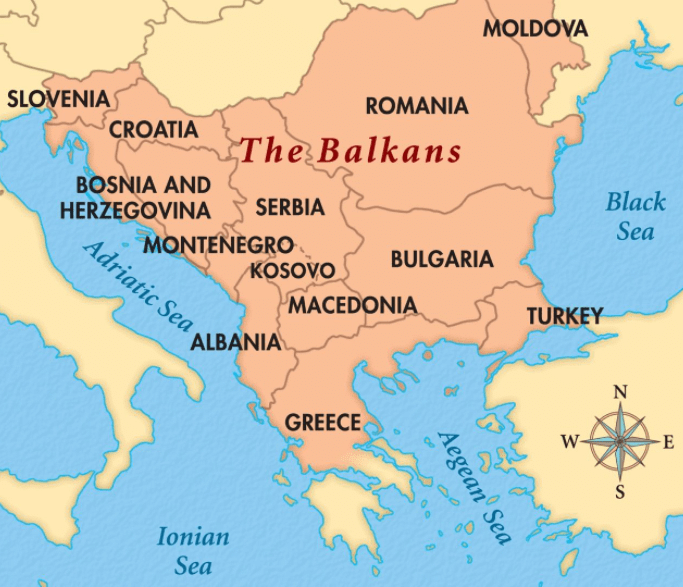
- Ethnic Variation: The Balkans was a region of geographical and ethnic variations comprising modern-day Romania, Bulgaria, Albania, Greece, Macedonia, Croatia, Bosnia-Herzegovina, Slovenia, Serbia and Montenegro. Their inhabitants were known as Slavs.
- Disintegration of the Ottoman Empire: A large part of the Balkans was under the control of the Ottoman Empire. The ideas of romantic nationalism in the Balkans together with the disintegration of the Ottoman Empire made this region very explosive.
- Subjugation: Soon, many foreign powers attempted to subjugate these newly independent states. The Balkan people tried to claim independence by using history to prove that they had once been independent. Hence, the rebellious nationalities struggled to win back their long-lost independence.
- Jealousy: There was jealousy among the Balkan states and each hoped to expand their boundaries at the expense of others. During this period, the ideology of Europe was changed, the liberal feelings were narrowed down with limited ends. Intolerance followed among the groups and they were ready to fight a war.
- Power struggle: Russia, Germany, Austria, Hungary and Britain, the European powers were interested in expanding their own imperialism. Trade, colonies, naval and military powers were some of the major factors which all the European powers were struggling for. They were all very keen on controlling the hold of the other powers and extending their own.
NCERT Summary: The Rise of Nationalism in Europe
The French Revolution and the Idea of the Nation
French Revolution of 1789 was the first clear expression of nationalism. 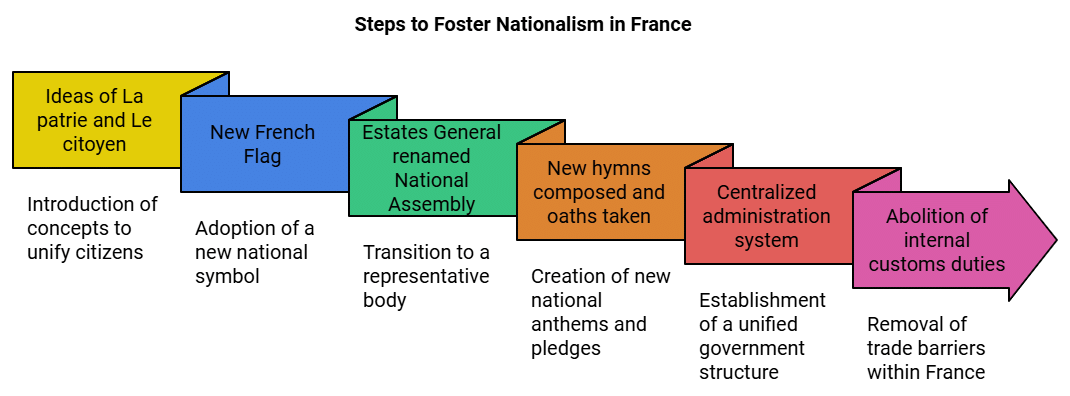
Steps taken by French Revolutionaries to create a sense of collective identity amongst the French people:
- Ideas of La patrie and Le citoyen
- New French Flag
- Estates General was elected and renamed National Assembly
- New hymns composed and oaths taken
- Centralized administration system
- Internal customs duties and dues were abolished
- Uniform system of weights and measures were introduced
- French became the common language
Napoleon
- Ruled France from 1799 to 1815.
- Gained absolute powers in 1799 by becoming the First Consul.
Civil Code of 1804 / Napoleonic Code:
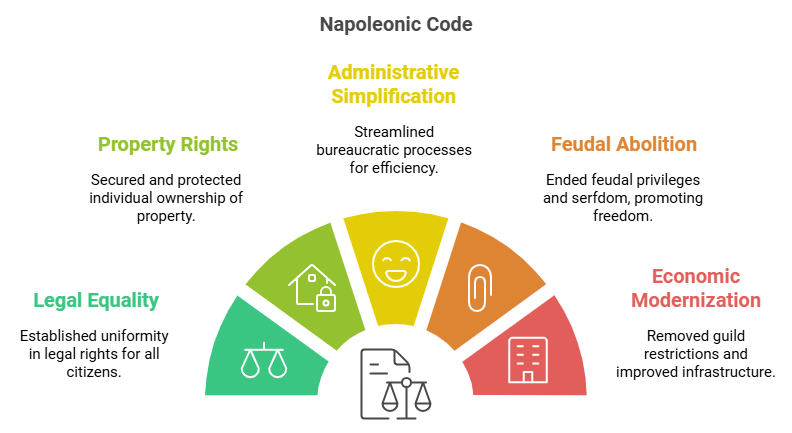
- Equality before the law was established
- Secured the right to property
- Simplified administrative measures
- Abolished feudal system
- Freed peasants from serfdom and manorial dues
- Guild restrictions were removed
- Transport and communication systems were improved.
Napoleon took away political freedom, increased taxes, imposed censorship and forced people to join French army.
Try yourself: What was one of the steps taken by the French Revolutionaries to create a sense of collective identity amongst the French people?
The Making of Nationalism in Europe
No Nation states were in Europe because of not common identity or culture.
- People residing in different areas spoke different languages.
Example: Hungary half of the population spoke Magyar other half spoke variety of dialects and in Galicia people spoke Polish.
The Aristocracy and the New Middle Class
Aristocracy
- The land owning class.
- Spoke French connected by ties of marriages.
- Numerically a small group.
Peasantry
- Majority of population
Middle class
- New Social class emerged with the growth of towns and emergence of commercial classes.
- Educated class where ideas of nationality gained popularity.
What did Liberal Nationalism Stand for?
- Liberalism stood for freedom for the individual and equality for all before the law
- The end of autocracy and clerical privileges
- A constitution and representative government through parliament.
- In the economic sphere liberalism stood for the freedom of markets and
- Zollverein abolished tariff barriers, reduced the number of currencies to two, and promoted a network of railways to stimulate mobility.
A New Conservatism after 1815
- Believed that established institutions of state and society should be preserved, with the changes initiated by Napoleon.
Treaty of Vienna (1815):
- Bourbon dynasty was restored to power in France
- A series of states created on the French boundary for preventing French expansion in future.
- German confederation was left untouched.
- Main intentions was to restore the monarchies that had been overthrown by Napoleon.
The Revolutionaries
- Acommitment to oppose monarchical forms that had been established after the Vienna Congress, and to fight for liberty and freedom.
Giuseppe Mazzini:
- Born in Genoa in 1807
- A member of the secret society of Carbonari
- Founded Young Italy in Marseilles, Young Europe in Berne.
- Believed in the unification of Italy into a republic.
| Get additional INR 200 off today with EDUREV200 coupon. | Avail Offer |
The Age of Revolutions: 1830-1848
- In July 1830, Bourbon kings of France were overthrown and a constitutional monarchy was established.
- Belgium broke away from the United kingdoms of the Netherlands.
- Greece which had been a part of the Ottoman Empire since the fifteenth century, struggled for independence.
- Treaty of Constantinople of 1832 recognised Greece as an independent nation.
The Romantic Imagination and National Feeling
- A cultural movement which sought to develop a particular form of nationalist sentiment, criticized the glorification of reason and science and focused instead on emotions, intuition and mystical feelings.
- German philosopher Johann Gottfried Herder tried to discovered culture among common people, through folk songs, folk poetry and folk dances.
Hunger, Hardship and Popular Revolt
- In most countries there were more seekers of jobs than employment.
- Population from rural areas migrated to the cities to live in overcrowded slums.
- The rise of food prices or a year of bad harvest led to widespread pauperism in town and country.
- In 1848, the Population of Paris came out on the roads and Louis Philippe was forced to flee and National Assembly proclaimed a Republic.
- In 1845, weavers in Silesia led a revolt against contractors.
1848: The Revolution of the Liberals
- The revolution was led by educated middle classes who combined their demands for constitutionalism with national unification.
Frankfurt Parliament:
- On 18 May 1848, members of political association's elected 831 representatives who took their places in the Frankfurt Parliament convened in the Church of St. Paul and drafted a Constitution for the German nation.
- It was opposed by King of Prussia and also lost its social basis as no rights were given to workers and women.
- It forced the autocratic monarchs to introduce some changes - serfdom and bonded labour was abolished
- Hungarians were granted more autonomy.
Also read: Flowcharts & Important Terms: The Rise of Nationalism in Europe |
The Making of Germany and Italy
Germany
- Otto Van Bismarck with the help of Prussian army and bureaucracy took on the leadership of the movement for national unification.
- Three war over seven years ended in Prussian victory and completed the process of unification.
- Kaiser William I of Prussia headed the new German Empire.
Italy
- Italy was divided into seven states of which only Sardinia Piedmont was ruled by an Italian Princely state.
- Initially a unification programme was initiated by Giuseppe Mazzini, but it failed.
- Chief Miniser Cavour led the movement, with the help of Giuseppe Garibaldi.
- In 1861, Victor Emmanuel II was proclaimed king of united Italy.
The Strange Case of Britain
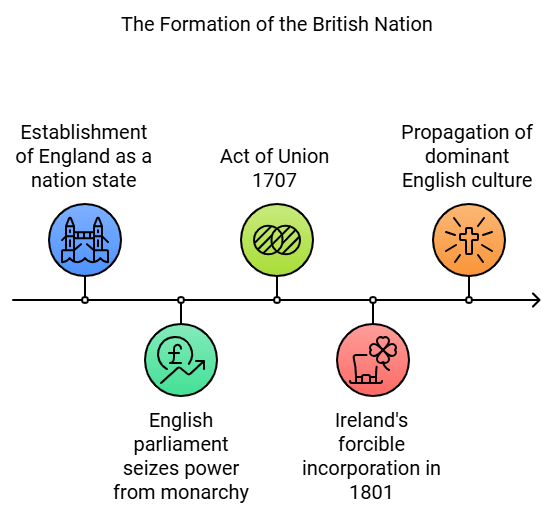
- In 1688, England established as a nation state.
- English parliament seized power from the monarchy.
- The Act of Union 1707 resulted in the formation of the 'United Kingdom of Great Britain'.
- In 1801, Ireland was forcibly taken by the British after the failed revolution.
- A new 'British Nation' was founded through the propagation of a dominant English culture.
| Attention! Sale expiring soon, act now & get EduRev Infinity at 40% off! | Claim Offer |
Visualising the Nation
- Nations were portrayed as female figure (Allegory).
- The female form that was chosen to personify the nation did not stand for any particular woman in real life, rather it sought to give the abstract idea of the nation a concrete form.
- In France the allegory was christened as Marianne, in Germany - Germania became the allegory.
Also read: Flowcharts & Important Terms: The Rise of Nationalism in Europe |
Nationalism and Imperialism
- The Balkans comprised modern-day Romania, Bulgaria, Albania, Greece, Macedonia, Croatia, Bosnia-Herzegovina, Slovenia, Serbia and Montenegro.
- Balkans was a region of geographical and ethnic variation was under the control of the Ottoman Empire.
- The idea of Romantic nationalism made this region very explosive.
- The Balkan states were fiercely jealous of each other and each hoped to gain more territory at the expense of each other.
- European powers were also looking for the extend their control over the area.
- This led to a series of wars in the region and finally resulted in the First World War.
Long Answer Questions: The Rise of Nationalism in Europe
Q1: How did the French territory change due to the Treaty of Vienna in 1815?
Ans: Representatives of European powers, i.e. Austria, Britain, Russia and Prussia, met at Vienna in 1815 after having defeated Napoleon. The Austrian Chancellor Duke Metternich was the head of the Congress. Here the Treaty of Vienna of 1815 was drawn to undo the changes after the Napoleonic wars.
- Thus the Bourbon dynasty, deposed during the French Revolution, was put back in power even as France lost the territories it had annexed under Napoleon.
- To prevent every future expansion of France, many states were set up on France's boundaries. So the kingdom of Netherlands including Belgium came up in the north, while Genoa came together with Piedmont in the south.
- Prussia received some important new territories on its western frontiers.
- Austria gained control of northern Italy.
- The 39 states in the German Confederation as set up by Napoleon did not change. In the east, Russia received a part of Poland and Prussia received a part of Saxony.
- The objective was to restore the monarchies overthrown by Napoleon and create a new conservative order in Europe.

Q2: Discuss the lives of the aristocrats and the new middle class in the 19th century Europe.
Ans: In the 19th-century Europe, the landed aristocracy dominated all social and political spheres. They were united by a common lifestyle. They owned huge estates in the countryside and some had large townhouses too. Their spoken language was French, both in high society and in diplomatic circles. Most of the aristocratic families were connected by marriage. The aristocrats formed a small group but held a lot of power.
Peasantry comprised the larger group of the population. To the west, most of the land was farmed by small owners and tenants. In eastern and central Europe, the pattern of landholding was characterized by vast estates cultivated by the serfs. In the western and some parts of central Europe industrial production and trade was on the rise and with them towns grew and the commercial classes emerged.
Their existence was based on the production for the market. Industrialization took birth in England in the 1850s but France and Germany experienced it only during the 19th century. This caused the emergence of new social groups - working class and middle class.
The latter comprised industrialists, businessmen and professionals. These groups were not many in central and eastern Europe. So it was the liberal, educated middle class which encouraged national unity after aristocratic privileges were abolished.
Q3: What views did the conservatives hold?
Ans: Napoleon was defeated in 1815 and soon European governments adopted the idea of conservatism. The conservatives held the belief that established traditional institutions of state and society like monarchy, church, social hierarchies, property and family must be protected and preserved.
They never proposed a pre-revolutionary period to return to but they knew that as Napoleon had carried out changes, modernization would in fact contribute to a strong monarchy. They believed that it would strengthen the power of the state and make it much more effective.
For them it was a firm belief that aristocratic monarchies of Europe would gain much from a modern army, an efficient bureaucracy, a dynamic economy, the abolition of feudalism and serfdom.
Q4: Friedrich List, Professor of Economics at the University of Tubingen in Germany, wrote in 1834.
"The aim of the Zollverein is to bind the Germans economically into a nation. It will strengthen the nation materially as much by protecting its interests externally as by stimulating its internal productivity. It ought to awaken and raise national sentiment through a fusion of individual and provincial interests. The German people have realized that a free economic system is the only means to engender national feelings."
Read the statement by Professor List and discuss what political ends he hoped, would be achieved by economic measures.
Ans: Professor List was sure that economic measures could result in certain political ends:
(a) A national economy binds the nation together. For example, Zollverein abolished tariff barriers. It also reduced the currencies from thirty to two. This economic union was joined by most of the German states and brought them together and created a national feeling.
(b) It also promoted internal productivity, for example, to help trade growth, a network of railways was needed for increased mobility. This also brought people together.
(c) Economic measures like the Zollverein also protected nation's external interests (the use of common currency and abolishing of tariffs). This fusion of individual and provincial interests aroused national sentiments in people.
Q5: The French philosopher Ernst Renan (1823-92) outlined his understanding of a nation in the following way:
"A nation is the result of a long past of endeavors, sacrifice and devotion. A heroic past, great men, glory, that is the social capital upon which one bases a national idea. To have common glories in the past, to have a common will in the present, to have performed great deeds together, to wish to perform still more, these are the essential conditions of being a people. A nation is, therefore, large-scale solidarity ... Its existence is a daily plebiscite ... A province is its inhabitants; if anyone has the right to be consulted, it is the inhabitants. A nation never has any real interest in annexing or holding on to a country against its will. The existence of nations is a good thing, a necessity even. Their existence is a guarantee of liberty, which would be lost if the world had only one law and only one master."
(a) What, according to Renan, are the attributes of a nation?
(b) Why does he think nations are important?
(c) How is his idea different from others? Do you agree with him? Ans:
Ans:
(a) According to Renan, a nation must have people who have shared "a glorious past," and have a desire, a will to perform deeds together for the glory of the country in the present and in the future also. There is solidarity. They belong to the nation and have to be consulted on any issue, they exercise their rights daily. A nation does not want to grab territories, it does not want to conquer any country or dominate it against the will of the people.
(b) A nation is necessary because it guarantees freedom to every citizen. This liberty (individual) would be lost, if there was a uniform law for everyone and only one ruler.
(c) He differs from others as he does not believe that a nation speaks the same language, follow the same religion, belongs to the same race and occupies the same territory. I agree with him. India is a nation made of different races, different religions, we speak different languages, follow different cultures. Yet, we have unity in diversity as we have a common past and a desire to live together.
Q6: What is the significance of the symbols given in this picture?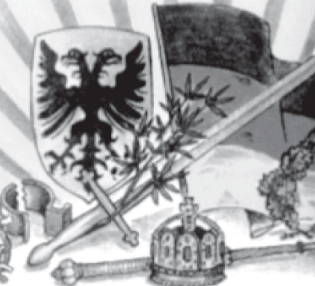 Ans: Each symbol has meaning and significance.
(a) The broken chains represent freedom, freedom from slavery.
(b) The breastplate with an eagle on it represents the German Empire and its strength (the eagle is a strong bird).
(c) The tricolour - black, red and gold - was the flag of liberal nationalists in 1848. It was banned by Dukes of the German states. A flag always unites people and arouses national feelings.
(d) The sword symbolises a readiness to fight. The German nation was ever ready to fight for its honour.
(e) The crown of oak leaves stands for courage, bravery and heroism.
(f) The olive branches around the sword show that Germans are as eager for peace as they are eager to fight.
(g) The rays of the rising sun symbolizes the beginning of a new era as a united German nation.
Q7: Read the two opinions about the role of women in society:
1. Carl Welcker: A liberal politician member of the Frankfurt Parliament:
'Nature has created men and women to cany out different functions ... Man, the stronger, the bolder and peer of the two, has been designated as protector of the family, its provider, meant for public tasks in the domain of law, production, defence. Woman, the weaker, dependent and timid, requires the protection of man. Her sphere is the home, the care of the children, the nurturing of the family ... Do we require any father proof that given such differences, equality' between the sexes would only endanger harmony and destroy the dignity of the family?'
2. Louise Otto Peters, a political activist, wrote in a journal (21 April, JS4Q): 'Let us ask how many men, possessed by thoughts of Iriing and dying for the sake of Liberty, would be prepared to fight for the freedom of the entire people, of all human beings? When asked this question, they would all too easily respond with a "Yes", though their untiring efforts are intended for the benefit of only one half of humanity- men. But Liberty is mdnisible' Free men therefore must not tolerate to be surrounded by the unfree.
(a) What according to Carl Welcker is a woman's function? Does he think women should be given equality and liberty?
(b) Louise Otto Peters asks a question in his article. What is the significance of his question? How does he define liberty?
Ans:
(a) A woman, according to Carl Welcker, is weak, timid and needs the protection of the strong, bold, free man. He confines the woman to the kitchen, home and children. He does not support equality and liberty for women. A woman must remain subservient to a man.
(b) Louise Otto Peters is certainly a feminist. Does he want to know whether men are prepared to fight for "freedom of the entire people, all human beings"? His question is significant because though the men will unanimously answer "yes" but they are not ready to grant this freedom to women, who constitute half the population of the world.
For him Liberty is indivisible, it cannot be given to some and not to others. He certainly holds a totally different view from Carl Welcker, who is a male chauvinist!
Q8: How was the history of nationalism in Britain, unlike the rest of Europe?
OR
How was the formation of the nation-state the result of a long drawn-out process in Britain?
Explain.
Ans: In Britain, the formation of the nation-state was not the result of a sudden upheaval or revolution. It was the result of a long-drawn-out process. There was no British nation prior to the eighteenth century. All the ethnic groups had their own cultural and political traditions.
But as the English nation steadily grew in wealth, importance and power, it extended influence over other nations of the island. The English parliament, which had seized power from the monarchy in 1688 at the end of a protracted conflict, was the instrument through which a nation-state, with England at its centre, came to be forged.
The Act of Union (1707) between England and Scotland that resulted in the formation of the 'United Kingdom of Great Britain' meant, in effect, that England was able to impose its influence on Scotland. The British parliament was henceforth dominated by its English members.
The growth of a British identity meant that Scotland's distinctive culture and political institutions were systematically suppressed. Ireland suffered a similar fate. It was a country deeply divided between Catholics and Protestants. The English helped the Protestants of Ireland to establish their dominance over a largely Catholic country. Catholic revolts against the British dominance were suppressed.
Q9: Analyse the measures and practices introduced by the French revolutionaries to create a sense of collective identity amongst the French people.
Ans: The measures and practices introduced by the French revolutionaries to create a sense of collective identity among the French people were as follows.
- The idea of la patrie (the fatherland) and le citoyen (the citizen) emphasised the idea of united people enjoying equal rights under a constitution.
- A new French flag, the tricolour, was chosen to replace the former royal standard.
- The Estates General was elected by the active citizens and renamed the National Assembly.
- New hymns were composed, oaths taken and martyrs commemorated in the name of nation.
- Regional dialects were discouraged and French, as it was spoken and written in Paris, became the common language of the nation.
- A centralised administrative system was put in practice and it formulated uniform laws for all citizens within its territory.
- Internal customs duties and dues were abolished and a uniform system of weights and measures was adopted.
Q10: 'Nationalism no longer retained its idealistic liberal democratic sentiments by the last quarter of the 19th century in Europe'. Analyse the statement with examples.
Ans:
- Towards the end of the 19th century, nationalism became a narrow belief with inadequate ends.
- This period saw nationalist groups becoming increasingly prejudiced against each other and ready to wage a war at the slightest pretext.
- Nationalism was now identified with increasing one's sphere of influence, by establishing control over more territories. Balkan states became jealous of each other and entered into a conflict to establish more control and power in the region at the cost of others.
- The chief European authorities saw this as an opportunity and manipulated the nationalist desires of the subject peoples.
- European powers were keen on countering the hold of other powers over the Balkans. They did nothing serious to solve the Balkan issue but rather watched the situation to turn fruitful for them.The most severe tensions emerge after 1871, leading to a series of wars and ultimately led to the First World War in 1914.
Multiple Choice Questions
Q1: Romanticism refers to(a) cultural movement
(b) religious movement
(c) political movement
(d) literary movement
Ans: (a)
Romanticism was a cultural movement that originated in the late 18th century in Europe. It emphasized emotion, individualism, nature, and glorified the past, especially the medieval era, opposing the rationalism of the Enlightenment.
Q2: In Prussia, who was referred to as 'Junkers'?
(a) Military officials
(b) Large landowners
(c) Factory owners
(d) Aristocratic nobles
Ans: (b)
The term 'Junkers' was used for the wealthy, conservative landowning class in Prussia. They held significant political power and supported the monarchy and military traditions.
Q3: Who among the following was proclaimed the first King of United Italy?
(a) Nicholas II
(b) King George II
(c) Wilhelm IV
(d) Victor Emmanuel II
Ans: (d)
Victor Emmanuel II was the King of Sardinia-Piedmont and became the first King of a unified Italy in 1861. He played a key role in the Italian unification movement.
Q4: A large number of people were hostile to the Napoleonic code because
(a) it was not suitable for all.
(b) it destroyed the special privileges of the rulers.
(c) administrative changes did not go hand-in-hand with political freedom.
(d) none of the above.
Ans: (c)
Although the Napoleonic Code introduced modern laws and administrative reforms, it often ignored democratic principles. People resented the lack of political freedom and imposition of French control.
Q5: Who, among the following, hosted the Congress at Vienna in 1815?
(a) King of the Netherlands
(b) Giuseppe Mazzini
(c) Duke Metternich
(d) Otto von Bismarck
Ans: (c)
The Congress of Vienna was hosted by Duke Metternich. It aimed to restore monarchies and balance power in Europe after Napoleon's defeat.
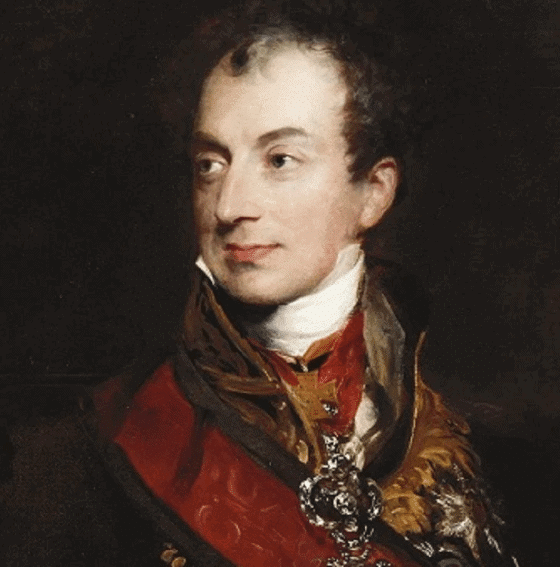
| Get additional INR 200 off today with EDUREV200 coupon. | Avail Offer |
Very Short Answer Questions
Q1: Who remarked, "When France sneezes, the rest of Europe catches a cold".
Ans: Duke Metternich.
Q2: Name the Treaty of 1832 that recognised Greece as an independent nation.
Ans: Treaty of Constantinople (1832).
Q3: What was the main aim of the revolutionaries of Europe during the years following 1815?
Ans: To oppose monarchical forms of government.
Q4: Who was proclaimed German Emperor in a ceremony held at Versailles in January 1871?
Ans: Kaiser William I of Prussia was proclaimed German Emperor in a ceremony held at Versailles in January 1871.
Q5: Name the event that mobilised nationalist feelings among the educated elite across Europe in 1830-1848.
Ans: The Greek War of Independence in 1821.
Also read: PPT: The Rise of Nationalism in Europe |
Short Answer Type Questions
Q1: Explain the contribution of Otto von Bismarck to German unification.Ans: Otto von Bismarck played a significant role in the German unification process as nationalist sentiments gained traction among middle-class Germans in 1848. During this period, there was a concerted effort to unite various regions of the German Confederation into a single nation-state, aiming for a government with elected representatives. Unfortunately, this liberal movement faced suppression from a coalition of monarchy and military forces, backed by Prussian landowners.
Q2: Describe any three reforms introduced by Napoleon in the territories he conquered.
Ans: Napoleon implemented three key reforms in the territories he conquered:
The Napoleonic Code: This legal framework eliminated birth-based privileges, ensuring equality before the law and safeguarding property rights.
Administrative Simplification: Napoleon streamlined administrative divisions, abolished the feudal system, and emancipated peasants from serfdom and manorial dues.
Standardization Measures: He established uniform laws, standardized weights and measures, and introduced a common national currency to facilitate the seamless movement and exchange of goods and capital across different regions.
Q3: How did nationalism develop through culture in Europe? Explain.
Or
Describe the role of culture in shaping the feelings of nationalism in Europe from 1830 to the end of the 19th century.
Ans:(i) Culture played a pivotal role in fostering nationalist sentiments, with art, poetry, and music serving as mediums for expressing such feelings. The cultural movement of Romanticism, which prioritized emotions over reason, played a significant role in shaping nationalist ideals.
(ii) Language also played a crucial role in nurturing nationalism. In the face of Russian occupation, the Polish resistance adopted language as a tool of national defiance after an armed rebellion against Russian rule in 1831.
(iii) Additionally, music and dance played a role in popularizing the spirit of the nation. Romantics like the German philosopher Herder emphasized the importance of discovering true national culture among the common people, or "das volk," through folk songs, poetry, and dances.
Q4: Explain the conditions that were viewed as obstacles to the economic exchange and growth by the new commercial classes during the nineteenth century in Europe.
Ans:
- Liberalism in the economic sphere championed free markets and the removal of state-imposed restrictions on the movement of goods and capital.
- In the 19th century, Napoleon's administrative measures consolidated numerous small principalities into a confederation of 39 states.
- Each state had its currency, weights, and measures, creating a fragmented economic landscape.
- Merchants travelling from Hamburg to Nuremberg, for example, encountered 11 custom barriers, with a 5% duty at each checkpoint.
- Diverse regional systems of weights and measures added complexity, requiring time-consuming calculations.
- The new commercial classes saw these conditions as impediments to economic growth and exchange.
- Advocates argued for the establishment of a unified economic territory to enable the free movement of goods, people, and capital.
Q5: Describe three economic hardships faced by Europe in the 1830s.
Ans: In the 1830s, Europe faced significant economic hardships, which can be summarised as follows:
- Widespread Unemployment: Many countries experienced a surplus of job seekers, leading to high levels of unemployment. Urban areas became overcrowded as people migrated from rural regions in search of work.
- Intense Competition: Small producers struggled against cheap, machine-made goods imported from England. The rapid industrialisation in England, particularly in textile production, outpaced the capabilities of local producers on the continent.
- Feudal Burdens: In areas where the aristocracy held power, peasants were burdened by feudal dues and obligations. Rising food prices and poor harvests worsened their situation, contributing to widespread poverty.
| Attention! Sale expiring soon, act now & get EduRev Infinity at 40% off! | Claim Offer |
Long Answer Type Questions
Q1: Describe the ideology of liberalism during the early 19th century.Ans: Liberalism in the early 19th century represented a significant shift in political thought, particularly for the new middle classes. It was characterised by several key principles:
- Individual Freedom: Liberalism advocated for the freedom of the individual and equality before the law.
- Government by Consent: It emphasised that governments should operate with the consent of the governed.
- End of Autocracy: The ideology called for the abolition of autocratic rule and clerical privileges.
- Property Rights: It upheld the inviolability of private property and supported free markets without state restrictions.
The term 'liberalism' comes from the Latin word liber, meaning 'free'. For the middle classes, it symbolised:
- A demand for political rights, although initially limited to property-owning men, excluding the lower classes and women.
- Inspiration from the French Revolution, which highlighted the need for constitutional and representative government.
Despite its focus on equality, liberalism did not advocate for universal suffrage. The right to vote was primarily reserved for men with property, reflecting the social hierarchies of the time. Overall, early 19th-century liberalism laid the groundwork for modern democratic principles, influencing future movements for broader political rights.
Q2: What was the status of France as a state before 1789? Which two political and constitutional changes came in the wake of the French Revolution?
Ans. Before 1789, France was a territorial state governed by an absolute monarch.
- The French Revolution shifted power from the monarchy to the citizens of France.
- It established that the people would now form the nation and determine its future.
The revolutionaries introduced several key changes:
- They fostered a sense of collective identity among the French.
- They promoted the ideas of la patrie (the fatherland) and le citoyen (the citizen), highlighting equal rights.
- A new national flag, the tricolour, replaced the royal standard.
- The Estates General was reformed into the National Assembly, elected by active citizens.
- New hymns and oaths were created, commemorating martyrs in the name of the nation.
- A centralised administration was established, implementing uniform laws across the territory.
- Internal customs duties were abolished, and a standard system of weights and measures was adopted.
- Regional dialects were discouraged, promoting the use of French as the common language.
Q3: What happened during the year following 1815 when the fear of repression drove many liberal nationalists underground? Explain.
Ans: (i) Secret societies sprang up in many European states to train revolutionaries and spread their ideas.
(ii) To be revolutionary at this time meant a commitment to oppose monarchical forms that had been established after the Vienna Congress, and to fight for liberty and freedom.
(iii) Most of these revolutionaries also saw the creation of nation-states as a necessary part of this struggle for freedom. One such individual was the Italian revolutionary Giuseppe Mazzini.
(iv) He subsequently founded two more underground societies, first, Young Italy in Marseilles, and then, Young Europe in Berne, whose members were like-minded young men from Poland, France, Italy, and the German states.
(v) Mazzini believed that God had intended nations to be the natural units of mankind. So, Italy could not continue to be a patchwork of small states and kingdoms. It had to be forged into a single unified republic within a wider alliance of nations.
(vi) This unification alone could be the basis of Italian liberty. Following his model, secret societies were set up in Germany, France, Switzerland, and Poland.
(vii) Mazzini's relentless opposition to monarchy and his vision of democratic republics frightened the conservatives. Metternich described him as 'the most dangerous enemy of our social order'.
Q4:Explain the process of unification of Italy.
Ans:
- Italy had a history of political fragmentation, with Italians scattered across dynastic states and the Habsburg Empire.
- The country was divided into seven states, and the Italian language lacked a common form.
- Giuseppe Mazzini played a key role in unification, forming the secret society 'Young Italy' to promote his goal of a unified republic.
- Mazzini believed that Italy should not remain a patchwork of small states and needed to be forged into a single, unified republic.
- After unsuccessful uprisings in 1831 and 1848, the responsibility for unification shifted to Sardinia-Piedmont under Emmanuel II.
- Chief Minister Cavour, under Emmanuel II's rule, successfully defeated Austrian forces in 1859.
- Cavour, through diplomatic alliances with France, overcame Austrian forces, and Giuseppe Garibaldi also joined the cause.
- In 1860, they marched towards South Italy and the Kingdom of the Two Sicilies, with local peasant support, driving out the Spanish rulers.
- In 1861, Victor Emmanuel II was proclaimed the King of a United Italy.
Q5: Describe the process of the Unification of Britain.
Or
How has Britain come into existence? Explain.
Ans: Nationalism in Britain differed from that in the rest of Europe in several key aspects:
Gradual Evolution: Unlike many European nations, British nationalism did not emerge suddenly through uprisings or revolutions but developed over an extended period.
Ethnic Diversity: Before the 18th century, there was no unified British nation; instead, the British Isles housed distinct ethnic groups such as the English, Welsh, Scots, and Irish. The English, gaining wealth and influence, gradually extended their dominance over other nations, including Scotland.
English Dominance: The British Parliament, largely composed of English members, sought to suppress Scotland's unique culture and political institutions. This led to restrictions on language, dress, and the expulsion of many Scots.
Bloodless Revolution: In 1688, a bloodless revolution saw the English Parliament wrest power from the monarchy, establishing itself as the focal point of a nation-state.
Incorporation of Scotland and Ireland: The Act of Union in 1707 brought Scotland into the United Kingdom, while Ireland, despite opposition, was forcibly incorporated in 1801.
Parliamentary Action: The formation of the British nation was achieved primarily through parliamentary actions rather than through revolutions or wars.
Cultural Propagation: The creation of a new 'British Nation' involved the promotion of English culture. Symbols like the Union Jack, the national anthem "God Save Our Noble King," and the English language were emphasized, with the older nations becoming subordinate partners in the Union.
Passage
Q6: Read the extract and answer the questions that follow.By the last quarter of the nineteenth century, nationalism no longer retained its idealistic liberal democratic sentiment of the first half of the century but became a narrow creed with limited ends. During this period nationalist groups became increasingly intolerant of each other and ever ready to go to war. The major European powers, in turn, manipulated the nationalist aspirations of the subject peoples in Europe to further their imperialist aims. The most serious source of nationalist tension in Europe after 1871 was the area called the Balkans. The Balkans was a region of geographical and ethnic variation comprising modern-day Romania, Bulgaria, Albania, Greece, Macedonia, Croatia, Bosnia-Herzegovina, Slovenia, Serbia and Montenegro, whose inhabitants were broadly known as the Slavs. A large part of the Balkans was under the control of the Ottoman Empire. The spread of the ideas of romantic nationalism in the Balkans, together with the disintegration of the Ottoman Empire, made this region very explosive. All through the nineteenth century the Ottoman Empire had sought to strengthen itself through modernization and internal reforms but with very little success. One by one, its European subject nationalities broke away from its control and declared independence. The Balkan peoples based their claims for independence or political rights on nationality and used history to prove that they had once been independent but had subsequently been subjugated by foreign powers. Hence the rebellious nationalities in the Balkans thought of their struggles as attempts to win back their long-lost independence. As the different Slavic nationalities struggled to define their identity and independence, the Balkan area became an area of intense conflict. The Balkan states were fiercely jealous of each other and each hoped to gain more territory at the expense of the others. Matters were further complicated because the Balkans also became the scene of big power rivalry. During this period, there was intense rivalry among the European powers over trade and colonies as well as naval and military might. These rivalries were very evident in the way the Balkan problem unfolded. Each power - Russia, Germany, England, and Austro-Hungary - was keen on countering the hold of other powers over the Balkans and extending its control over the area. This led to a series of wars in the region and finally the First World War.
Questions: (i) Why did the major European powers manipulate the nationalist aspirations of the subject peoples in Europe by the last quarter of the nineteenth century?
(ii) What was the basis of the Balkan people regarding their claim for independence?
(iii) State any two reasons that led to a series of wars in the Balkan region and finally the First World War.
Ans. (i) The major European powers manipulated the nationalist aspirations of the subject people in Europe by the last quarter of the nineteenth century to fulfill their imperialistic aims.
(ii) The Balkan peoples based their claims for independence or political rights on nationality and used history to prove that they had once been independent but had subsequently been subjugated by foreign powers. Hence, the rebellious nationalities in the Balkans thought of their struggles to win back their long-lost independence.
(iii) Two major reasons that led to a series of wars in the Balkan region and finally the
First World War:
(a) The Balkan area had become an area of intense conflict. The Balkan states were fiercely jealous of each other and each hoped to gain more territory at the expense of the others. Matters were further complicated because the Balkans also became the scene of big power rivalry.
(b) During this period, there was intense rivalry among the European powers over trade and colonies as well as naval and military might. These rivalries were very evident in the way the Balkan problem unfolded. Each power was keen on countering the hold of other powers over the Balkans and extending its control over the area.
Infographics: The Rise of Nationalism in Europe
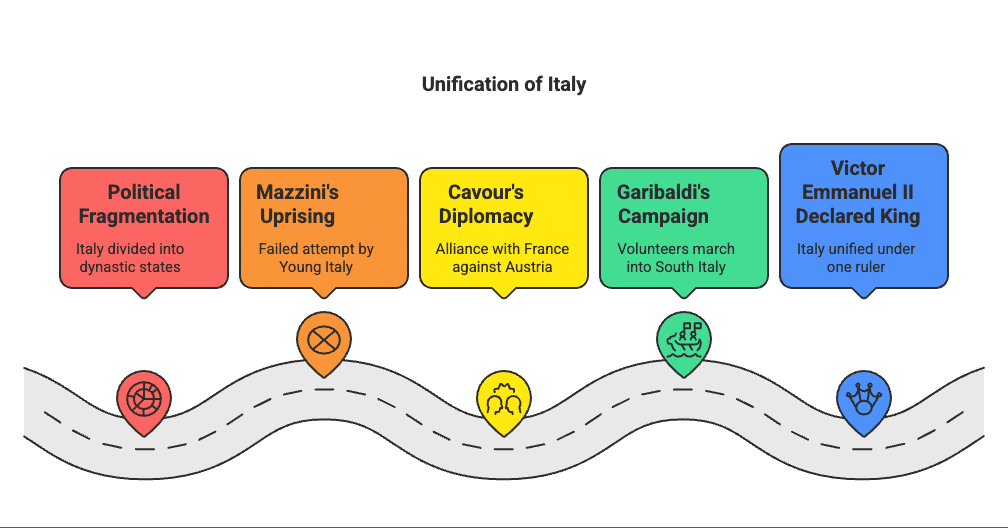
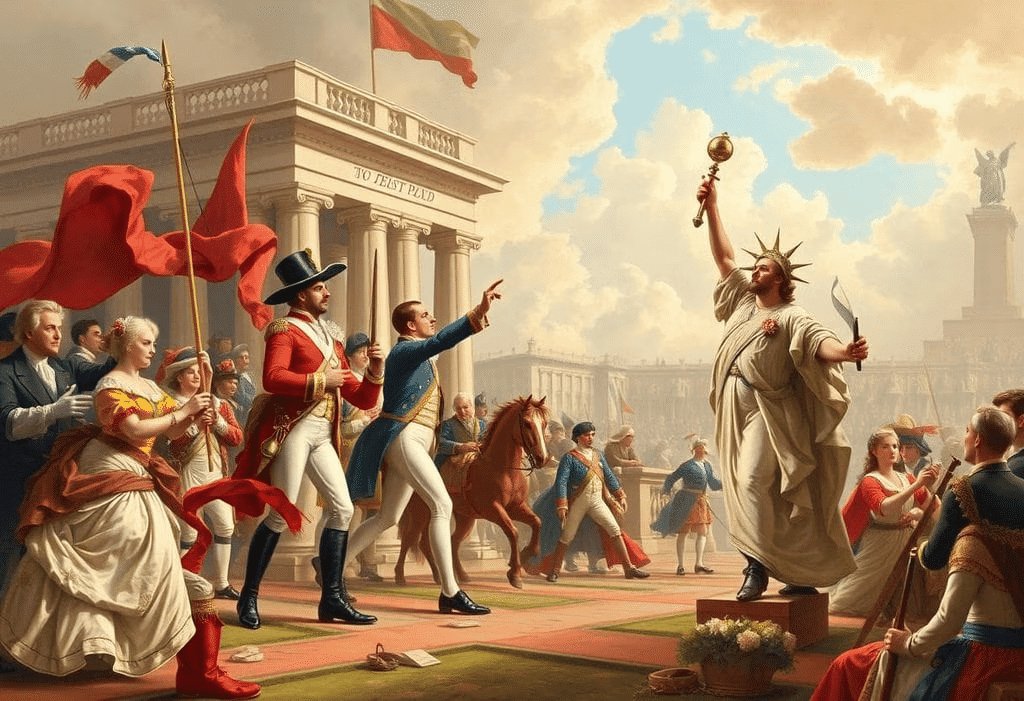


: