

Algebraic Expressions
An algebraic expression is a combination of numbers, letters (representing variables), and symbols used for mathematical operations.
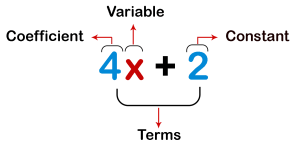 Algebraic Expressions
Polynomial
An expression using mathematical operations such as addition, subtraction, multiplication, and division can include fractional exponents.
On the other hand, a polynomial is a mathematical expression consisting of variables and coefficients where the exponent of each variable is a non-negative integer.
 | Get additional INR 200 off today with EDUREV200 coupon. | Avail Offer |
Degree of a Polynomial
For a polynomial in one variable - the highest exponent on the variable in a polynomial is the degree of the polynomial.
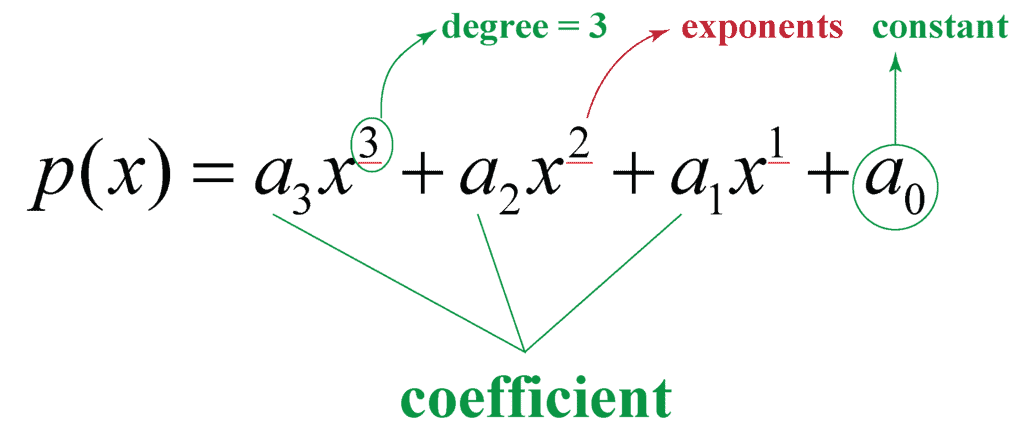 Degree of a Polynomial
Also read: Worksheet: Polynomials |
Types of Polynomials
a) Monomial - A polynomial with just one term. Example: 2x, 6x2, 9xy
b) Binomial - A polynomial with two unlike terms. Example: 4x2+x, 5x+4
c) Trinomial - A polynomial with three unlike terms. Example: x2+3x+4
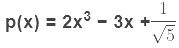
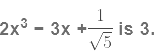
Example 1: Write the degree of the following Polynomials.
i)
Sol: As the highest power of x in p(x) is 3. The degree of polynomial,
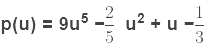
ii)
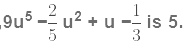
Sol: As the highest power of u in p(u) is 5. The degree of the polynomial,
Example 2: Identify the type of the Polynomials given below (on the basis of degree)
i) 2y + 6
Sol: Here, the highest power of y in the given polynomial is 1, so it is a Linear Polynomial
ii) √2 + y2 + y
Sol: Here, the highest power of y in the given polynomial is 2, so it is a Quadratic Polynomial.
iii) y3 + 4y2 + 2y + 1
Sol: Here, the highest power of y in the given polynomial is 3, so it is a Cubic Polynomial.
Try yourself: The polynomial equation x (x + 1) + 8 = (x + 2) (x – 2) is
We have x(x + 1) + 8 = (x + 2) (x – 2)
⇒ x² + x + 8 = x² – 4
⇒ x² + x + 8- x² + 4 = 0
⇒ x + 12 = 0, which is a linear equation.
Zeroes of a Polynomial
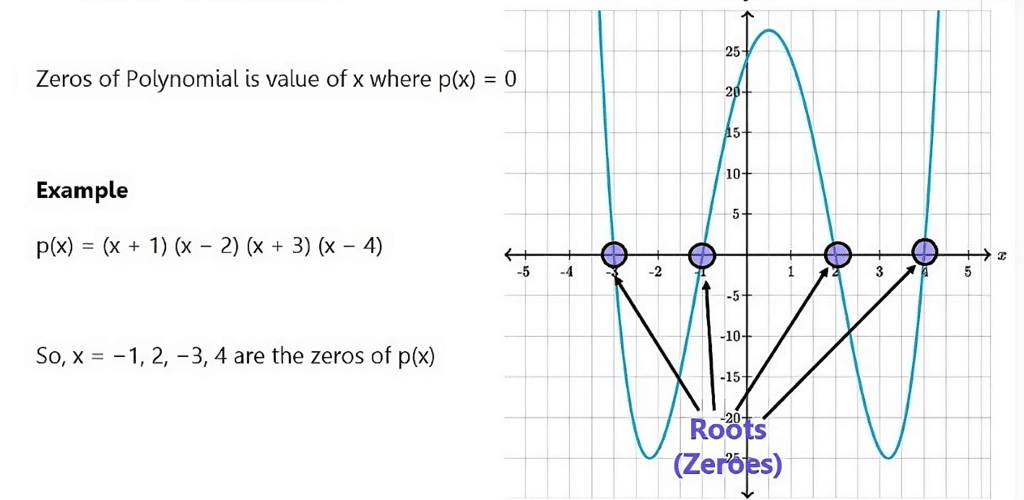
If p(x) is a polynomial in x and k is any real number, then the value obtained by replacing x by k in p(x), is called the value of p(x) at x = k, and is denoted by p(k).
 Zeroes of a Polynomial
Let us consider the polynomial p(x) = 2x3 - 3x2 + 1
If we put x = 2 in the polynomial, that is, we replace x by 2 in the given polynomial, we get,
p(2) = 2(2)3 - 3(2)2 + 1 = 16 - 12 + 1 = 5
Therefore, the value of the polynomial p(x) at x = 2 is 5, that is, p(2) = 5
Similarly, we can find the value of p(x) at x = 0,
p(0) = 2(0)3 - 3(0)2 + 1 = 0 - 0 + 1 = 1
The value of p(x) at x = 0 is 1, that is, p(0) = 1
Now consider another case where we find the value of p(x) at x = 1
p(1) = 2(1)3 - 3(1)2 + 1 = 2 - 3 + 1 = 3 - 3 = 0
Here, we see that the value of the polynomial p(x) is 0 at x = 1
As p(1) = 0, 1 is called a zero of the polynomial
p(x) = 2x3 - 3x2 + 1
A real number k is said to be a zero of the polynomial p(x) if p(k) = 0.
Now consider a linear polynomial,p(x) = 2x + 1,
If k is a zero of p(x), then p(k) = 0
2k + 1 = 0
2k = -1
k = -1/2
If k is a zero of a polynomial, p(x) = ax + b, then,
p(k) = ak + b = 0
k = -b/a
Therefore, the zero of the polynomial, ax + b = -b/a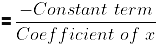
Example 3: If 3 is a zero of polynomial,p(x) = 2x2 + 3x - 9a, then find the value of a.
Sol:
If 3 is a zero of the polynomial, p(x) = 2x2 + 3x - 9a then p(3) = 0
Now, p(x) = 2x2 + 3x - 9a
p(3) = 2(3)2 + 3(3) - 9a
Now we will equate p(3) to 0.
2(3)2 + 3(3) - 9a = 0
18 + 9 - 9a = 0
27 - 9a = 0
27 = 9a
a = 3
∴ The value of a = 3.
Example 4: For what value of k, -2 is a zero of the polynomial 3x2 + 4x + 2k.
Sol:
If -2 is a zero of the polynomial, p(x) = 3x2 + 4x + 2k then p(-2) = 0
Now, p(x) = 3x2 + 4x + 2k
As -2 is a zero of p(x), we will replace x by -2 in the given polynomial and equate it to 0.
p(-2) = 3(-2)2 + 4(-2) + 2k = 0
12 - 8 + 2k = 0
2k = -4
k = -2
Example 5: If 1 and 2 are zeroes of a polynomial p(x) = 2x2 - kx + 2m, then find the value of k and m.
Sol:
Here, 1 and 2 are zeroes of the polynomial,
p(x) = 2x2 - kx + 2m
So, p(1) = 2(1)2 - k(1) + 2m = 0
2 - k + 2m = 0
k = 2m + 2 →(i)
Now p(2) = 2(22)- k(2) + 2m = 0
8 - 2k + 2m = 0
Putting the value of k in the above equation, we get
8 - 2(2m + 2) + 2m = 0
8 - 4m - 4 + 2m = 0
4 - 2m = 0
2m = 4
m = 2
We will now find the value of k by putting m = 2 in equation (i)
k = 2(2) + 2
k = 6
∴ k = 6 and m = 2
Try yourself: What is the relationship between the degree of a polynomial and the number of its zeroes?
The number of zeroes of a polynomial is always less than or equal to its degree. This is because the Fundamental Theorem of Algebra states that a polynomial of degree n has at most n zeroes (including complex zeroes). Therefore, a polynomial of degree 5, for example, can have at most 5 zeroes, but it could have fewer than 5 zeroes.
 | Attention! Sale expiring soon, act now & get EduRev Infinity at 40% off! | Claim Offer |
Geometrical Meaning of Zeroes of Polynomial
We know that a real number k is a zero of the polynomial p(x) if p(k) = 0.
A linear polynomial is of the form ax + b where a ≠ 0.
We will first study the graph of a linear polynomial, y = x + 3
If we put x = 2 in the above equation, we get
y = 2 + 3 = 5
Similarly, we can find more values of y by putting different values of x.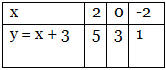
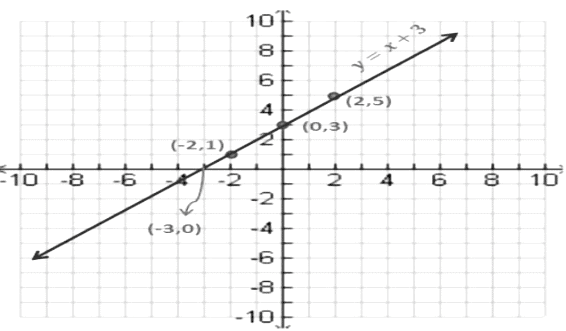 Here, we can see that the graph of a linear polynomial is a straight line.
The graph of y = x + 3 intersects the x - axis at x = -3
Thus, -3 is the zero of the linear polynomial, y = x + 3.
Therefore, the zero of the polynomial, x + 3 is the x -coordinate of the point where the graph of y = x + 3 intersects the x-axis.
- For a linear polynomial ax + b, where a ≠ 0, the graph of y = ax + b is a straight line that intersects the x-axis at exactly one point, that is, (-b/a, 0)
- Therefore, the linear polynomial ax + b has exactly one zero, namely the x -coordinate of the point where the graph of y = ax + b intersects the x-axis.
Next, we will study the geometrical meaning of a zero of a quadratic polynomial.
Consider a quadratic polynomial, x2 - 4
First, we will find some values of y = x2 - 4 corresponding to some values of x. If we plot these points on a graph, this is how the graph will look like.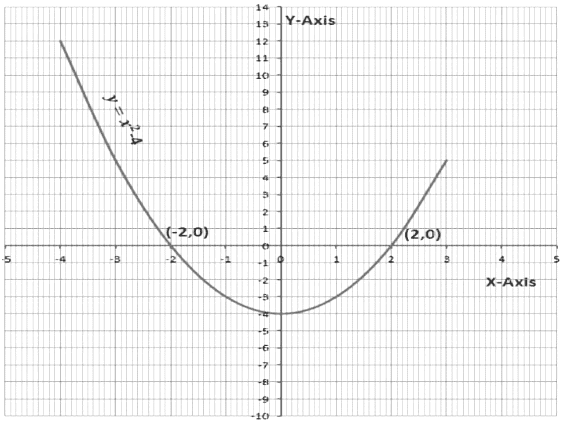
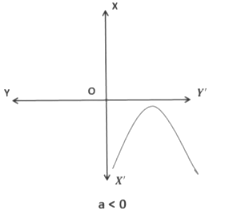
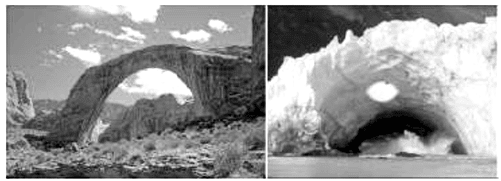
For that matter, any quadratic polynomial y = ax2 + bx + c, where a ≠ 0 the graph will have either one of the two shapes depending on the value of a
i) If a > 0, then the shape is open upwards. ii) If a < 0, then the shape is open downwards
 These curves are called parabolas.
If we see the graph, then -2 and 2 are the points on the x- axis where the graph of y = x2 - 4 intersects the x-axis.
Therefore -2 and 2 are the zeroes of the polynomial x2 - 4.
The zeroes of a quadratic polynomial ax2 + bx + c, a ≠ 0 are the x - coordinates of the point, where the parabola representing y = ax2 + bx + c intersects the x - axis.
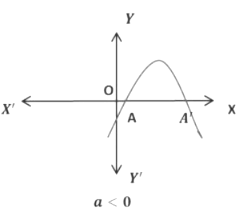
According to the shape of the graph of y = ax2 + bx + c, the following cases may arise.
Case 1:
In this case, the graph intersects the x-axis at two distinct points A and A′, then the x- coordinates of A and A′are the two zeroes of the quadratic polynomial ax2 + bx + c.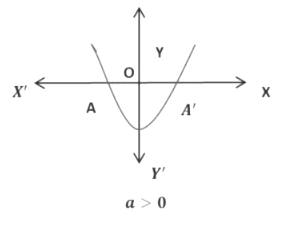
Case 2:
In this case, the graph cuts the x - axis at exactly one point. Therefore, the two points A and A′of Case 1 coincide here to become one point A.
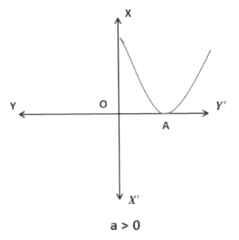
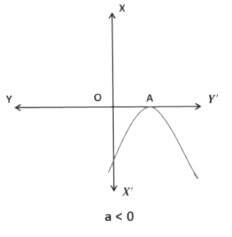 Here, the x- coordinate of A is the only zero for the quadratic polynomial, ax2 + bx + c.
Case 3:
In the third case, the graph is either completely above x-axis or completely below x-axis. Therefore, the graph does not intersect the x-axis at any point. Thus, the quadratic polynomial has no zero.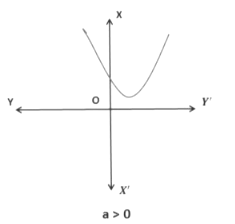
So, after studying all the cases we can see that a quadratic polynomial can have,
- Two distinct zeroes ( shown in case 1)
- Two equal zeroes or one zero ( shown in case 2)
- No zero (shown in case 3)
Therefore, geometrically we can see that a quadratic polynomial can have either two distinct zeroes or two equal zeroes that are one zero or no zero. Thus a quadratic polynomial of degree 2 has at most 2 zeroes.
Now we will study the geometrical meaning of the zeroes of a cubic polynomial. Consider a cubic polynomial x3 - 4x. First, we will find some values of y corresponding to a few values of x. If we plot these points on the graph, the graph will look like this,
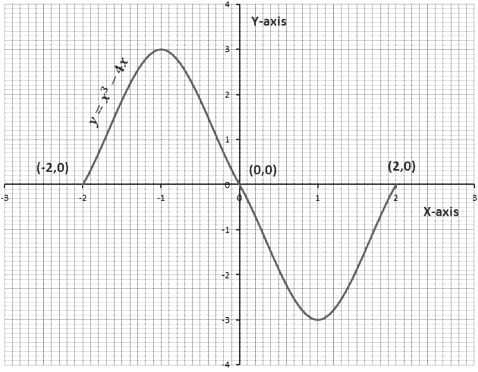 If we observe the graph, we see that -2, 0 and 2 are the x-coordinate of the points where the graph of y = x3 - 4x intersect the x-axis. Thus -2, 0 and 2 are the zeroes of the cubic polynomial, y = x3 - 4x.
We will draw the graphs of a few more cubic polynomials.
Let us first consider the cubic polynomial, y = x3. We will find a few values of x and y.
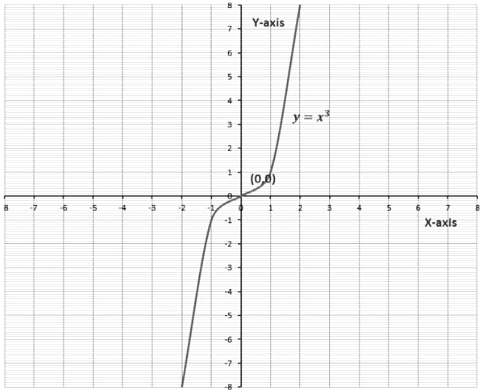 If we observe the graph we see that 0 is the only zero of the cubic polynomial, y = x3 as its graph intersects the x-axis at the origin only.
Now consider one more cubic polynomial, y = x3 - x. We will again find a few values of x and y.

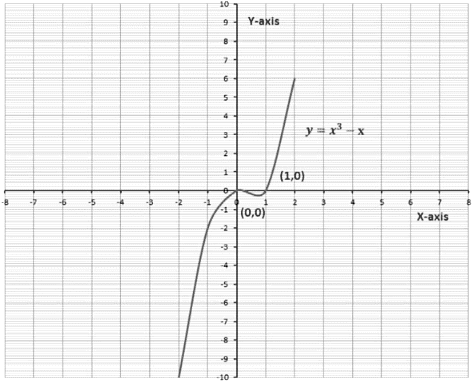 Now, we can see in the graph that 0 and 1 are the two zeroes of the cubic polynomial, y = x3 - x as its graph is intersecting the x-axis at (0, 0) and (1, 0).
Therefore, any cubic polynomial can have at most 3 zeroes.
Example 6: The graph of y = p(x) is given, for some polynomials p(x). Find the number of zeroes of p(x) in each case.
Sol:
(a)
This is a graph of a quadratic polynomial. As the graph of y = p(x) does not intersect the x - axis at any point. Thus, it has no zero.
(b)This is again a graph of a quadratic polynomial. Here, the graph of y = p(x) intersects the x- axis at two points. Hence the number of zeroes is 2.
(c)
This is a graph of a linear polynomial. The number of zeroes is 1. As the graph of y = p(x) is intersecting the x-axis at one point only.
(d)The given graph is of a cubic polynomial. Here the polynomial y = p(x) is intersecting the x - axis at 3 points. Therefore, the number of zeroes is 3.
Example 7: Which of the following is not the graph of a cubic polynomial?
Sol:
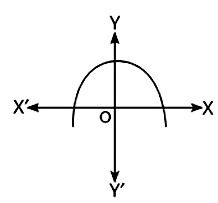
Option d) is not the graph of a cubic polynomial. It is a graph of a quadratic polynomial, as the graph is in the shape of a parabola which is opening downwards.
Try yourself: Which of the following polynomials represents a geometric shape that has no intercept with the x-axis?
The discriminant helps us to find the number of zeros (or the number of times the quadratic equation cuts the x-axis). Thus, to find the x-axis intercept, we will find the equation which has discriminant equal to 0.
The polynomial x2 + 4x + 5 has discriminant Δ = 42 - 4 · 1 · 5 = 16 - 20 = -4, which is less than zero.
Therefore, its graph is a parabola that opens upwards and has no real x-axis intercepts.
Also read: Worksheet: Polynomials |
Relationship between Zeroes and Coefficients of a Polynomial
We know that a quadratic polynomial is of the form ax2 + bx + c. A quadratic polynomial can have at the most two zeroes.
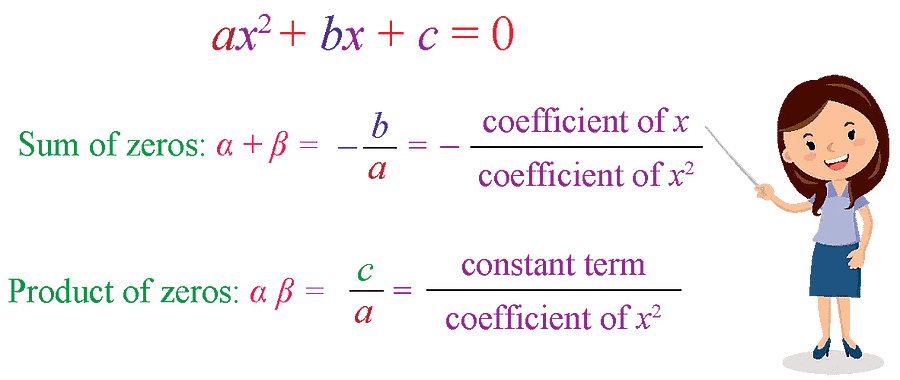 Sum and Product of ZeroesIn general, if α and β are the zeroes of the quadratic polynomial p(x) = ax2 + bx + c, a ≠ 0, then x - α and x - β are the actors of the p(x). Therefore,
ax2 + bx + c = k (x - a) (x - β)
= k(x2 - xβ - ax + aβ)
= [x2 - (β + a)x + aβ)
= kx2 - k (β + a)x + kaβ
Now, comparing the coefficients of x2, x and constant terms on both sides, we get
a = k, b = -k(β + a), c = kaβ
(a + β) = -b/k
Now k = a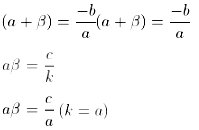
Sum of zeroes(α + β)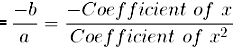
Product of zeroes(αβ)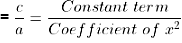
Example 8: If one zero of 2x2 - 3x + k is reciprocal to the other, then find the value of k.
Sol:
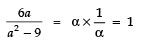
Let one zero be α, then the other zero will be 1/a
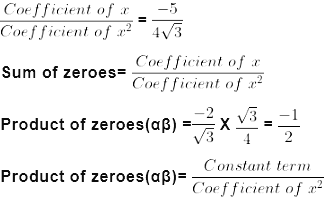
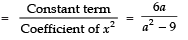
We know that, Product of zeroes(αβ) = c/a = Constant term / Coefficient of x2
= c/a = k/2
K= 2
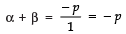
Example 9: If α and β are zeroes of the polynomial x2 - p(x + 1) + d such that (α + 1)(β + 1) = 0, then find the value of d.
Sol:
The given polynomial is x2 - p(x + 1) + d
x2 - px - p + d
Comparing the above equation with ax2 + bx + c, we get
a = 1, b = -p, c = -p + d
α and β are the zeroes of the polynomial x2 - px - p + d
Sum of zeroes(α + β)
Product of zeroes(αβ)
(α + 1)(β + 1) = 0 (given)
αβ + α + β + 1 = 0
Putting (α + β) = p and (αβ) = d - p in the above equation we get,
d - p + p + 1 = 0
d + 1 = 0
d = -1


Example 10: Form a quadratic polynomial, whose one zero is 7 and the product of zeroes is -56.
Sol:
Let the zeroes be α and β.
It is given that the value of one zero is 7, then let us assume that α = 7
Product of zeroes = αβ = 7β
Now, 7β = -56
β = -8
∴ α = 7 and β = -8
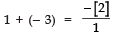
(α + β) = 7 - 8 = -1
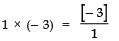
(αβ) = 7 × (-8) = -56
We know that a quadratic polynomial isx2 -(sum of zeroes)x + product of zeroes
x2 - (α + β)x + (αβ)
Putting (α + β) = -1 and (αβ) = -56
x2 + x - 56
Example 11: If the zeroes of the polynomial x2 + px + q are double in value of the zeroes of 2x2 - 5x - 3, then find the value of p and q.
Sol:
Let α and β be the zeroes of 2x2 - 5x - 3.
Sum of zeroes(α + β) =-ba
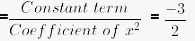
Product of zeroes(αβ) = c/a =
As the zeroes of x2 + px + q are double in value. Therefore, 2α and 2β are the zeroes of x2 + px + q
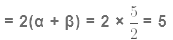
Sum of zeroes(2α + 2β) = 2(α + β)
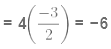
Product of zeroes(2α × 2β) = 4αβ
We know that a quadratic polynomial is x2 -(sum of zeroes)x + product of zeroes
∴ x2 - (2α + 2β)x + (2α × 2β)
x2 - 5x - 6
Comparing the above equation with x2 + px + q, we get
p = -5, q = -6

Example 12: Find the zeroes of the quadratic polynomial, 4√3x2 + 5x - 2√3 and verify the relationship between the zeroes and the coefficients.
Sol:
Letp(x) = 4√3x2 + 5x - 2√3
By splitting the middle term we get,
p(x) = 4√3x2 + 5x - 2√3
p(x) = 4√3x2 + (8 - 3)x - 2√3
p(x) = 4√3x2 + 8x - 3x - 2√3
p(x) = 4x(√3x + 2) - √3(√3x + 2)
p(x) = (√3x + 2)(4x - √3)
The value of 4√3x2 + 5x - 2√3 is zero, when x =-2/√3 and x = √3/4
Therefore, the zeroes of 4√3x2 + 5x - 2√3 are x = -2/√3 and x = √3/4
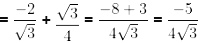
Sum of zeroes(α + β)
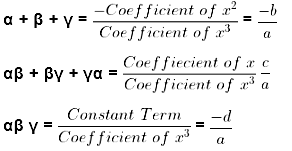
Let α, β, γ be the zeroes of a cubic polynomial
ax3 + bx2 + cx + d
x3 -(sum of zeroes)x2 + (sum of the product of zeroes taking two at a time)x - product of zeroes
x3 +( α + β + γ)x2 + (αβ + βγ + γα)x - αβ γ
Example 13: If two zeroes of the polynomial f(x) = x3 - 4x2 - 3x + 12 are √3 and -√3, then find its third zero.
Sol:
Let α and β be the two roots of the polynomial,
x3 - 4x2 - 3x + 12
Then α = √3 and β = - √3,
√3 - √3 + y = -(4)/1 = 4
γ = 4
Therefore the third zero is 4.

Example 14: If zeroes of the polynomial f(x) = x3 - 3x2 + x + 1 are a - b, a and a + b, then find a and b.
Sol:
Now, a - b, a, and a + b are zeroes of the cubic polynomial
Let α = a - b, β = a and γ = a + b
We know that,
a - b + a + a + b = -(3)/1 = 3
3a = 3 , a = 1
(a - b)a(a + b) = -(1)/1 = -1
a(a2 - b2) = -1
Putting a = 1 in the above equation
1(1 - b2) = -1
(1 - b2) = -1
b2 = 2
b = ±√2

Try yourself: If the sum of the roots of a quadratic equation is 4 and the product of the roots is 3, then what is the equation?
Using the relation that a quadratic with roots α and β can be written as
x² - (α+β)x + (αβ) = 0, and given the sum of roots is 4 and the product is 3,
we substitute to get x² - 4x + 3 = 0.
This factorises to (x - 1)(x - 3) = 0, giving roots 1 and 3 whose sum is 4 and product is 3, matching the condition. Hence, the required equation is x² - 4x + 3 = 0 (Option A).
Short Answer Type Questions
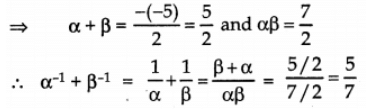
Q1: If a and b are roots of the equation x2 + 7 x + 7 . Find the value of a-1 + b-1 - 2αb.
Q2: If the zeroes of the quadratic polynomial x2 + (α + 1 ) x + b are 2 and -3, then find the value of a and b.
Q.3. If a and b are zeroes of the polynomial f (x) = 2x2 - 7x + 3, find the value of α2 + b2.
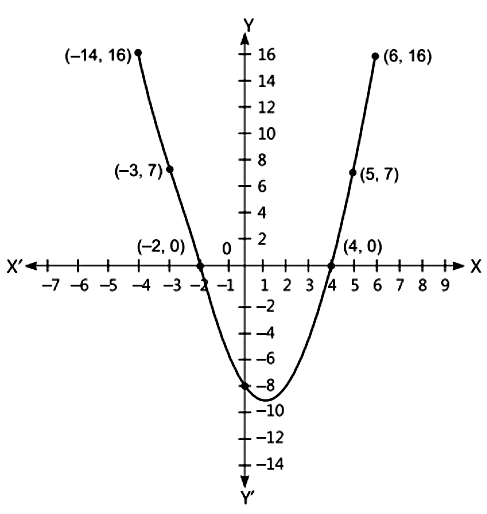
Q.4: Find the zeroes of the quadratic polynomial x2 + x - 12 and verify the relationship between the zeroes and the coefficients.
Q5: If p and q are zeroes of f (x) = x2 - 5x + k, such that p - q = 1 , find the value of k.
Q6: Given that two of the zeroes of the cubic polynomial αx3 + bx2 + cx + d are 0, then find the third zero.
Q.7. If one of the zeroes of the cubic polynomial x3 + αx2 + bx + c is -1, then find the product of the other two zeroes.
Q8: If a-b, a a+b , are zeroes of x3 - 6x2 + 8x , then find the value of b
Q9: Quadratic polynomial 4x2 + 12x + 9 has zeroes as p and q . Now form a quadratic polynomial whose zeroes are p - 1 and q - 1
Long Answer Type Questions
Q10: p and q are zeroes of the quadratic polynomial x2 - (k + 6 ) x + 2(2 k - 1) . Find the value of k if 2(p + q) = p q
Q11: Given that the zeroes of the cubic polynomial x3 - 6 x2 + 3 x + 10 are of the form a, a + b, a + 2b for some real numbers a and b, find the values of a and b as well as the zeroes of the given polynomial.
Q12: If one zero of the polynomial 2x2-5x-(2k + 1) is twice the other, find both the zeroes of the polynomial and the value of k.
Q.13: Using division show that 3y2 + 5 is a factor of 6y5 + 15y4 + 16y3 + 4y2 + 10y - 35 .
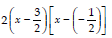
Q14: If (x - 2) and [x - 1/2 ] are the factors of the polynomials qx2 + 5x + r prove that q = r.
Q15: Find k so that the polynomial x2 + 2x + k is a factor of polynomial 2x4 + x3 - 14x2 + 5x + 6. Also, find all the zeroes of the two polynomials.
Important Definitions
1. Polynomials
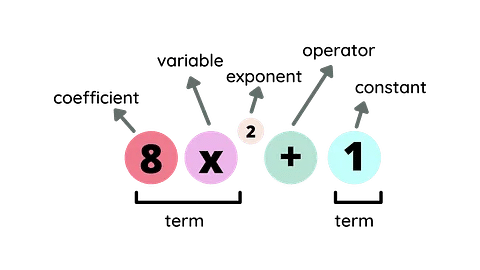
An algebraic expression of the form p(x) = a₀ + a₁ x + a₂ x2 + a₃ x3 + ...... + an xn, in which the variables involved have only non-negative integral exponents, is called a polynomial in x of degree n.
 Polynomial
Note:
In the polynomial a₀ + a₁ x + a₂ x2 + a₃ x3 + ...... + an xn
a₀, a₁ x, a₂ x2, a₃ x3 ..... an - 1 xn - 1, anxn are terms.
a₀, a₁, a₂, ..... an - 1, an are the co-efficients of x0, x1, x2, ....., xn-1, xn respectively.
| Get additional INR 200 off today with EDUREV200 coupon. | Avail Offer |
2. Degree of a Polynomial
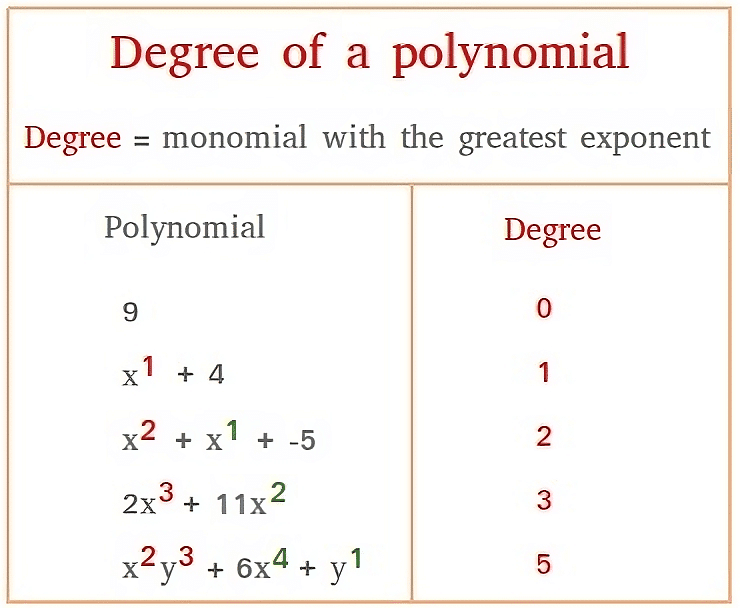
The highest power of the variable in a polynomial is called its degree.
 Example:
5x + 3 is a polynomial in x of degree 1.
p(y) = 3y2 + 4y - 4 is a polynomial in y of degree 2.
- Linear Polynomial: A polynomial of degree 1 is called a linear polynomial. A linear polynomial is generally written as ax + b (a ≠ 0), where a, and b are real coefficients.
- Quadratic Polynomial: A polynomial of degree 2 is called a quadratic polynomial. A quadratic polynomial is generally written as ax2 + bx + c (a ≠ 0), where a, b and c are real coefficients.
- Cubic Polynomial: A polynomial of degree 3 is called a cubic polynomial. A cubic polynomial is generally written as ax3 + bx2 + cx + d (a ≠ 0), where a, b, c and d are real coefficients.
Examples: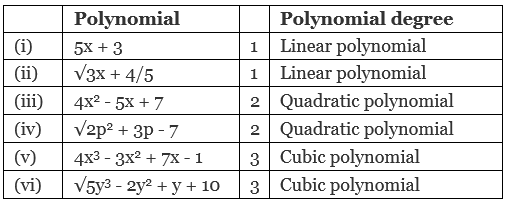
Try yourself: The degree of the polynomial, x4 – x2 +2 is
Degree is the highest power of the variable in any polynomial. In the equation given, it is 4.
Value of a Polynomial at a Given Point
If p (x) is a polynomial in x and 'a' is a real number. Then the value obtained by putting x = a in p (x) is called the value of p (x) at x = a.
Example: Let p(x) = 5x2 - 4x + 2 then its value at x = 2 is given by
p(2) = 5 (2)2 - 4 (2) + 2 = 5 (4) - 8 + 2 = 20 - 8 + 2 = 14
Thus, the value of p(x) at x = 2 is 14.
Also read: PPT: Polynomials |
3. Zeroes of a Polynomial
A real number 'a' is said to be a zero of the polynomial p (x), if p (a) = 0.
Example: Let p (x) = x2 - x - 2 Then p (2) = (2)2 - (2) - 2 = 4 - 4 = 0,
and p (-1) = (-1)2 - (-1) - 2 = 2 - 2 = 0
∴ (-1) and (2) are the zeroes of the polynomial x2 - x - 2.
Note:
I. A linear polynomial has at the most one zero.
II. A quadratic polynomial has at the most two zeroes.III. In general a polynomial of degree n has at the most n zeroes.
4. Geometrical Meaning of the Zeroes of a Polynomial
First, we consider a linear polynomial p (x) = ax + b.Let 'k' be a zero, then p(k) = ak + b = 0
⇒ ak + b = 0
⇒ ak = - b or
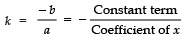
The graph of a linear polynomial is always a straight line. It may or may not pass through the x-axis. In case the graph line is passing through a point on the x-axis, then the y-coordinate of that point must be zero. In general, for a linear polynomial ax + b = 0, (a ≠ 0), the graph is a straight line that can intersect the x-axis at exactly one point, namely, 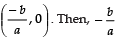 is the zero of the polynomial ax + b.
In the given figure, CD is meeting x-axis at x = -1.
∴ Zero of ax + b is -1.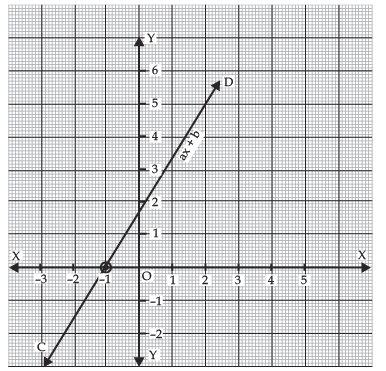
Note:
A zero of a linear polynomial is the x-coordinate of the point, where the graph intersects the x-axis.
Try yourself: What is the geometrical interpretation of the zeroes of a polynomial?
The correct answer is B. The zeroes of a polynomial are the values of the variable that make the polynomial equal to zero. Geometrically, the zeroes of a polynomial are the points where the polynomial intersects the x-axis of the coordinate plane. At these points, the value of the polynomial is zero, indicating that the graph of the polynomial is crossing the x-axis. Therefore, option B is the correct interpretation of the zeroes of a polynomial. Option A is incorrect because the points where the polynomial intersects the y-axis are not necessarily the zeroes of the polynomial. Options C and D are also incorrect as they do not relate to the zeroes of the polynomial.
| Attention! Sale expiring soon, act now & get EduRev Infinity at 40% off! | Claim Offer |
Important Methods and Formulas
1. Graph of a Quadratic Polynomial
The graph of ax2 + bx + c, (a ≠0) is a curve of ∪ shape, called a parabola.
- If a > 0 in ax2 + bx + c, the shape of the parabola is ∪ (opening upwards).
- If a < 0 in ax2 + bx + c, the shape of the parabola is ∩ (opening downwards).
In the given figure, the graph of a quadratic polynomial x2 - 3x - 4 is shown. It intersects x-axis at (-1, 0) and (4, 0). Therefore, its zeroes are -1 and 4. Here, a > 0, so the graph opens upwards.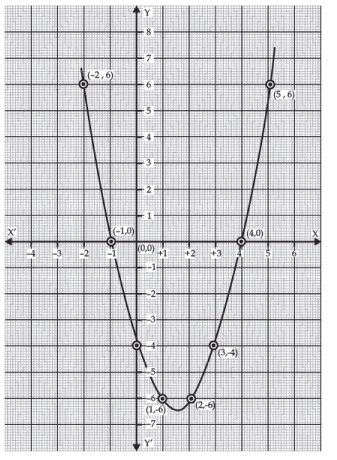
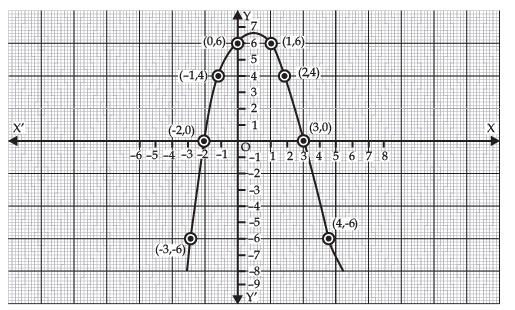
Whereas the following figure is a graph of the polynomial - x2 + x + 6. Since it intersects the x-axis at (3, 0) and (-2, 0). Therefore, the zeroes of - x2 + x + 6 are -2 and 3.
Here a < 0, so the parabola opens downwards.
Note: In the case of Quadratic polynomial - at most 2 zeroes, Cubic polynomial - at most 3 zeroes, Biquadratic polynomial - at most 4 zeroes.
Try yourself: What is the shape of a parabola when the value of 'a' is negative in the equation ax2 + bx + c?
The correct answer is (B) ∩ (opening downwards). When the value of 'a' is negative in the quadratic equation ax2 + bx + c, the parabola takes the shape of an inverted 'U' or an upside-down 'V', which is called a downward opening parabola or ∩ shape. On the other hand, when 'a' is positive, the parabola takes the shape of a 'U' or a 'V', which is called an upward opening parabola or ∪ shape. The direction of the opening of the parabola depends on the sign of the leading coefficient 'a'.
Also read: PPT: Polynomials |
2. Relationship between Zeroes and Coefficients of Polynomials
- For a quadratic polynomial,
p(x) = ax2 + bx + c,
Sum of Roots: α + β = -b/a
Product of Roots: αβ = c/a
where α and β are the zeroes of the polynomial p(x) = ax2 + bx + c - For a cubic polynomial,
p(x) = ax3 + bx2 + cx + d,
where α, β and γ are the zeroes of the polynomial p(x) = ax3 + bx2 + cx + d.
Try yourself: What is the quadratic polynomial whose sum and product of zeroes are √2 and 1/3, respectively?
Sum of zeroes = α + β = -b/a = √2
Product of zeroes = α β = c/a = 1/3
The standard form x2−(sum of roots)x + (product of roots) = 0
Substituting the given values:
∴ If α and β are zeroes of any quadratic polynomial, then the polynomial is;
x2– (α + β) x + αβ
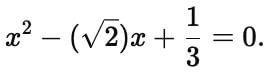
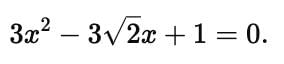
We need to clear the fraction by multiplying the entire equation by 3:
Key Questions
Q1: Find the zeroes of the quadratic polynomial .
Q2: Verify the relationship between zeroes and coefficients of the polynomial .
Q3: Find the value of k if one zero of polynomial is 2.
Q4: Find a quadratic polynomial whose sum and product of zeroes are 5 and 6.
Q5: Find the zeroes of the polynomial .
Q6: Show that the sum of zeroes of is .
Q7: Find the remainder when is divided by .
Q8: Factorise .
Q9: Find a cubic polynomial with zeroes 1, 2 and 3.
Q10: If α and β are zeroes of , find α + β and αβ.
Q11: Divide by .
Q12: Find the polynomial whose zeroes are double of the zeroes of .
Q13: Find the value of k if sum of zeroes of is 3.
Q14: Check whether is a factor of .
Q15: Find the zeroes of the polynomial .
NCERT Solutions: Polynomials (Exercise 2.1 & 2.2)
Exercise 2.1
Q1: The graphs of y = p(x) are given in Fig. 2.10 below, for some polynomials p(x). Find the number of zeroes of p(x), in each case.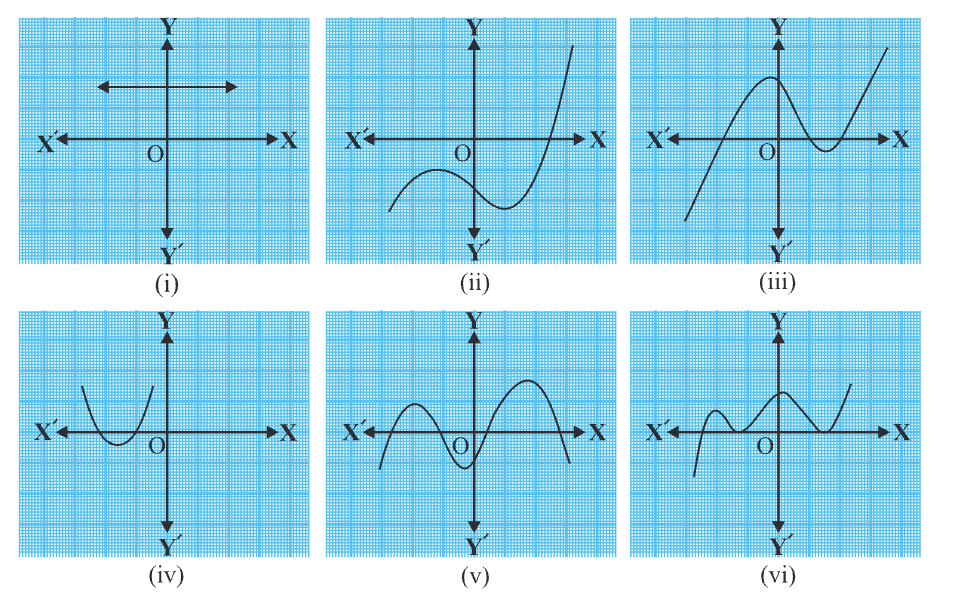
Sol:
Graphical method to find zeroes:
Total number of zeroes in any polynomial equation = total number of times the curve intersects x-axis.
(i) In the given graph, the number of zeroes of p(x) is 0 because the graph is parallel to x-axis does not cut it at any point.
(ii) In the given graph, the number of zeroes of p(x) is 1 because the graph intersects the x-axis at only one point.
(iii) In the given graph, the number of zeroes of p(x) is 3 because the graph intersects the x-axis at any three points.
(iv) In the given graph, the number of zeroes of p(x) is 2 because the graph intersects the x-axis at two points.
(v) In the given graph, the number of zeroes of p(x) is 4 because the graph intersects the x-axis at four points.
(vi) In the given graph, the number of zeroes of p(x) is 3 because the graph intersects the x-axis at three points.
(Exercise 2.2)
Q1: Find the zeroes of the following quadratic polynomials and verify the relationship between the zeroes and the coefficients.
(i) x2-2x -8
Sol: ⇒x2- 4x+2x-8 = x(x-4)+2(x-4) = (x-4)(x+2)
Therefore, zeroes of polynomial equation x2-2x-8 are (4, -2)
Sum of zeroes = 4-2 = 2 = -(-2)/1 = -(Coefficient of x)/(Coefficient of x2)
Product of zeroes = 4×(-2) = -8 =-(8)/1 = (Constant term)/(Coefficient of x2)
(ii) 4s2-4s+1
Sol: ⇒4s2-2s-2s+1 = 2s(2s-1)-1(2s-1) = (2s-1)(2s-1)
Therefore, zeroes of polynomial equation 4s2-4s+1 are (1/2, 1/2)
Sum of zeroes = (½)+(1/2) = 1 = -(-4)/4 = -(Coefficient of s)/(Coefficient of s2)
Product of zeros = (1/2)×(1/2) = 1/4 = (Constant term)/(Coefficient of s2 )
(iii) 6x2-3-7x
Sol: ⇒6x2-7x-3 = 6x2 - 9x + 2x - 3 = 3x(2x - 3) +1(2x - 3) = (3x+1)(2x-3)
Therefore, zeroes of polynomial equation 6x2-3-7x are (-1/3, 3/2)
Sum of zeroes = -(1/3)+(3/2) = (7/6) = -(Coefficient of x)/(Coefficient of x2)
Product of zeroes = -(1/3)×(3/2) = -(1/2) = (Constant term) /(Coefficient of x2 )
(iv) 4u2+8u
Sol: ⇒ 4u(u+2)
Therefore, zeroes of polynomial equation 4u2 + 8u are (0, -2).
Sum of zeroes = 0+(-2) = -2 = -(8/4) = = -(Coefficient of u)/(Coefficient of u2)
Product of zeroes = 0×-2 = 0 = 0/4 = (Constant term)/(Coefficient of u2 )
(v) t2-15
⇒ t2 = 15 or t = ± √15
Therefore, zeroes of polynomial equation t2 -15 are (√15, -√15)
Sum of zeroes =√15 + (-√15) = 0 = -(0/1)= -(Coefficient of t) / (Coefficient of t2)
Product of zeroes = √15 × (-√15) = -15 = -15/1 = (Constant term) / (Coefficient of t2 )
(vi) 3x2-x-4
⇒ 3x2-4x+3x-4 = x(3x-4)+1(3x-4) = (3x - 4)(x + 1)
Therefore, zeroes of polynomial equation3x2 - x - 4 are (4/3, -1)
Sum of zeroes = (4/3)+(-1) = (1/3)= -(-1/3) = -(Coefficient of x) / (Coefficient of x2)
Product of zeroes=(4/3)×(-1) = (-4/3) = (Constant term) /(Coefficient of x2 )
Q2: Find a quadratic polynomial each with the given numbers as the sum and product of its zeroes, respectively.
(i) 1/4 , -1
Sol: From the formulas of sum and product of zeroes, we know,
Sum of zeroes = α+β
Product of zeroes = α β
Sum of zeroes = α+β = 1/4
Product of zeroes = α β = -1
∴ If α and β are zeroes of any quadratic polynomial, then the quadratic polynomial equation can be written directly as:-
x2- (α+β) x + αβ = 0
x2-(1/4)x +(-1) = 0
4x2-x-4 = 0
Thus, 4x2- x - 4 is the quadratic polynomial.
(ii) √2, 1/3
Sol: Sum of zeroes = α + β =√2
Product of zeroes = α β = 1/3
∴ If α and β are zeroes of any quadratic polynomial, then the quadratic polynomial equation can be written directly as:-
x2- (α+β) x + αβ = 0
x2 -(√2)x + (1/3) = 0
3x2-3√2x+1 = 0
Thus, 3x2 - 3√2x + 1 is the quadratic polynomial.
(iii) 0, √5
Sol: Given,
Sum of zeroes = α+β = 0
Product of zeroes = α β = √5
∴ If α and β are zeroes of any quadratic polynomial, then the quadratic polynomial equation can be written directly as:-
x2- (α+β) x + αβ = 0
x2-(0)x +√5= 0
Thus, x2 + √5 is the quadratic polynomial.
(iv) 1, 1
Sol: Given,
Sum of zeroes = α+β = 1
Product of zeroes = α β = 1
∴ If α and β are zeroes of any quadratic polynomial, then the quadratic polynomial equation can be written directly as:-
x2- (α+β) x + αβ = 0
x2-x+1 = 0
Thus, x2 - x + 1 is the quadratic polynomial.
(v) -1/4, 1/4
Sol: Given,
Sum of zeroes = α+β = -1/4
Product of zeroes = α β = 1/4
∴ If α and β are zeroes of any quadratic polynomial, then the quadratic polynomial equation can be written directly as:-
x2- (α+β) x + αβ = 0
x2-(-1/4)x +(1/4) = 0
4x2+x+1 = 0
Thus, 4x2 + x + 1 is the quadratic polynomial.
(vi) 4, 1
Sol: Given,
Sum of zeroes = α+β =4
Product of zeroes = αβ = 1
∴ If α and β are zeroes of any quadratic polynomial, then the quadratic polynomial equation can be written directly as:-
x2- (α+β) x + αβ = 0
x2-4x+1 = 0
Thus, x2- 4x + 1 is the quadratic polynomial.
Unit Test (Solutions): Polynomials
Time: 1 hour
M.M. 30
Attempt all questions.
- Question numbers 1 to 5 carry 1 mark each.
- Question numbers 6 to 8 carry 2 marks each.
- Question numbers 9 to 11 carry 3 marks each.
- Question number 12 & 13 carry 5 marks each.
Q1: Which of the following is NOT a polynomial? (1 Mark)
(a) 2x + 3
(b) 4x2 - 7x + 1
(c) 2√x + 1
(d) x3 - 5x2 + 4x - 7
Ans: (c)
A polynomial is an expression consisting of variables and coefficients, combined using addition, subtraction, and multiplication, where the exponents of variables are whole numbers (non-negative integers). The option 2√x + 1 contains a square root (√) in the expression, making it not a polynomial. All other options are polynomials.
Q2: If a polynomial has exactly three terms, what is it called? (1 Mark)
(a) Monomial
(b) Binomial
(c) Trinomial
(d) Polynomial
Ans: (c)
A polynomial with exactly three terms is called a trinomial. If it has one term, it's a monomial, and if it has two terms, it's a binomial. Any expression with more than three terms is still considered a polynomial.
Q3: What is the degree of the polynomial 2x3 - 5x2 + 7x - 9? (1 Mark)
(a) 2
(b) 3
(c) 4
(d) 1
Ans: (b)
The degree of a polynomial is the highest power of the variable present in the expression. In this case, the highest power of x is 3 (in the term 2x^3), so the degree of the polynomial is 3.
Q4: State whether the following statement is True or False: "A polynomial of degree 0 is called a constant polynomial." (1 Mark)
Ans: True
A polynomial of degree 0 is called a constant polynomial. It is a polynomial with no variable term, and the expression consists only of a constant value.
Q5: Identify the coefficients of the following polynomial: 3x2 - 8x + 5. (1 Mark)
Ans: The coefficients are 3, -8, and 5.
The coefficients of a polynomial are the numerical values multiplied by each variable term. In this case, the coefficients are 3 (multiplied by x^2), -8 (multiplied by x), and 5 (constant term).
Q6: Find the value of 'k' in the polynomial x2 - kx + 9, if one of its zeros is 3. (2 Marks)
Ans: k = 6
If one of the zeros of a polynomial is 3, it means that when x = 3, the polynomial becomes equal to 0. Substituting x = 3 in the given polynomial and solving for 'k':
32 - 3k + 9 = 0
9 - 3k + 9 = 0
-3k + 18 = 0
-3k = -18
k = -18 / -3
k = 6
Q7: Factorize the polynomial completely: 2x3 - 8x2 + 4x. (2 Marks)
Ans: 2x(x2 - 4x + 2)
To factorize the polynomial completely, first, we take out the common factor '2x' from each term:
2x3 - 8x2 + 4x = 2x(x2 - 4x + 2)
The expression (x2 - 4x + 2) cannot be further factorized using integers. So, the polynomial is completely factored as 2x(x2 - 4x + 2).
Q8: If (x + 2) is a factor of the polynomial 2x3 + kx2 - 4x + 16, find the value of 'k'. (2 Marks)
Ans: k = -2
If (x + 2) is a factor of the polynomial, it means that when x = -2, the polynomial becomes equal to 0. Substituting x = -2 in the given polynomial and solving for 'k':
2(-2)3 + k(-2)2 - 4(-2) + 16 = 0
-16 + 4k + 8 + 16 = 0
4k + 8 = 0
4k = -8
k = -8 / 4
k = -2
Q9: If the sum of the zeroes of the polynomial x2 - kx + 15 is 5, find the value of 'k'. (3 Marks)
Ans: k = 5
The sum of the zeroes of the polynomial x2 - kx + 15 is given by the formula: Sum of zeroes = -Coefficient of x / Coefficient of x2.
In this case, the sum of zeroes is 5. So,
5 = -(-k) / 1
5 = k
Therefore, the value of k is 5.
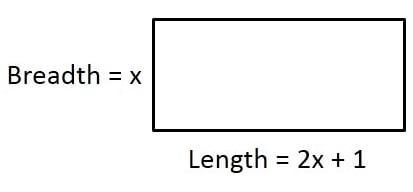
Q10: The area of a rectangular garden is given by the polynomial 2x2 + 7x - 15. Find the dimensions of the garden if its length is 2 units more than its breadth. (3 Marks)
Ans:
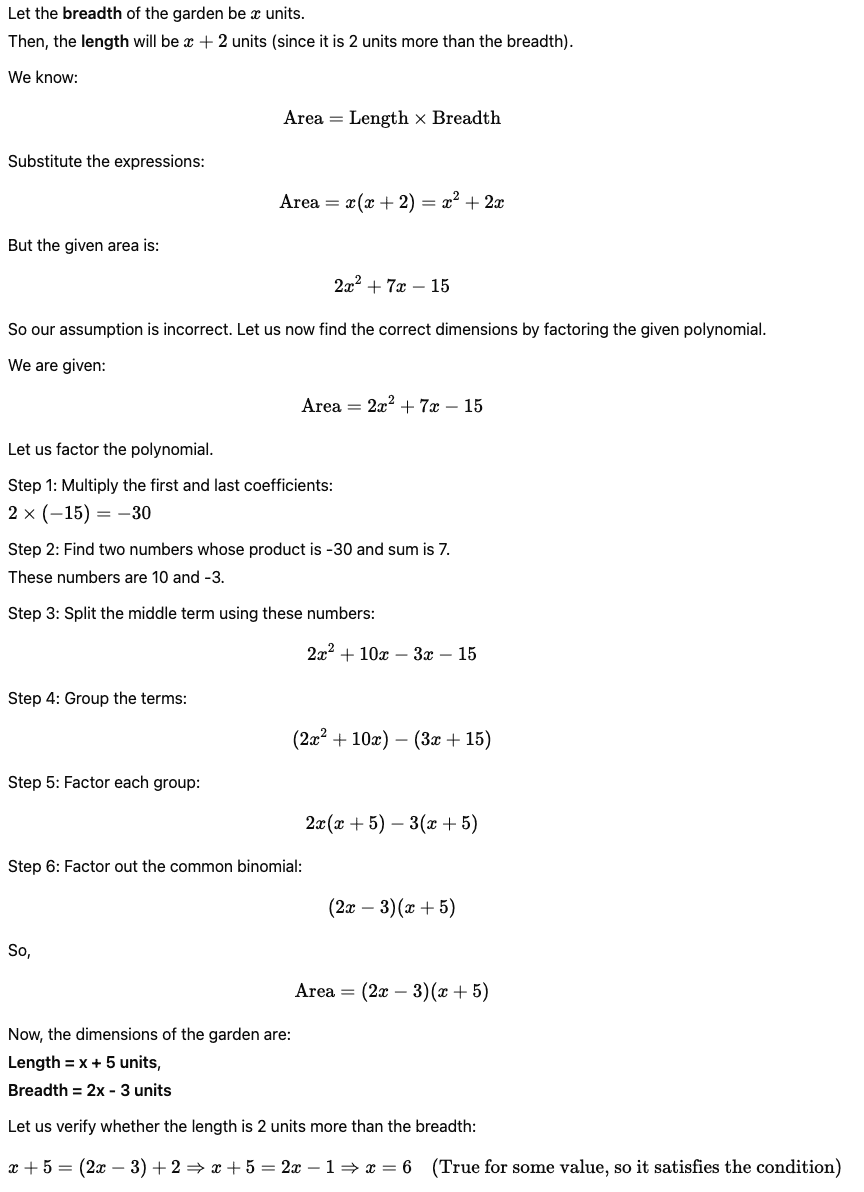
Substitute x=6 back into the dimensions:
Q11: Find the value of 'p' for which (2p - 1) is a factor of the polynomial 4p3 - 6p2 + 3p - 1/2. (3 Marks)
Ans: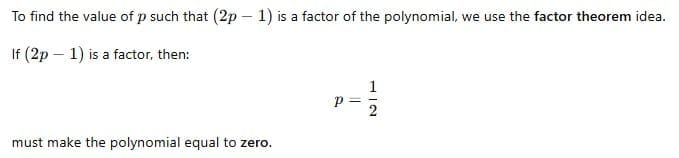
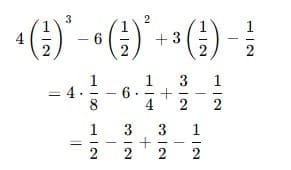

Q12: Find the zeroes of the polynomial 2x2 - 7x + 3 and verify the relationship between zeroes and coefficients. (5 Marks)
Ans: Given polynomial: p(x) = 2x² - 7x + 3
Step 1: Find the zeroes
Factorize the polynomial:
2x² - 7x + 3
= 2x² - 6x - x + 3
= 2x(x - 3) - 1(x - 3)
= (2x - 1)(x - 3)
So, the zeroes are:
2x - 1 = 0 ⇒ x = 1/2
x - 3 = 0 ⇒ x = 3
Step 2: Verify relationship between zeroes and coefficients
For polynomial ax² + bx + c:
a = 2, b = -7, c = 3
Let zeroes be α = 1/2 and β = 3
Sum of zeroes:
α + β = 1/2 + 3 = 7/2
According to formula:
-b/a = -(-7)/2 = 7/2
Hence, verified.
Product of zeroes:
αβ = (1/2) × 3 = 3/2
According to formula:
c/a = 3/2
Hence, verified.
Q13: Find a quadratic polynomial whose zeroes are 3 and -2. Also verify the relationship between the zeroes and the coefficients. (5 Marks)
Ans: Given zeroes: α = 3, β = -2
Step 1: Find the polynomial
Sum of zeroes = α + β = 3 + (-2) = 1
Product of zeroes = αβ = 3 × (-2) = -6
Quadratic polynomial =
x² - (sum)x + (product)
= x² - (1)x + (-6)
= x² - x - 6
Step 2: Verify relationship between zeroes and coefficients
For polynomial ax² + bx + c:
a = 1, b = -1, c = -6
Sum of zeroes:
α + β = 1
According to formula:
-b/a = -(-1)/1 = 1
Hence, verified.
Product of zeroes:
αβ = -6
According to formula:
c/a = -6/1 = -6
Hence, verified.

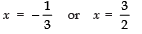
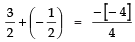
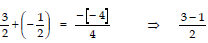
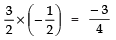
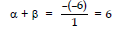
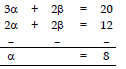
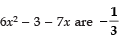 and 3/2.

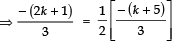
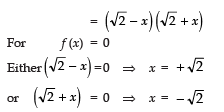
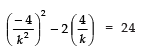
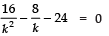
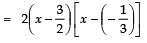

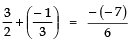

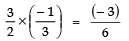

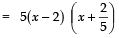

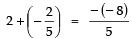

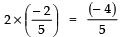

 ⇒ - 6 = 4 × a
 ⇒
⇒ 
 are zeroes of p (x).
 ⇒
⇒ 


: