

Value Based Questions: Polynomials
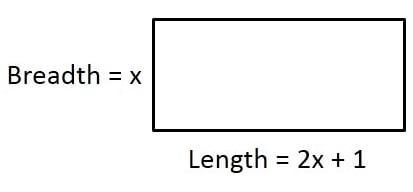
Ques 1: A charity trust decides to build a prayer hall having a carpet area of 300 square metres with its length one metre more than twice its breadth.
(i) Find the length and the breadth of the hall.
(ii) Which mathematical concept is used in the above problem?
(iii) By building a prayer hall, whose value is depicted by the trust?
Sol:
(i) Let the breadth of the hall = x metres
∴ Length of the hall
= 2 [Breadth of the hall] + 1 metre
= (2x + 1) metre
∴ Carpet area of the hall= Length × Breadth
= (2x + 1) × x
= 2x2 + x
But the carpet area of the hall = 300 sq. metre
∴ 2x2 + x = 300
⇒ 2x2 + x - 300 = 0
⇒ 2x2 + 25x - 24x - 300 = 0
⇒ x(2x + 25) -12(2x + 25) = 0
⇒ (x - 12) (2x + 25) = 0
⇒ x - 12 = 0
or 2x + 25 = 0
⇒x = 12
or x = - 252But x = - 252 is not required as the length
or breadth cannot be negative.
∴ x = 12 m and 2x + 1 = (2 × 12) + 1 = 25 m
∴ Breadth of the hall = 12 m
Length of the hall = 25 m
(ii) Quadratic equations
(iii) Enhancing prayer and God fearing feelings.
Q2. Match the following,
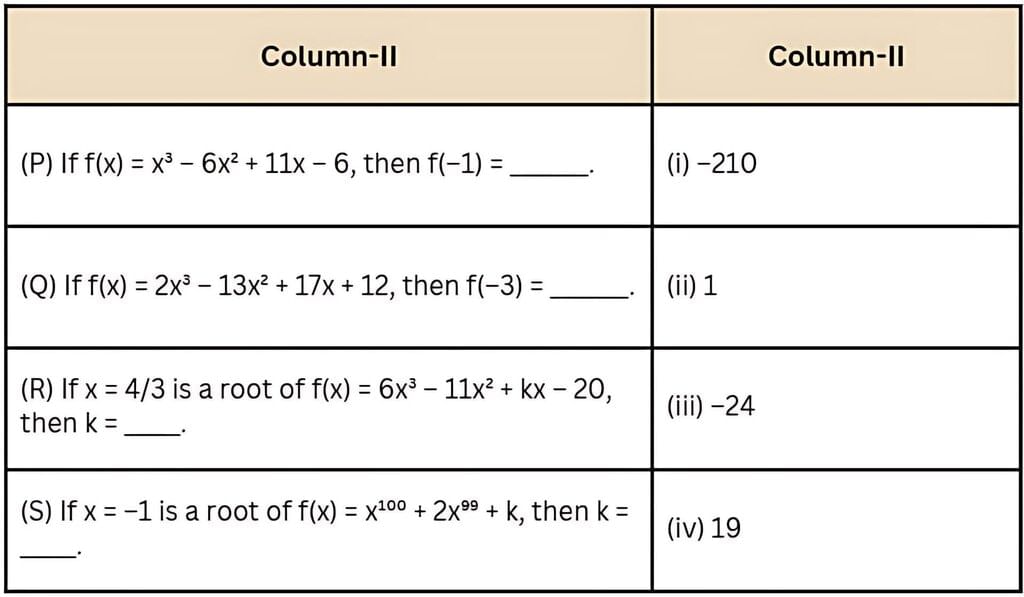
Sol:
(P)
f(x) = x³ - 6x² + 11x - 6.
Find f(-1):
f(-1) = (-1)³ - 6(-1)² + 11(-1) - 6
= -1 - 6 - 11 - 6
= -24.
So, P → -24 (matches (iii)).(Q)
f(x) = 2x³ - 13x² + 17x + 12.
Find f(-3):
f(-3) = 2(-3)³ - 13(-3)² + 17(-3) + 12
= 2(-27) - 13(9) - 51 + 12
= -54 - 117 - 51 + 12
= -210.
So, Q → -210 (matches (i))(R)
Given x = 4/3 is a root of f(x) = 6x³ - 11x² + kx - 20.
A "root" means f(4/3) = 0. Substitute x = 4/3:
6(4/3)³ - 11(4/3)² + k(4/3) - 20 = 0
6·64/27 - 11·16/9 + 4k/3 - 20 = 0
= 128/9 - 176/9 + 4k/3 - 20 = 0
= (-48/9) + 4k/3 - 20 = 0
= (-16/3) + 4k/3 - 20 = 0.
Multiply everything by 3 to clear denominators:
-16 + 4k - 60 = 0 ⇒ 4k - 76 = 0 ⇒ k = 19.
So, R → 19 (matches (iv))
(S)Given x = -1 is a root of f(x) = x¹⁰⁰ + 2x⁹⁹ + k.
So f(-1) = 0:(-1)¹⁰⁰ + 2(-1)⁹⁹ + k = 0
1 - 2 + k = 0 ⇒ k = 1.
So, S → 1 (matches (ii)).
Q3. Santosh has ₹ (x³ - 3x² + 4x + 50). He want to buy chocolates each of cost ₹ (x - 3). After buying maximum number of chocolates with his money, how much money is left with him?
Sol:
Step 1: Understand the question
Total money Santosh has: M = x³ - 3x² + 4x + 50
Cost of 1 chocolate: C = x - 3
We need to find remainder money after buying maximum chocolates. This means we have to divide the total money by the cost of one chocolate and see what is left (the remainder).Step 2: Use polynomial division
We divide x³ - 3x² + 4x + 50 by x - 3.
After using long division method , we get
So, x³ - 3x² + 4x + 50 = (x - 3)(x² + 4) + 62Step 3: Interpret remainder
The remainder 62 is the money left after buying the maximum number of chocolates.
Q4. Area of a rectangular field is (2x³ - 11x² - 4x + 5) sq. units and side of a square field is (2x² + 4) units. Find the difference between their areas (in sq. units).
Sol: Area of the square = (2x² + 4)² = 4x⁴ + 16x² + 16.
Area of the rectangle = 2x³ - 11x² - 4x + 5.
Difference = square area - rectangle area
= (4x⁴ + 16x² + 16) - (2x³ - 11x² - 4x + 5)
= 4x⁴ - 2x³ + 27x² + 4x + 11
Q5. Length, breadth and height of a cuboidal tank are (x - 3y) m, (x + 3y) m and (x² + 9y²) m respectively. Find the volume of the tank.
Sol: Volume = length × breadth × height
= (x - 3y)(x + 3y)(x² + 9y²)
= (x² - 9y²)(x² + 9y²) [using (a - b)(a + b) = a² - b²]
= x⁴ - 81y⁴.
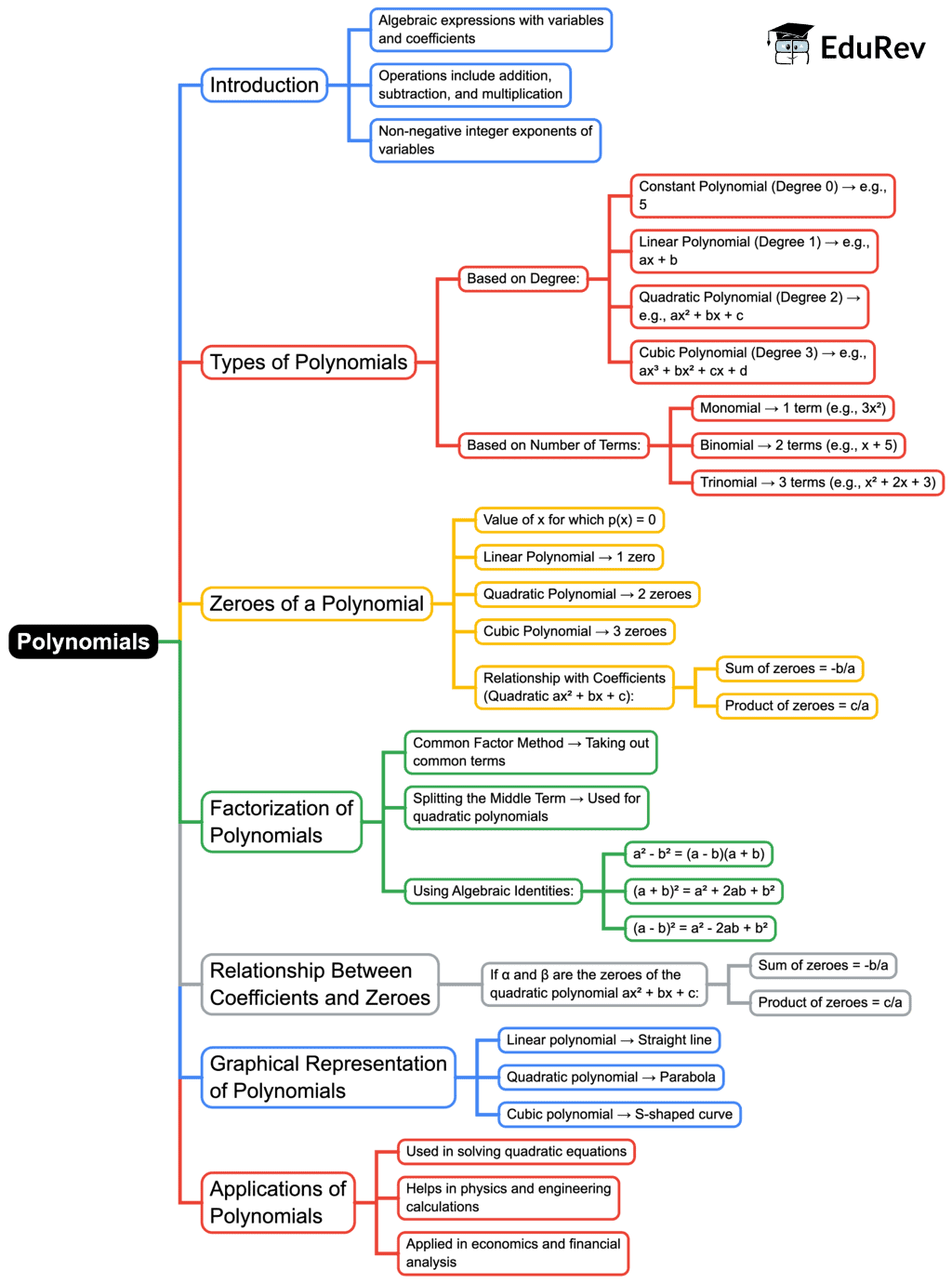
Mind Map: Polynomials
Case Based Questions: Polynomials
Q1: Read the source below and answer the questions that follow:
Ramesh was asked by one of his friends Anirudh to find the polynomial whose zeroes are -2/√3 and √3/4.
He obtained the polynomial by following steps which are as shown below:
Let α = -2/√3 and β = √3/4
Then,
α + β = (-2/√3) + (√3/4) = (-8 + 1) / (4√3) = -7 / (4√3)
and
αβ = (-2/√3) × (√3/4) = -1/2
∴ Required polynomial = x² - (α + β)x + αβ
= x² - (-7/4√3)x + (-1/2)
= x² + (7x/4√3) - 1/2
= 4√3x² + 7x - 2√3
His another friend Kavita pointed out that the polynomial obtained is not correct.
i. Is the claim of Kavita correct? (1 mark)
ii. If given polynomial is incorrect, then find the correct quadratic polynomial. (1 mark)
iii. Find the value of α² + β². (2 mark)
Or
iii. If correct polynomial p(x) is a factor of (x - 2), then find f(2). (2 mark)
Ans:
i. Given, α = -2/√3 and β = √3/4
∴ α + β = (-2/√3) + (√3/4) = (-8 + 3) / 4√3 = -5 / 4√3
and αβ = (-2/√3) × (√3/4) = -1/2
Yes, because value of (α + β) calculated by Anirudh is incorrect.
ii. Required polynomial = k(x² - (α + β)x + αβ)
k(x² + (5x/4√3) - 1/2)
= (k/4√3)(4√3x² + 5x - 2√3)
= (4√3x² + 5x - 2√3) where k = 4√3
iii. α² + β² = (α + β)² - 2αβ
= (-5/4√3)² - 2 × (-1/2)
= 25/48 + 1 = 73/48
Alternate method:
α² + β² = (-2/√3)² + (√3/4)²
= 4/3 + 3/16 = 64/48 + 9/48 = 73/48
Or
iii. We have, p(x) = 4√3x² + 5x - 2√3
Since, p(x) is a factor of (x - 2), then
p(2) = 4√3(2)² + 5(2) - 2√3
= 16√3 + 10 - 2√3 = 14√3 + 10
Hence, remainder is 14√3 + 10.
 | Get additional INR 200 off today with EDUREV200 coupon. | Avail Offer |
Q2: Read the source below and answer the questions that follow:
A group of school friends went on an expedition to see caves. One person remarked that the entrance of the caves resembles a parabola and can be represented by a quadratic polynomial f(x)= ax2 + bx + c, a# 0, where a, b and c are real numbers. i. Draw a neat labelled figure to show above situation diagrammatically. (1 mark)
ii. If one of the zeroes of the quadratic polynomial (p-1)x² + px + 1 is 4. Find the value of p. (1 mark)
iii. Find the quadratic polynomial whose zeroes are 5 and -12. (1 mark)
iv. If one zero of the polynomial f(x) = 5x² + 13x + m is reciprocal of the other, then find the value of m. (1 mark)
Ans:
i. We have, f(x) = ax² + bx + c, a<0 It means a figure is a shape of parabola which open downwards.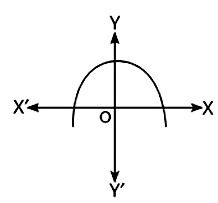 ii. Since, x = 4 is one of the zeros of the polynomial (p - 1)x² + px + 1.
∴ (p - 1)(4)² + p(4) + 1 = 0
⇒ 16p - 16 + 4p + 1 = 0
⇒ 20p = 15
⇒ p = 3/4
iii. Required quadratic polynomial = k [x² - (Sum of zeroes)x + (Product of zeroes)] = k(x²-(-12+5)x+(-12)(5)) = k(x²+7x-60), where k is any arbitrary constant.
iv. Let the zeroes of the quadratic polynomial be α. Since, one zero of the polynomial f(x) is reciprocal of the other.
∴ Product of zeroes = (-1)² × (Constant term / Coefficient of x²)
⇒ α × (1/α) = 1 × (m/5) ⇒ m = 5
Also read: Mind Map: Polynomials |
Q3: Read the source below and answer the questions that follow:
A student was given a task to prepare a graph of quadratic polynomial p(x)=-8-2x+x². To draw this graph, he take seven values of y corresponding to different values of x. After plotting the points on the graph paper with suitable values, he obtain the graph as shown below.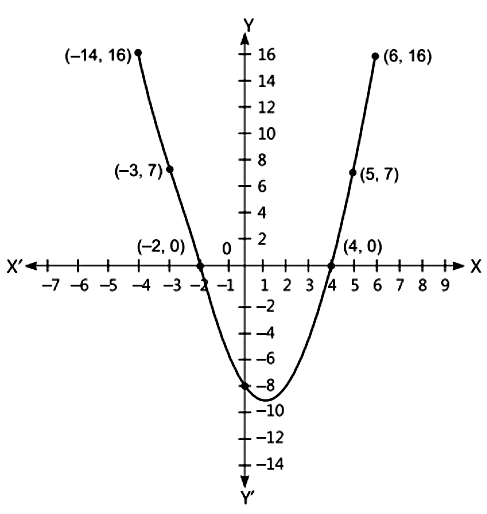 i. What is the shape of graph of a quadratic polynomial? (1 mark)
ii. Find the zeroes of given quadratic polynomial. (1 mark)
iii. The graph of the given quadratic polynomial cut at which points on the X-axis? (1 mark)
iv. The graph of the given quadratic polynomial cut at which point on Y-axis? (1 mark)
Ans:
i. The graph of a quadratic polynomial is a parabola which open upwards.
ii. The zeroes of the quadratic polynomial p(x) = -8 -2x + x² are x-coordinates of the points where the graph intersects the X-axis. From the given graph, -2 and 4 are the x-coordinates of the points where the graph of p(x)=-8-2x+x² intersects the X-axis. Hence, -2 and 4 are zeroes of p(x)=-8-2x+x².
iii. The graph of the given quadratic polynomial cut X-axis at points (-2, 0) and (4,0).
iv. The graph of the given quadratic polynomial cut Y-axis at point (0, -8).
 | Attention! Sale expiring soon, act now & get EduRev Infinity at 40% off! | Claim Offer |
Q4: Read the source below and answer the questions that follow:
Pooja was asked by her friend Arjun to find a polynomial whose zeroes are 3/√2 and -√2/5. She performed the following steps: Let α = 3/√2 and β = -√2/5. Then, α + β = 3/√2 + (-√2/5) = (15 - 2)/(5√2) = 13/(5√2) and αβ = 3/√2 × (-√2/5) = -3/5. Thus, the polynomial obtained is x² - (α + β)x + αβ = x² - 13x/(5√2) - 3/5 = 5√2x² - 13x - 3√2. However, her friend Neha pointed out an error in her solution.i. Is Neha correct in her claim? (1 mark)
ii. If the polynomial is incorrect, find the correct polynomial. (1 mark)
iii. Find the value of α² + β². (1 marks)
iv. If the correct polynomial q(x) is a factor of (x+3), find q(-3). (1 marks)
Ans:
i. Yes, Neha is correct.
The sum of roots should be α + β = 3/√2 + (-√2/5) = (15 - 2)/(5√2) = 13/(5√2),
which is correct, but the final polynomial calculation by Pooja is incorrect.
ii. Correct Polynomial:
p(x) = k(x² - (α + β)x + αβ)
= k(x² - 13x/(5√2) - 3/5)
Multiplying by 5√2 to remove the denominator:
= 5√2x² - 13x - 3√2
where k = 5√2.
iii. Value of α² + β²:
α² + β² = (α + β)² - 2αβ
= (13/(5√2))² - 2(-3/5)
= 169/50 + 6/5
= 169+60/50 = 229/50.
iv. If q(x) = 5√2x² - 13x - 3√2 is a factor of (x + 3):
q(-3) = 5√2(-3)² - 13(-3) - 3√2
= 5√2(9) + 39 - 3√2
= 45√2 + 39 - 3√2
= 42√2 + 39.
Long Questions: Polynomials
Q1: Find the value of "p" from the polynomial x2 + 3x + p, if one of the zeroes of the polynomial is 2.
Ans: As 2 is the zero of the polynomial.
We know that if α is a zero of the polynomial p(x), then p(α) = 0
Substituting x = 2 in x2 + 3x + p,
⇒ 22 + 3(2) + p = 0
⇒ 4 + 6 + p = 0
⇒ 10 + p = 0
⇒ p = -10
Q2: Compute the zeroes of the polynomial 4x2 - 4x - 8. Also, establish a relationship between the zeroes and coefficients.
Ans: Let the given polynomial be p(x) = 4x2 - 4x - 8
To find the zeroes, take p(x) = 0
Now, factorise the equation 4x2 - 4x - 8 = 0
4x2 - 4x - 8 = 0
4(x2 - x - 2) = 0
x2 - x - 2 = 0
x2 - 2x + x - 2 = 0
x(x - 2) + 1(x - 2) = 0
(x - 2)(x + 1) = 0
x = 2, x = -1
So, the roots of 4x2 - 4x - 8 are -1 and 2.
Relation between the sum of zeroes and coefficients:
-1 + 2 = 1 = -(-4)/4 i.e. (- coefficient of x/ coefficient of x2)
Relation between the product of zeroes and coefficients:
(-1) × 2 = -2 = -8/4 i.e (constant/coefficient of x2)
Q3: Find the quadratic polynomial if its zeroes are 0, √5.
Ans: A quadratic polynomial can be written using the sum and product of its zeroes as:
x2 - (α + β)x + αβ
Where α and β are the roots of the polynomial.
Here, α = 0 and β = √5
So, the polynomial will be:
x2 - (0 + √5)x + 0(√5)
= x2 - √5x
Q4: Find the value of "x" in the polynomial 2a2 + 2xa + 5a + 10 if (a + x) is one of its factors.
Ans: Let f(a) = 2a2 + 2xa + 5a + 10
Since, (a + x) is a factor of 2a2 + 2xa + 5a + 10, f(-x) = 0
So, f(-x) = 2x2 - 2x2 - 5x + 10 = 0
-5x + 10 = 0
5x = 10
x = 10/5
Therefore, x = 2
Q5: How many zeros does the polynomial (x - 3)2 - 4 have? Also, find its zeroes.
Ans: Given polynomial is (x - 3)2 - 4
Now, expand this expression.
=> x2 + 9 - 6x - 4
= x2 - 6x + 5
As the polynomial has a degree of 2, the number of zeroes will be 2.
Now, solve x2 - 6x + 5 = 0 to get the roots.
So, x2 - x - 5x + 5 = 0
=> x(x - 1) -5(x - 1) = 0
=> (x - 1)(x - 5) = 0
x = 1, x = 5
So, the roots are 1 and 5.
Q6: α and β are zeroes of the quadratic polynomial x2 - 6x + y. Find the value of 'y' if 3α + 2β = 20.
Ans: Let, f(x) = x² - 6x + y
From the given,
3α + 2β = 20-------(i)
From f(x),
α + β = 6-------(ii)
And,
αβ = y-------(iii)
Multiply equation (ii) by 2. Then, subtract the whole equation from equation (i),
=> α = 20 - 12 = 8
Now, substitute this value in equation (ii),
=> β = 6 - 8 = -2
Substitute the values of α and β in equation (iii) to get the value of y, such as;
y = αβ = (8)(-2) = -16
Q7: Find a quadratic polynomial each with the given numbers as the sum and product of its zeroes, respectively.
(i) 1/4, -1
(ii) 1, 1
(iii) 4, 1
Ans:
(i) From the formulas of sum and product of zeroes, we know,
Sum of zeroes = α + β
Product of zeroes = αβ
Given,
Sum of zeroes = 1/4
Product of zeroes = -1
Therefore, if α and β are zeroes of any quadratic polynomial, then the polynomial can be written as:-
x2 - (α + β)x + αβ
= x2 - (1/4)x + (-1)
= 4x2 - x - 4
Thus, 4x2 - x - 4 is the required quadratic polynomial.
(ii) Given,
Sum of zeroes = 1 = α + β
Product of zeroes = 1 = αβ
Therefore, if α and β are zeroes of any quadratic polynomial, then the polynomial can be written as:-
x2 - (α + β)x + αβ
= x2 - x + 1
Thus, x2 - x + 1 is the quadratic polynomial.
(iii) Given,
Sum of zeroes, α + β = 4
Product of zeroes, αβ = 1
Therefore, if α and β are zeroes of any quadratic polynomial, then the polynomial can be written as:-
x2 - (α + β)x + αβ
= x2 - 4x + 1
Thus, x2 - 4x +1 is the quadratic polynomial.
Q8: Find a quadratic polynomial whose zeroes are reciprocals of the zeroes of the polynomial f(x) = ax2 + bx + c, a ≠ 0, c ≠ 0.
Ans: Let α and β be the zeroes of the polynomial f(x) = ax2 + bx + c.
So, α + β = -b/a
αβ = c/a
According to the given, 1/α and 1/β are the zeroes of the required quadratic polynomial.
Now, the sum of zeroes = (1/α) + (1/β)
= (α + β)/αβ
= (-b/a)/ (c/a)
= -b/c
Product of two zeroes = (1/α) (1/β)
= 1/αβ
= 1/(c/a)
= a/c
The required quadratic polynomial = k[x2 - (sum of zeroes)x + (product of zeroes)]
= k[x2 - (-b/c)x + (a/c)]
= k[x2 + (b/c)x + (a/c)]
Q9: If α and β are zereos of the polynomial 2x2 - 5x + 7, then find the value of α-1 + β-1.
Ans: Here p(x) = 2x2 - 5x + 7
α, β are zeroes of p(x)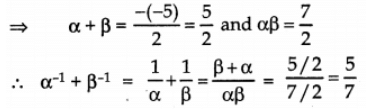
Q10: If p and q are the roots of ax2 - bx + c = 0, a ≠ 0, then find the value of p + q.
Ans: Here, p and q are the roots of ax2 - bx + c = 0.
Sum of roots = -b/a
∴ p + q = -b/a

: