

Short Notes
What are Pair of Linear Equations in Two Variables?
- General form of a linear equation is given by ax + by + c = 0.
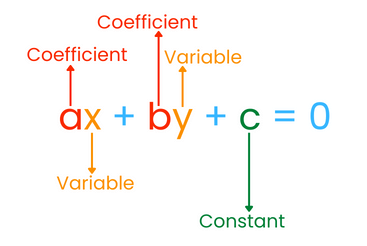
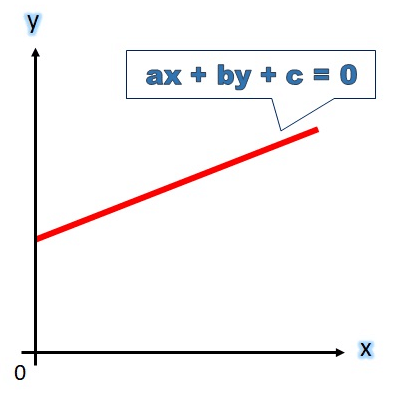
- For any linear equation, each solution (x, y) corresponds to a point on the line.
- The graph of a linear equation is a straight line.
- Two linear equations in the same two variables are called a pair of linear equations in two variables.
- The most general form of a pair of linear equations is:
- A pair of values of variables 'x' and 'y' which satisfy both the equations in the given system of equations is said to be a solution of the simultaneous pair of linear equations.
Try yourself: What is the standard form of a linear equation?
The standard form of a linear equation is ax+by+c=0 where a, b, c are constants and, a and b are not both equal to zero. This form is used to represent a linear equation in two variables x anfd y.
Methods to solve a Pair of Linear Equations in Two Variables
A pair of linear equations in two variables can be represented and solved, by
(i) Graphical method
(ii) Algebraic method
 | Get additional INR 200 off today with EDUREV200 coupon. | Avail Offer |
Graphical Method
The procedure of solving a system of linear equations by drawing the graph is known as the graphical method.
To solve a pair of linear equations in two variables graphically we follow the following steps:
Step 1. Get the given system of linear equations in two variables.
Step 2. Plot the graph of the first equation and then the second equation on the same coordinate system.
Example: Consider two linear equations, y = x -1 and y =2x + 2. Sove these equations with graphical method.
Sol: Let's graph both of these equations on the same set of axes:
Equation 1: y = x -1
For this equation, you can create a table of values and plot some points to draw the line.
| x | 0 | 1 |
| y | -1 | 0 |
Equation 2: y =2x + 2
Again, create a table of values and plot some points:
| x | 0 | 1 |
| y | 2 | 4 |
Now, you can plot these points and draw the lines.
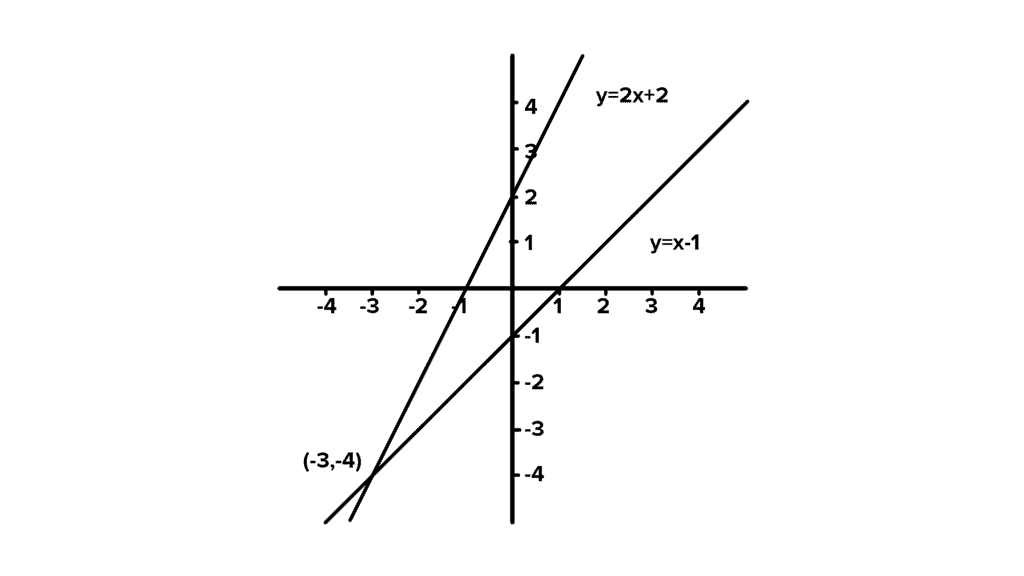
From the graph, we can see the two linear equations intersect at the common point
(-3, -4), which is the solution for the given system of linear equations.
Also read: Assignment: Pair of Linear Equations in Two Variables |
Algebraic Methods
Following are the methods for finding the solutions(s) of a pair of linear equations:
Substitution Method
The substitution method can be defined as a way to solve a linear system algebraically. The substitution method works by substituting one y-value with the other. To put it simply, the method involves finding the value of the x-variable in terms of the y-variable.
The method of substitution involves three steps:
Step 1: First you need to solve one equation for one of the variables.
Step 2: Now you need to substitute (plug-in) this expression into the other equation and solve it.
Step 3: In the last step you need to re-substitute the value into the original equation and you will be able to find the corresponding variable.
Example: Solve for the values of 'x' and 'y': x + y = 5 and 3x + y = 11
Sol: Let's write down the information given,
x + y = 5 ............... Equation (i)
3x + y = 11 ............Equation (ii)
Now let us try to solve them using the method of substitution:
From the first equation we find that we can write y = 5 - x.
Substituting the value of y in the Equation (ii),
we get:
3x + (5 - x) = 11⇒2x = 11 - 5⇒ 2x = 6⇒ x = 6/2.
Therefore, the value of x = 3.
Now substituting the value x = 3 in the other equation that is y = 5 - x,
we get:
y = 5- x
⇒y = 5 - 3
Therefore, we get the value of y = 2.
Hence, the value of x = 3 and the value of y = 2
Elimination Method
The elimination method is one of the most commonly used methods when it comes to solving an equation. You can eliminate one variable so you can solve the equation with ease. It is also called the addition method.
Let's look at how equations can be solved through the elimination method math step by step.
Step 1: The first step is to multiply both the linear equations by a constant on a non-zero value. This would make the coefficients of either of the variables, x or y, numerically equal.
Step 2: The next step is adding or subtracting one equation from the other in a way that one of the variables is easily eliminated. Once you get an equation with one variable, follow the next steps. If you do not get this, then there can be two possibilities:
- If you get a true statement with no variable, then it means that the original equations have infinite solutions.
- If you get a false statement with no variable, then it means that the original equations do not have any solution and are inconsistent.
Step 3: The next step is solving the equation with one variable, either x or y, and you would get the value of that specific value.
Step 4: substituting this value in the previous equation, you would get the value of the other variable as well.
This will help you to solve the elimination method problems.
Example: Solve this set of equations 2x + y = -4 and 5x - 3y = 1 using elimination method.
Sol: The equations given are: 2x + y = -4 ............... (i)
5x - 3y = 1 ............... (ii)
Multiplying equation (i) by 3, you get,
{2x + y = -4} ............... {× 3}
6x + 3y = -12 ............... (iii)
Adding equations (ii) and (iii), you get,
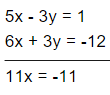
Therefore, x = -11/11
Hence, x = -1
Substituting this value of x = -1 in equation (i), you get,
2 × (-1) + y = -4
-2 + y = -4y = -4 + 2
Hence, y = -2
Therefore, x = -1 and y = -2 is the solution of the set of equations 2x + y = -4 and 5x - 3y = 1
 | Attention! Sale expiring soon, act now & get EduRev Infinity at 40% off! | Claim Offer |
Consistency of System
- Consistent system. A system of linear equations is said to be consistent if it has at least one solution.
- Inconsistent system. A system of linear equations is said to be inconsistent if it has no solution.
Also read: Assignment: Pair of Linear Equations in Two Variables |
Condition for Consistency
Let the two equations be:
a1x + b1y + c1 = 0
a2x + b2y + c2 = 0
Then, 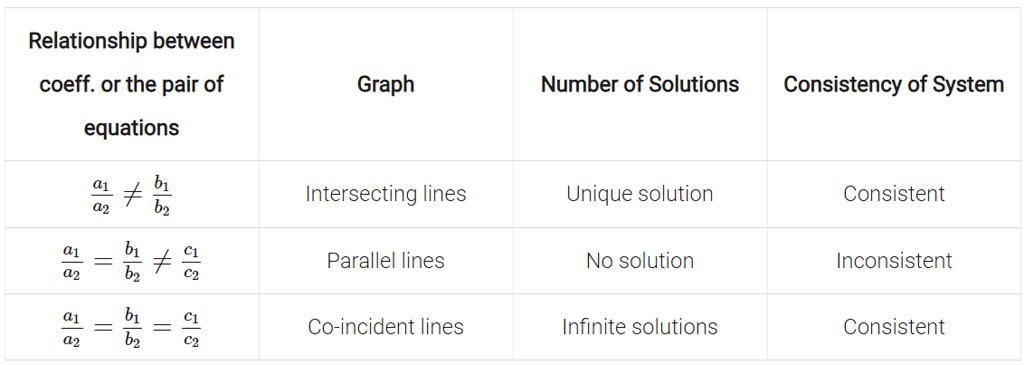
Multiple Choice Questions
Q1. The pairs of equations x + 2y - 5 = 0 and -4x - 8y + 20 = 0 have:
(a) Unique solution
(b) Exactly two solutions
(c) Infinitely many solutions
(d) No solution
Ans. (c) Infinitely many solutions
For a pair of linear equations and , we compare the ratios of coefficients:
This shows:
When the ratios of all corresponding coefficients are equal, the two equations represent the same line. Therefore, the pair of equations has infinitely many solutions.
Q2. If a pair of linear equations is consistent, then the lines are:
(a) Parallel
(b) Always coincident
(c) Always intersecting
(d) Intersecting or coincident
Ans. (d) Intersecting or coincident
A pair of linear equations is consistent when it has at least one solution. The lines can either intersect at exactly one point (unique solution) or coincide completely (infinitely many solutions). In both cases, the system is consistent because the two lines definitely have a common solution.
Q3. The pairs of equations 9x + 3y + 12 = 0 and 18x + 6y + 26 = 0 have:
(a) Unique solution
(b) Exactly two solutions
(c) Infinitely many solutions
(d) No solution
Ans. (d) No solution
Given equations: 9x + 3y + 12 = 0 and 18x + 6y + 26 = 0
Comparing coefficients:
Since , the two equations represent parallel lines. Parallel lines never intersect each other at any point, therefore there is no possible solution. The system is inconsistent.
Q4. If the lines 3x + 2ky - 2 = 0 and 2x + 5y + 1 = 0 are parallel, then what is the value of k?
(a) 4/15
(b) 15/4
(c) 4/5
(d) 5/4
Ans. (b) 15/4
For two lines to be parallel, the condition is:
From the given equations, we have a₁ = 3, b₁ = 2k, c₁ = -2 and a₂ = 2, b₂ = 5, c₂ = 1.
Applying the parallel condition:
Cross-multiplying:
Q5. If one equation of a pair of dependent linear equations is -3x + 5y - 2 = 0, the second equation will be:
(a) -6x + 10y - 4 = 0
(b) 6x - 10y - 4 = 0
(c) 6x + 10y - 4 = 0
(d) -6x + 10y + 4 = 0
Ans. (a) -6x + 10y - 4 = 0
The condition for dependent linear equations (equations representing the same line) is:
For option (a), -6x + 10y - 4 = 0:
Since all three ratios are equal, option (a) represents a pair of dependent linear equations.
Short and Long Questions
Q1. The sum of the digits of a two-digit number is 8 and the difference between the number and that formed by reversing the digits is 18. Find the number.
Let the units digit be x and the tens digit be y.
Original number = 10y + x
Reversed number = 10x + y
According to the first condition:
... (i)
From equation (i): ... (ii)
According to the second condition, the difference between the original and reversed number is 18:
Dividing both sides by 9:
... (iii)
Substituting the value of y from equation (ii) into equation (iii):
From equation (ii):
Therefore, the original number = 10(5) + 3 = 53
Q2. Solve the following pair of linear equations graphically: x + 3y = 6 and 2x - 3y = 12. Also find the area of the triangle formed by the lines representing the given equations with the y-axis.
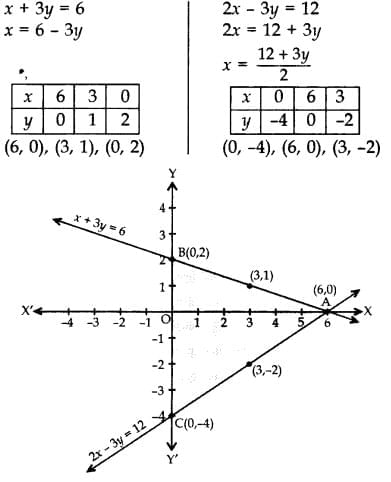
To solve graphically, we first find the coordinates of points on each line.
For the line x + 3y = 6:
When x = 0: 3y = 6, so y = 2. Point: (0, 2)
When y = 0: x = 6. Point: (6, 0)
When x = 3: 3 + 3y = 6, so y = 1. Point: (3, 1)
For the line 2x - 3y = 12:
When x = 0: -3y = 12, so y = -4. Point: (0, -4)
When y = 0: 2x = 12, so x = 6. Point: (6, 0)
When x = 3: 6 - 3y = 12, so y = -2. Point: (3, -2)
The two lines intersect at the point (6, 0), which is the unique solution of the system.
Finding the area of the triangle:
The two lines intersect the y-axis at (0, 2) and (0, -4), and intersect each other at (6, 0).
The triangle is formed by the three vertices: (0, 2), (0, -4), and (6, 0).
Base of triangle (along y-axis) = distance from (0, 2) to (0, -4) = 2 - (-4) = 6 units
Height of triangle (perpendicular distance from y-axis) = 6 units
Area =
Q3. The age of the father is twice the sum of the ages of his 2 children. After 20 years, his age will be equal to the sum of the ages of his children. Find the age of the father.
Let the present ages of his children be x years and y years.
According to the first condition, the present age of the father:
... (i)
After 20 years, the ages will be:
Father's age =
First child's age =
Second child's age =
According to the second condition:
From equation (i), the present age of the father:
Q4. On comparing the ratios a₁/a₂, b₁/b₂, and c₁/c₂, find out whether the following pair of linear equations are consistent or inconsistent.
(i) 3x + 2y = 5 and 2x - 3y = 7
Rewriting in standard form: 3x + 2y - 5 = 0 and 2x - 3y - 7 = 0
Comparing with a₁x + b₁y + c₁ = 0 and a₂x + b₂y + c₂ = 0, we get:
a₁ = 3, b₁ = 2, c₁ = -5
a₂ = 2, b₂ = -3, c₂ = -7
Computing the ratios:
Since , the lines intersect each other at exactly one point and have a unique solution.
Therefore, the equations are consistent.
(ii) 2x - 3y = 8 and 4x - 6y = 9
Rewriting in standard form: 2x - 3y - 8 = 0 and 4x - 6y - 9 = 0
We get: a₁ = 2, b₁ = -3, c₁ = -8
a₂ = 4, b₂ = -6, c₂ = -9
Computing the ratios:
Since , the lines are parallel and do not intersect. The system has no solution.
Therefore, the equations are inconsistent.
Q5. Solve by elimination: 3x = y + 5 and 5x - y = 11
Rewriting the equations in standard form:
... (i)
... (ii)
Subtracting equation (i) from equation (ii):
Substituting x = 3 in equation (i):
Therefore,
Case Based Questions
Scenario 1: Boat Speed Problem
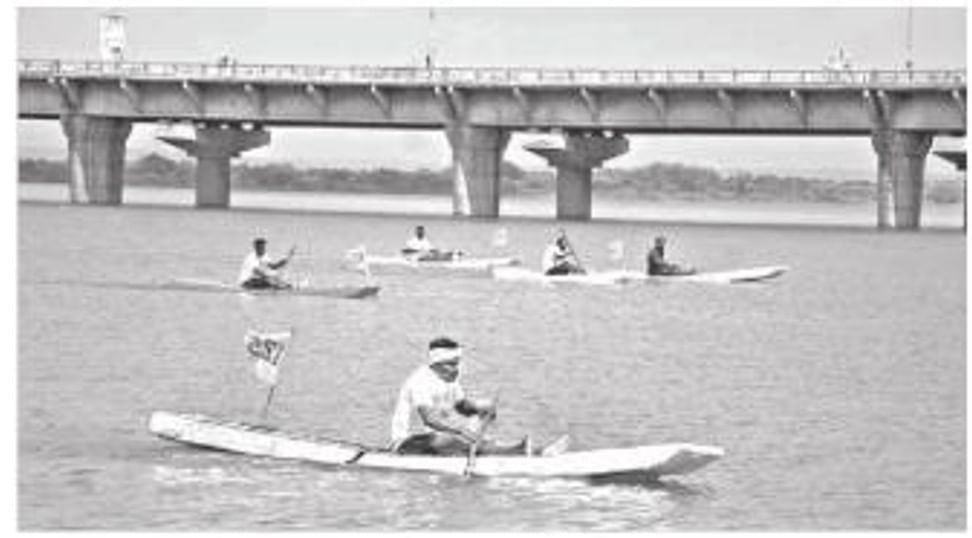
Sanjeev, a student of class X, goes to the Yamuna river with his friends. When he sees a boat in the river, he wants to sit in it. All his friends are ready to sit with him. Sanjeev is sitting in a boat which moves upstream at a speed of 8 km/h and downstream at a speed of 16 km/h. While in the boat, some questions arise in his mind. Answer the given questions based on this information.
Q1. The speed of the boat in still water is:
(a) 8 km/h
(b) 10 km/h
(c) 12 km/h
(d) 14 km/h
Ans. (c) 12 km/h
Let the speed of the boat in still water be x km/h and the speed of the stream be y km/h.
Upstream speed: ... (1)
Downstream speed: ... (2)
Adding equations (1) and (2):
Q2. The speed of the stream is:
(a) 3 km/h
(b) 4 km/h
(c) 6 km/h
(d) 5 km/h
Ans. (b) 4 km/h
From the previous calculation, we have x = 12 km/h (speed of boat in still water).
Using equation (2) from Q1:
The speed of the stream is 4 km/h.
Q3. Which mathematical concept is used in the above problem?
(a) Pair of linear equations
(b) Cross-multiplication method
(c) Factorisation method
(d) None of the above
Ans. (a) Pair of linear equations
The concept of pair of linear equations in two variables has been used in the above problem. We formed two equations with two unknowns (x and y representing the speed of the boat and stream respectively) and solved them simultaneously.
Q4. The direction in which the speed is maximum is:
(a) Upstream
(b) Downstream
(c) Both have equal speed
(d) None of the above
Ans. (b) Downstream
The speed in downstream is (x + y) km/h = 12 + 4 = 16 km/h
The speed in upstream is (x - y) km/h = 12 - 4 = 8 km/h
Since 16 > 8, the downstream speed is greater than the upstream speed. This is because in downstream, the current of the stream aids the motion of the boat, whereas in upstream, the current opposes the motion. Therefore, the direction in which the speed is maximum is downstream.
Q5. The average speed of the stream and boat in still water is:
(a) 8 km/h
(b) 10 km/h
(c) 12 km/h
(d) 5 km/h
Ans. (a) 8 km/h
Speed of boat in still water = x = 12 km/h
Speed of stream = y = 4 km/h
Average speed = km/h
The average speed of the stream and boat in still water is 8 km/h.
Scenario 2: Park Paths Problem
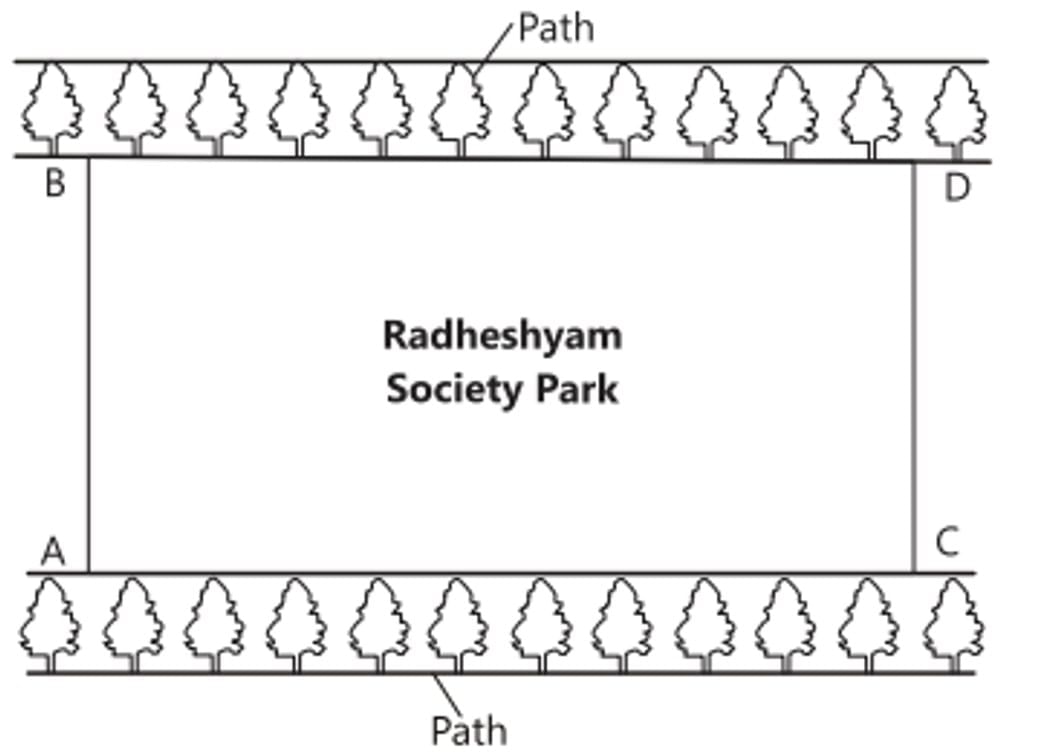
The resident welfare association of Radheshyam society has decided to build two straight paths in their neighbourhood park such that they do not cross each other. They also plan to plant trees along the boundary lines of each path. One of the members, Shyam Lal, suggested that the paths should be constructed as represented by the two linear equations x - 3y = 2 and -2x + 6y = 5. Based on this information, answer the following questions.
Q1. If the pair of equations a₁x + b₁y + c₁ = 0 and a₂x + b₂y + c₂ = 0 has infinitely many solutions, then the condition is:
(a)
(b)
(c)
(d) None of these
Ans. (b)
A pair of linear equations has infinitely many solutions when the two equations represent the same line. This occurs when all the ratios of corresponding coefficients are equal:
In this case, the lines are coincident, and every point on one line also lies on the other, resulting in infinitely many common solutions.
Q2. If a pair of lines are parallel, then the pair of linear equations is:
(a) Inconsistent
(b) Consistent
(c) Consistent or inconsistent
(d) None of the above
Ans. (a) Inconsistent
When two lines are parallel, they never intersect each other. This means the pair of linear equations has no common solution. A system with no solution is called an inconsistent system.
Q3. Check whether the two paths will cross each other or not.
(a) Yes
(b) No
(c) Can't say
(d) None of these
Ans. (b) No
Given equations of paths: x - 3y = 2 and -2x + 6y = 5
Rewriting in standard form: x - 3y - 2 = 0 and -2x + 6y - 5 = 0
Comparing with a₁x + b₁y + c₁ = 0 and a₂x + b₂y + c₂ = 0:
a₁ = 1, b₁ = -3, c₁ = -2
a₂ = -2, b₂ = 6, c₂ = -5
Computing the ratios:
Since , the two paths represented by these equations are parallel. Therefore, the two paths will not cross each other.
Q4. How many point(s) lie on the line x - 3y = 2?
(a) One
(b) Two
(c) Three
(d) Infinitely
Ans. (d) Infinitely
A line is a collection of infinitely many points. Any equation of the form ax + by = c (where a, b, c are constants and a, b are not both zero) represents a straight line in a two-dimensional plane. Since there are infinitely many pairs of values (x, y) that satisfy the equation x - 3y = 2, infinitely many points lie on this line.
Q5. If the line 2x + 6y = 5 intersects the x-axis, then find its coordinate.
(a) (-2.5, 0)
(b) (2.5, 0)
(c) (0, 2.5)
(d) (0, -2.5)
Ans. (b) (2.5, 0)
When a line intersects the x-axis, the y-coordinate at that point is always zero.
Substituting y = 0 in the equation 2x + 6y = 5:
Therefore, the coordinate where the line intersects the x-axis is (2.5, 0).
: