

Previous Year Questions 2021
Q21: The value of k. for which the pair of linear equations x + y - 4 = 0, 2x + ky - 3 = 0 have no solution, is (1 Mark)
(b) 2
(c) 6
(d) 8
Ans: (b)
Given equations:
x + y - 4 = 0
2x + ky - 3 = 0
The general form of a linear equation is ax + by + c = 0. So, comparing terms:
For the first equation, a1 = 1, b1 = 1, c1 = -4.For the second equation, a2 = 2, b2 = k, c2= -3.
For the lines to be parallel (and hence have no solution), we need:
a1a2 = b1b2 ≠ c1c2
So, 1/2 = 1/k
Cross-multiplying gives:
k = 2
Now, let's check the condition for the
c1c2 = -4-3 = 43
Since 1/2 = 1/k when k = 2 but 1/2 ≠ 4/3, the condition for no solution is satisfied.
Thus, the value of k for which the equations have no solution is: 2
So, the correct answer is (b) 2.
Q22: The solution of the pair of linear equations x = -5 and y = 6 is (1 Mark)
(a) (-5, 6)
(b) (-5, 0)
(c) (0, 6)
(d) (0, 0)
Ans: (a)
Sol: (-5, 6) is the solution of x = -5 and y = 6.
Q23: The value of k for which the pair of linear equations 3x + 5y = 8 and kx + 15y = 24 has infinitely many solutions, is (1 Mark)
(a) 3
(b) 9
(c) 5
(d) 15
Ans: (b)
Sol: For. infinitely many solutions
a1a2 = b1b2 = c1c2
⇒ 3k = 515 = 824
k = 9
Q24: The values of x and y satisfying the two equations 32x + 33y = 34, 33x + 32y = 31 respectively are: (1 Mark)
(a) -1, 2
(b) -1, 4
(c) 1, -2
(d) -1, -4
Ans: (a)
Sol: 32x + 33y = 34 ...(i)
33x + 32y = 31 ...(ii)
Adding equation (i) and (ii) and subtracting equation (ii) from (i),
we get 65x + 65y = 65 or x + y = 1 ...(iii)
and - x + y = 3 ...(iv)
Adding equation (iii) and (iv),
we get y = 2
Substituting the value of y in equation (iii),
x = -1
Q25: Two lines are given to be parallel. The equation of one of the lines is 3x - 2y = 5. The equation of the second line can be (1 Mark)
(a) 9x + 8 y = 7
(b) - 12 x - 8 y = 7
(c) - 12 x + 8y = 7
(d) 12x + 8y = 7
Ans: (c)
Sol: If two lines a1x + b1y + c1 = 0 and a2x + b2y + c2 = 0 are parallel, then
a1a2 = b1b2 ≠ c1c2
It can only possible between 3x - 2y = 5 and -12x + 8y = 7.
Q26: The sum of the numerator and the denominator of a fraction is 18. If the denominator is increased by 2, the fraction reduces to 1/3. Find the fraction. (2 Marks)
Ans: 5/13
Let the numerator be x and the denominator be y of the fractions. Then, the fraction = x /y.
Given , x + y = 18 - (i)
and 
⇒ 3x - y = 2 . . (ii)
Adding (i) and (ii), we get
4x = 20 ⇒ x = 5
Put the value of x in (i), we get
5+ y= 18
⇒ y = 13
∴ The required fraction is 5/13
Q27: Find the value of K for which the system of equations x + 2y = 5 and 3x + ky + 15 = 0 has no solution. (2 Marks)
Ans: Given, the system of equations
x + 2y = 5
3k + ky = - 15 has no solution.
∴ 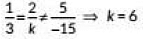
For K = 6 the given system of equations has no solution.
Q28: Case study-based questions are compulsory. (1 x 5 = 5 Marks)
A bookstore shopkeeper gives books on rent for reading. He has a variety of books in his store related to fiction, stories, quizzes etc. He takes a fixed charge for the first two days and an additional charge for subsequent days Amruta paid ₹22 for a book and kept it for 6 days: while Radhika paid ₹16 for keeping the book for 4 days.
Assume that the fixed charge is ₹x and the additional charge (per day) is ₹y.
Based on the above information, answer any four of the following questions.
(i) The situation of the amount paid by Radhika. is algebraically represented by (1 Mark)
(a) x - 4 y = 16
(b) x + 4 y = 16
(c) x - 2 y = 16
(d) x + 2 y = 16
Ans: (d)
Sol: For Amruta, x + (6 - 2)y = 22
i. e., x + 4y = 22 ...(i)
For Radhika, x + (4 - 2)y = 16 i.e.,x + 2y = 16 ...(ii)
Solving equation (i) and (ii). we get
x = 10 and y = 3
i.e., Fixed charges (x) = 10 ...(iii)
and additional charges per subsequent day
(y) = ₹ 3 ...(iv)
x + 2 y = 16 [From equation (ii)]
(ii) The situation of the amount paid by Amruta. is algebraically represented by (1 Mark)
(a) x - 2y = 11
(b) x - 2y = 22
(c) x + 4 y = 22
(d) x - 4 y = 11
Ans: (c)
Sol: For Amruta, x + (6 - 2)y = 22
i. e., x + 4y = 22 ...(i)
For Radhika, x + (4 - 2)y = 16 i.e.,x + 2y = 16 ...(ii)
Solving equation (i) and (ii). we get
x = 10 and y = 3
i.e., Fixed charges (x) = 10 ...(iii)
and additional charges per subsequent day
(y) = ₹ 3 ...(iv)
x + 4 y = 22 [From equation (i)]
(iii) What are the fixed charges for a book? (1 Mark)
(a) ₹ 9
(b) ₹ 10
(c) ₹ 13
(d) ₹ 15
Ans: (b)
Sol: For Amruta, x + (6 - 2)y = 22
i. e., x + 4y = 22 ...(i)
For Radhika, x + (4 - 2)y = 16 i.e.,x + 2y = 16 ...(ii)
Solving equation (i) and (ii). we get
x = 10 and y = 3
i.e., Fixed charges (x) = 10 ...(iii)
and additional charges per subsequent day
y = ₹ 3 ...(iv)
x = ₹ 10 [From equation (iii)]
(iv) What are the additional charges for each subsequent day for a book? (1 Mark)
(a) ₹ 6
(b) ₹ 5
(c) ₹ 4
(d) ₹ 3
Ans: (d)
Sol: For Amruta, x + (6 - 2)y = 22
i. e., x + 4y = 22 ...(i)
For Radhika, x + (4 - 2)y = 16 i.e.,x + 2y = 16 ...(ii)
Solving equation (i) and (ii). we get
x = 10 and y = 3
i.e., Fixed charges (x) = 10 ...(iii)
and additional charges per subsequent day
y = ₹ 3 ...(iv)
y = ₹ 3 [From equation (iv)]
(v) What is the total amount paid by both, if both of them have kept the book for 2 more days? (1 Mark)
(a) ₹ 35
(b) ₹ 52
(c) ₹ 50
(d) ₹ 58
Ans: (c)
For Amruta, x + (6 - 2)y = 22
i. e., x + 4y = 22 ...(i)
For Radhika, x + (4 - 2)y = 16 i.e.,x + 2y = 16 ...(ii)
Solving equation (i) and (ii). we get
x = 10 and y = 3
i.e., Fixed charges (x) = 10 ...(iii)
and additional charges per subsequent day
y = ₹ 3 ...(iv)
Total amount paid for 2 more days by both
= (x + 4 y) + 2 y + (x + 2y ) + 2 y
= 2 x + 10y
= 2 x 10 + 10 x 3
= ₹ 50
Previous Year Questions 2020
Q29: The pair of equations x = a and y = b graphically represent lines which are (1 Mark)(a) Intersecting at (a, b)
(b) Intersecting at (b, a)
(c) Coincident
(d) Parallel
Ans: (a)
Sol: The pair of equations x = a and y = b graphically represent lines which are parallel to the y-axis and x-axis respectively.
The lines will intersect each other at (a, b).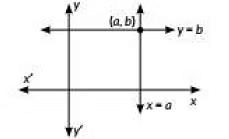
Q30: If the equations kx - 2y = 3 and 3x + y = 5 represent two intersecting lines at unique points, then the value of k is _________. (2 Marks)
Ans: For any real number except k = -6
kx - 2y = 3 and 3x + y = 5 represent lines intersecting at a unique point.
⇒ k3 ≠ -21
⇒ k ≠ -6
For any real number except k ≠ -6
The given equation represent two intersecting lines at unique point.
Q31: The value of k for which the system of equations x + y - 4 = 0 and 2x + ky = 3 has no solution is (1 Mark)
(a) -2
(b) ≠2
(c) 3
(d) 2
Ans: (d)
Sol: For no solution; a1a2 = b1b2 ≠ c1c2
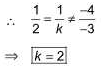
Q32: Determine graphically the coordinates of the vertices of a triangle, the equations of whose sides are given by 2y - x = 8, 5y - x = 14, and y - 2x = 1. (3 Marks)
Ans: Solutions of linear equations
2y - x = 8 ..(i)
5y - x = 14 ...(ii)
and y - 2x = 1 ...(iii)
are given below: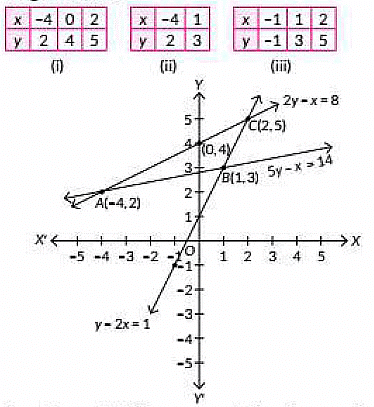
From the graph of lines represented by given equations, we observe that
Lines (i) and (iii) intersect each other at C(2, 5),
Lines (ii) and {iii) intersect each other at B(1, 3) and Lines (i) and (ii) intersect each other at 4(-4, 2).
Coordinates of the vertices of the triangle are A(-4, 2), B(1, 3) and C(2, 5).
Q33: Solve the equations x + 2y = 6 and 2x - 5y = 12 graphically. (3 Marks)
Ans: Solution of linear equations
x + 2y = 6 and 2x - 5y = 12
are given below
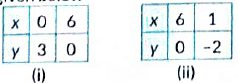
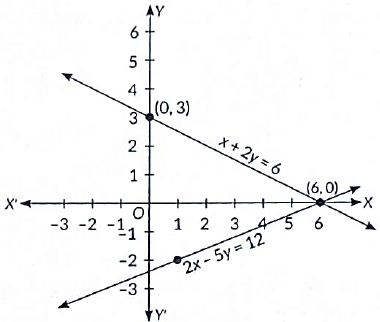
From the graph, the two lines intersect each other at point (6, 0)
∴ x = 6 and y = 0
Q34: A fraction becomes 1/3 when 1 is subtracted from the numerator, and it becomes 1/4 when 8 is added to its denominator. Find the fraction. (3 Marks)
Ans: Let the required fraction be x/y.
According to question, we have
x - 1y = 13 ... (i)
and
xy + 8 = 14 ... (ii)
From (i), 3x - 3 = y
⇒ 3x - y - 3 = 0 ... (iii)
From (ii), 4x = y +8
so, 4x - y - 8 = 0 ... (iv)
Subtracting (iii) from (iv),
we get x = 5
Substituting the value of x in (iii),
we get y = 12
Thus, the required fraction is 5/12
Q35: The present age of a father is three years more than three times the age of his son. Three years hence, the father's age will be 10 years more than twice the age of the son. Determine their present ages. (3 Marks)
Ans: Let the present age of son be x years and that of father be y years.
According to question, we have
y = 3x+ 3 ⇒ 3x - y + 3 = 0 (i)
And y + 3 = 2(x + 3) + 10
⇒ y + 3 = 2x + 6 +10
⇒ 2x - y + 13 = 0 (ii)
Subtracting (ii) from (i), we get x = 10
Substituting the value of x in (ii). we get y = 33
So. the present age of the son is 10 years and that of the father is 33 years.
Q36: Solve graphically : 2x + 3y = 2, x - 2y = 8 (5 Marks)
Ans: Given lines are 2x + 3y = 2 and x - 2y = 8
2x + 3y = 2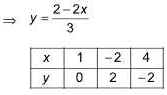
and x - 2y = 8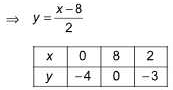
∴ We will plot the points (1, 0), (-2, 2) and (4, - 2 ) and join them to get the graph of 2x + 3y = 2 and we will plot the points (0, -4), (8, 0) and (2, -3) and join them to get the graph of x - 2y = 8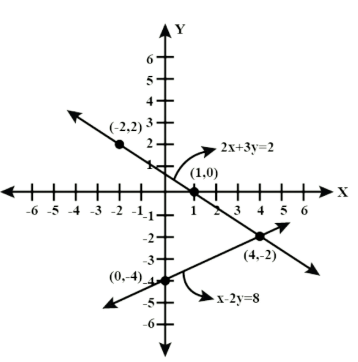
Q37: A train covered a certain distance at a uniform speed. If the train had been 6 km/hr faster, it would have taken 4 hours less than the scheduled time and if the train were slower by 6 km/hr, it would have taken 6 hours more than the scheduled time. Find the length of the journey. (5 Marks)
Ans: Let the original uniform speed of the train be x km/hr and the total length of journey be l km. Then, scheduled time taken by the train to cover a distance of l km = l/x hours
Now,
lx + 6 = lx - 4
⇒ lx - lx + 6 = 4
⇒ x + 6 - xx(x + 6) = 4
⇒ 6lx(x + 6) = 4
⇒ l = 2x(x + 6)3 ... (i)
Also,
lx - 6 = lx + 6
⇒ lx - 6 - lx = 6
⇒ x - x + 6(x - 6)x = 6
⇒ 6l(x - 6)x = 6
⇒ l = x(x - 6) ... (ii)
From equations (i) and (ii), we have
2x(x + 6)3 = x(x - 6)
⇒ 2x + 12 = 3x - 18
⇒ x = 30
Putting the value of x in eq. (ii), we get
l = 30(30 - 6)
= 30 × 24
= 720
Hence, the length of the journey is 720 km.
Also read: Long Answer Questions: Pair of Linear Equations in Two Variables |
Previous Year Questions 2019
Q38: Draw the graph of the equations x - y + 1 = 0 and 3x + 2y - 12 = 0. Using this graph, find the values of x and y which satisfy both the equations. (3 Marks)Ans: Solutions of linear equation
x - y + 1 = 0 ...(i)
and 3x + 2y - 12 = 0 ...(ii)
are given below: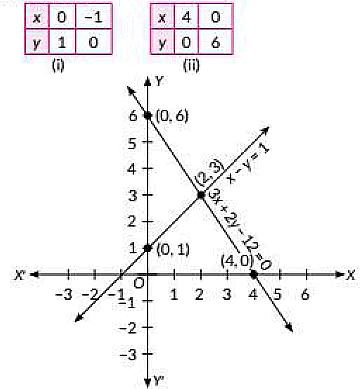
From the graph, the two lines intersect each other at the point (2, 3)
∴ x = 2, y = 3.
Q39: The larger of two supplementary angles exceeds the smaller by 18°. Find the angles. (3 Marks)
Ans: Let the larger angle be x° and the smaller angle be y°. We know that the sum of two supplementary pairs of angles is always 180°.
We have x° + y° = 180° (i)
and x° - y° = 18° (ii) [Given]
By (1), we have x° = 180° - y° _(iii)
Put the value of x° in (ii), we get
180° - y° - y° = 18°
⇒ 162° = 2y°
⇒ y = 81
From (3), we have x° = 180° - 81° = 99°
The angles are 99° and 81°
Q40: Solve the following pair of linear equations: 3x - 5y =4, 2y+ 7 = 9x. (3 Marks)
Ans: Given, pair of linear equations:
3x - 5y = 4, ....... (i)
2y+ 7 = 9x
9x - 2y = 7 ........ (ii)
Multiply (i) by 3 and subtract from (ii), as
⇒ 9x - 2y - 9x + 15y = -5 → 13y = -5
⇒ y = -5/13
Put y = -5/13 in (i), we get
3x - 5( -5/13 )= 4
⇒ 3x + 25/13 = 4
⇒ 3x = 4 - 25/13
⇒ x = (27/13) × 3 = 9/13
Hence, x = 9/13 and y = -5/13
Q41: A father's age is three times the sum of the ages of his two children. After 5 years his age will be two times the sum of their ages. Find the present age of the father. (3 Marks)
Ans: Let the ages of two children be x and y respectively.
Father's present age = 3(x +y)
After 5 years, sum of ages of children = x + 5 + y + 5
= x + y + 10
and age of father = 3(x + y) + 5
According to the question,
3(x + y) + 5 = 2(x + y+ 10)
3x + 3y + 5 = 2x + 2y + 20
⇒ x + y = 15
Hence, present age of father = 3(x + y)
= 3 x 15 = 45 years
Q42: A fraction becomes 1/3 when 2 is subtracted from the numerator and will becomes 1/2 when 1 is subtracted from the denominator. Find the fraction. (3 Marks)
Ans: Let the fraction be x/y
Then, according to question.
x - 2y = 13 and xy - 1 = 12
⇒ 3x - 6 = y and 2x = y - 1
⇒ 3x - y - 6 = 0 ... (i) and 2x - y + 1 = 0 ... (ii)
Subtracting (ii) from (i), we get x - 7 = 0
So, x = 7
From (i) ,3(7) - y - 6 = 0
⇒ 21 - 6 = y
⇒ y = 15
Therefore required fraction is 7/15
Q43: Find the value(s) of k so that the pair of equations x + 2y = 5 and 3x + ky + 15 = 0 has a unique solution. (2 Marks)
Ans: The given pair of linear equations is
x + 2y = 5
3x + ky= -15
Since the system of equations has a unique solution
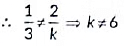
∴ For all values of k except k = 6, the given pair of linear equations will have a unique solution.
Q44: Find the relation between p and q if x = 3 and y = 1 is the solution of the pair of equations x - 4y + p = 0 and 2x + y - q -2 = 0. (2 Marks)
Ans: Given pair of equations are
x - 4y + p = 0 (i)
and 2x + y - q - 2 = 0 (ii)
It is given that x = 3 and y = 1 is the solution of (i) and (ii)
∴ 3 - 4 x 1+ p = 0
⇒ p = 1
and 2 x 3 + 1 - q - 2 = 0
⇒ q = 5
∴ q = 5p
Q45: For what value of k, does the system of linear equations 2x + 3y=7 and (k - 1)x + (k + 2) y = 3k have an infinite number of solutions? (3 Marks)
Ans: The given system of linear equations are:
2x + 3y = 7
(k - 1)x + (k + 2)y = 3k
For infinitely many solutions:
a1a2 = b1b2 = c1c2
Here,
a1 = 2, b1 = 3, c1 = -7
a2 = (k - 1), b2 = (k + 2), c2 = -3k
⇒ 2k - 1 = 3k + 2 = -7-3k
⇒ 2(k + 2) = 3(k - 1); 3(3k) = 7(k + 2)
⇒ 2k - 3k = -3 - 4; 9k - 7k = 14
⇒ -k = -7; 2k = 14
⇒ k = 7; k = 7 Hence, the value of k is 7
: