

Introduction
- Linear equations can be used to represent almost any situation involving an unknown quantity.
- We apply linear equations in various real-life situations like weather predictions, ingredients of a recipe, our monthly expenditure, predicting profit in business and Government surveys.
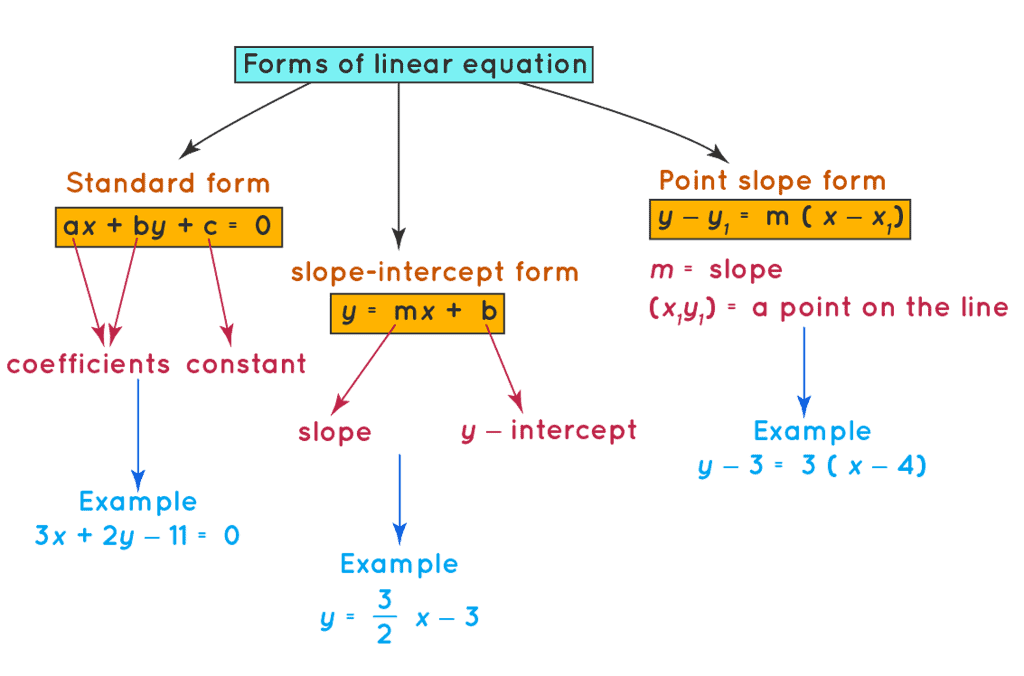 Various forms of Linear Equation
- The general form of a linear equation in two variables is ax + by + c = 0, where a and b cannot be zero simultaneously.
Let us consider an example of a linear equation in two variables, x + 3y = 7.
LHS = x + 3y
If we substitute x=1 and y=2 into the LHS of the equation, we get:
LHS = x+3y = 1+3(2) = 7Here, LHS = RHS.
Thus, we can conclude that x=1 and y=2 is a solution to the equation x+3y=7.
Now, let's consider another pair of values for x and y.
Substituting x=2 and y=1 into the LHS of the equation, we get:
LHS = x+3y = 2+3(1) = 5Here, LHS RHS.
Therefore, x=2 and y=1 is not a solution to the equation x+3y = 7.
We know that the graph of a linear equation in two variables is a straight line.
If x=1 and y=2 is a solution of x+3y=7, then the point (1,2) lies on the line representing the equation x+3y = 7.
In the case of x=2 and y=1, which is not a solution, the point(2,1) does not lie on the line representing the equation x+3y = 7.
Thus, we conclude that every solution of the equation is a point on the line representing it.
Pair of Linear Equations in Two Variables
The general form for a pair of linear equations in two variables x and y is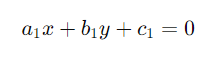
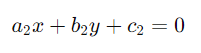
A pair of linear equations in two variables can have one of the following types of solutions:
1. Unique Solution
- When the two equations represent two distinct lines in a coordinate plane, and these lines intersect at a single point, there is a unique solution.
- Mathematically, this means that the lines are not parallel (their slopes are different), and they are not coincident (they do not represent the same line).
2. Infinitely Many Solutions
- If the two linear equations represent the same line in a coordinate plane, they have an infinite number of solutions.
- This occurs when the equations are essentially equivalent, and every point on the common line satisfies both equations.
3. No Solution
- When the two equations represent parallel lines that do not intersect, there is no solution.
- Mathematically, this means that the lines have the same slope (their coefficients are proportional), but they have different y-intercepts.
Example:
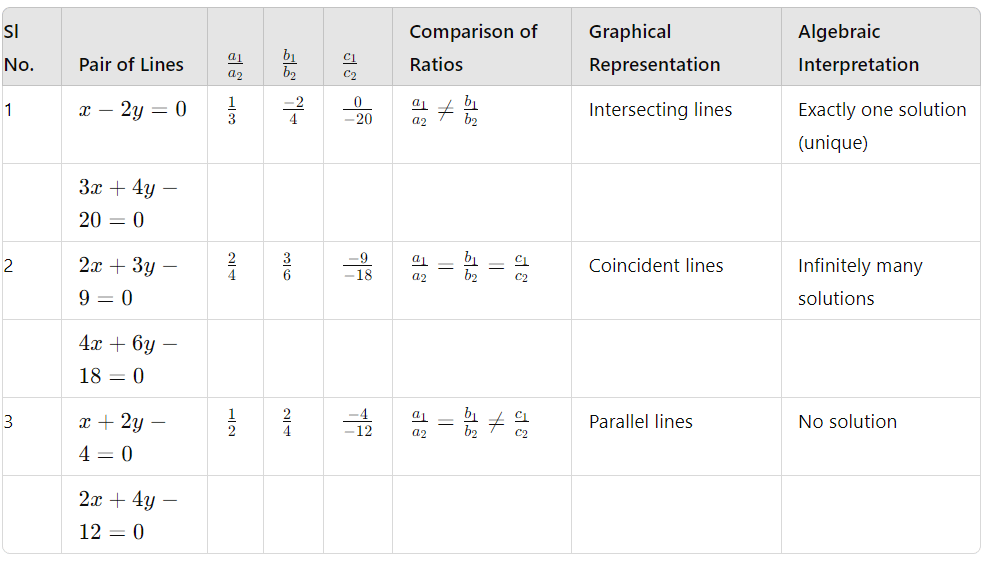
Try yourself: Which of the following statements is true for a system of linear equations in two variables?
A system of linear equations in two variables is of the form:
ax + by = c
dx + ey = f
where a, b, c, d, e, and f are constants.
The system can have multiple solutions if the two equations represent two lines that are coincident, i.e., they overlap each other. In this case, every point on the line represents a solution to the system.
The system can have no solution if the two equations represent two parallel lines that do not intersect. In this case, there is no point that satisfies both equations simultaneously.
The system can have exactly one solution if the two equations represent two intersecting lines. In this case, the point of intersection represents the unique solution to the system.
Therefore, option (d) is the correct answer, as a system of linear equations in two variables can have any of the above outcomes.
 | Get additional INR 200 off today with EDUREV200 coupon. | Avail Offer |
Graphical Representation of Linear Equation
We know that the geometrical representation of linear equations in two variables is a straight line, but when we have a pair of linear equations then there will be two straight lines, which are considered together.
When there are two lines in a plane, one of the following possibilities may arise.
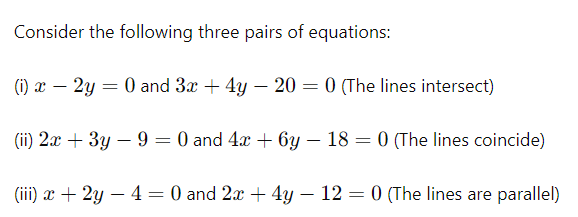
(i) The two lines will intersect

(ii) The two lines are parallel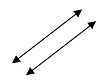
(iii) Two lines are coincident
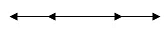
Graphical Method of Solution of a Pair of Linear Equations
We know that a pair of linear equations is represented graphically by two straight lines and these lines may be parallel, may intersect or may coincide.
Now, we will consider certain cases here,
- If the two lines intersect each other at one point only, then we say that there is one and only one solution, that is, a unique solution exists for this pair of linear equations in two variables. Such a pair of linear equations is called a consistent pair of Linear equations.
- If the two lines are coincident then we say that the pair of linear equations has infinitely many solutions. Such a pair of linear equations is called an consistent pair of Linear equations.
- If the two lines are parallel to each other, that is, they do not meet at all, and then we say that the two linear equations have no common solution. Such a pair of linear equations is called a dependent pair of Linear equations.
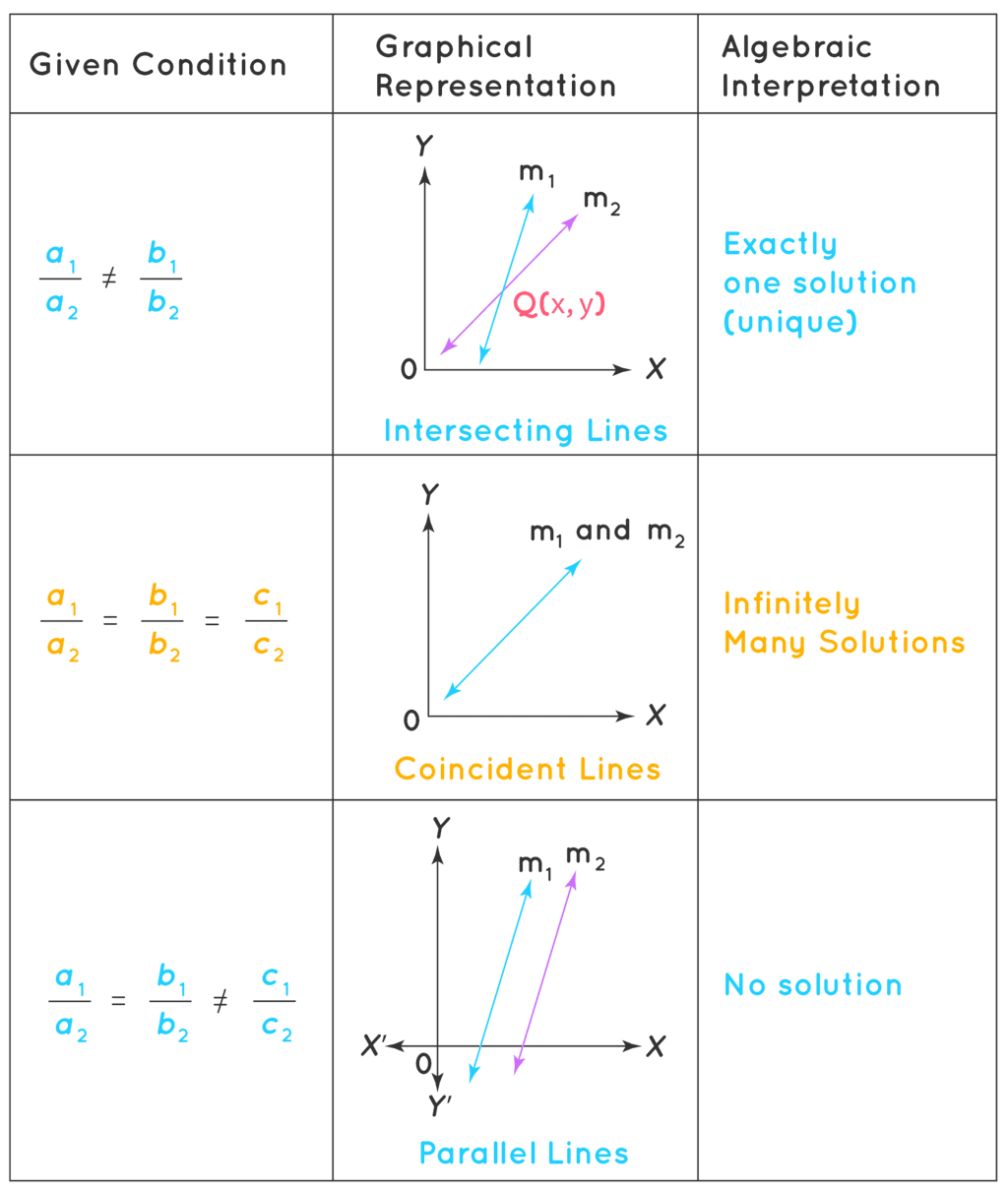
If the lines represented by the equation,
a1x + b1y + c1 = 0
a2x + b2y + c2 = 0 are,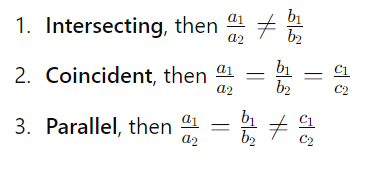
Let us consider some examples here, to understand better the above relations.
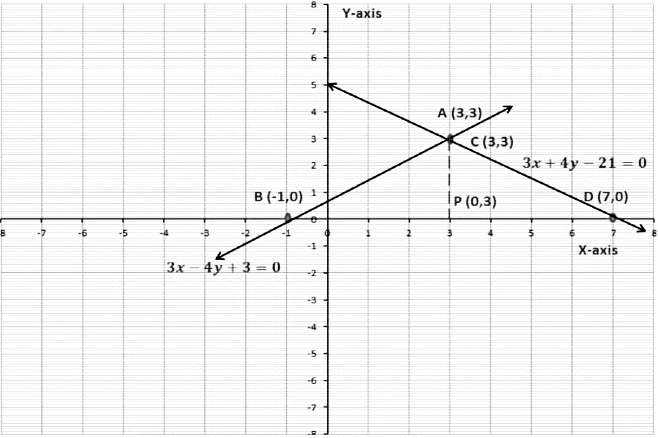
Example 1: Solve graphically the pair of linear equations 3x - 4y + 3 = 0 and 3x + 4y - 21 = 0. Find the coordinate of the vertices of the triangular region formed by these lines and X-axis. Also, calculate the area of this triangle.
Sol:
Firstly we will find two solutions for each equation.
(i) Table for 3x - 4y + 3 = 0
Let the points be A (3, 3) and B (-1,0)(ii) Table for 3x + 4y - 21 = 0
Let the points be C (3, 3) and D (7,0)
Now we will plot these points on a graph paper.
We will join points A and B, A and D respectively.
(Point A and Point C have the same coordinate)
When we join these points we will get a triangle ∆ ABD.
The coordinates of the vertices of ∆ ABD are,
A (3,3), B (-1,0) and D (7,0)
Next, we have to find the area ∆ ABD.
We know,
Area of a triangle = 1/2 × Base × Height
In ∆ ABD,
Base = 8 units
Height = 3 units
Area of ∆ ABD = 1/2 ×BD×AP
=12× 8 ×3 = 12 sq. units


Example 2: Solve the following system of linear equations graphically:
2x - y - 4 = 0
x + y + 1 = 0
Sol:
The pair of linear equations is,
2x - y - 4 = 0
x + y + 1 = 0
First, we will find two solutions of each equation.
(i) Table for 2x - y - 4 = 0
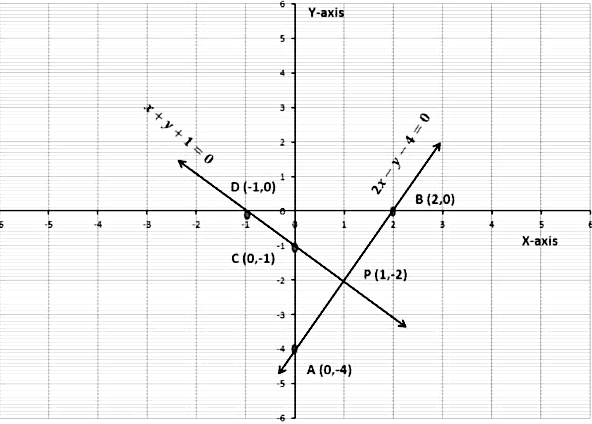
Let the points be A(0,-4) and B(2,0)
(ii) Table for x + y + 1 = 0
Let the points be C (0,-1) and D (-1,0)
Now we plot these points on a graph paper.
We have joined points A and B, C and D respectively.
We see that the two lines are intersecting at point P (1, -2).
So the solution of the given pair of equations is x = 1 and y =-2.

Example 3: Form a pair of linear equations in two variables using the following information and solve it graphically. Five years ago, Mayank was twice as old as Rajat. Ten years later, Mayank's age will be ten years more than Rajat's age. Find their present ages.
Sol:
Let Mayank's and Rajat's present age be x years and y years respectively.
5 years ago,
Mayank's age was (x - 5) years
Rajat's age was (y - 5) years
Now it is given that 5 years ago Mayank was twice as old as Rajat.
∴ (x - 5) = 2(y - 5)
x - 5 = 2y - 10
x - 2y = -10 + 5
x - 2y = -5 → Eq.1
10 years later,
Mayank's age will be (x + 10) years
Rajat's age was (y + 10) years
It is given that 10 years later, Mayank's age will be ten years more than Rajat's age.∴ (x + 10) = (y + 10) + 10
x + 10 = y + 20
x - y = 10 → Eq.2
We get a pair of linear equations,
x - 2y + 5 = 0
x - y - 10 = 0
Now we draw the graph of Equations 1 and 2.
We will find two solutions of the two equations first
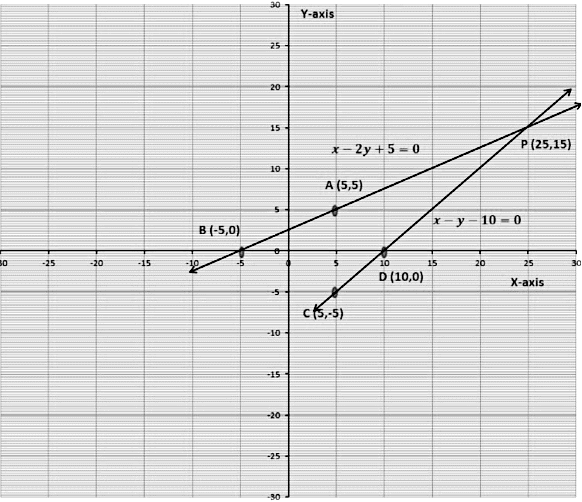
Table for x - 2y + 5 = 0Let the points be A (5, 5) and B(-5,0)
Table for x - y - 10 = 0
Let the points be C (5,-5) and D (10,0)
Now we plot these points on a graph paper.
Join points A and B to get, line AB
Join points C and D to get, line CD
We see that the lines AB and CD are intersecting at point P. The coordinate of points of P is (25, 15), that is, x = 25 years and y = 15 years
Mayank's age = 25 years
Rajat's age = 15 years
Example 4: Check whether the given pair of linear equations is consistent or inconsistent. x + 2y = 4 and 3x + 6y = 12
Sol:
The pair of linear equations is
x + 2y = 4
3x + 6y = 12
The standard form of pair of linear equations is
a1x + b1y + c1 = 0
a2x + b2y + c2 = 0
On comparing the linear equations with the standard form of equations we get,
a1 = 1, b1 = 2 and c1 = 4
a2 = 3, b2 = 6 and c2 = 12
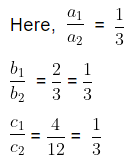
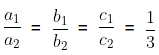
We see that
Therefore, the given pair of linear equations is consistent.
Example 5: Find the value of 'k' for which the system of equations kx - 5y = 2 and 6x + 2y = 7 has no solution.
Sol:
The given pair of linear equations is,
kx - 5y = 2
6x + 2y = 7
We know the standard form of pair of linear equations is
a1x + b1y + c1 = 0
a2x + b2y + c2 = 0
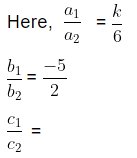
On comparing the linear equations with the standard form of equations we get,a1 = k, b1 = -5 and c1 = 2
a2 = 6, b2 = 2 and c2 = 7
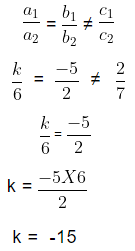
We know that a pair of linear equations has no common solution when,
Also read: NCERT Solutions: Pair of Linear Equations in Two Variables (Exercise 3.1, 3.2 & 3.3) |
Algebraic Methods of Solving a Pair of Linear Equations
The graphical method for solving a pair of linear equations is more suitable for integers but for non-integers, it may not be as accurate as we need. So, we use other algebraic methods to solve the pair of linear equations. 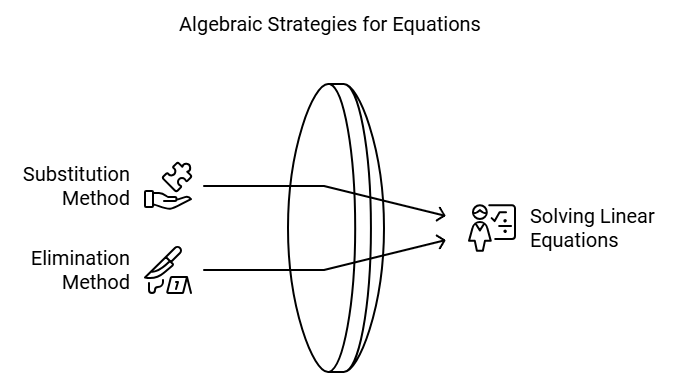
Some of the algebraic methods which we are going to study now are
- Substitution Method
- Elimination Method
 | Attention! Sale expiring soon, act now & get EduRev Infinity at 40% off! | Claim Offer |
1. Substitution Method
In the substitution method, we find out the value of one variable in terms of the other variable and then we substitute this value in other equations to get an equation in one variable. Now, this equation can be solved easily.
Let us consider some examples to understand the substitution method better.
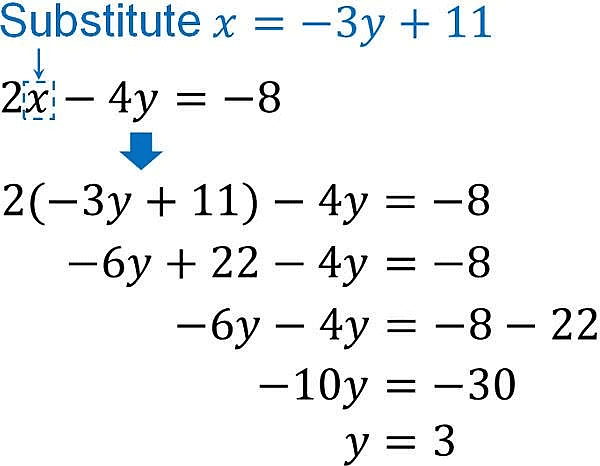 Example of Substitution Method
Example 6: Solve the following pair of linear equations by the substitution method.
0. 2x + 0. 3y = 1. 3 and 0. 6x + 0. 5y = 2. 3
Sol: The given pair of linear equations is
0. 2x + 0. 3y = 1. 3 →Eq 1
0. 6x + 0. 5y = 2. 3 →Eq 2
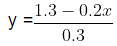
First, we find the value of variable y in terms of other variables, i.e. x.
From equation (1),
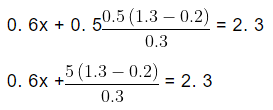
Next, we substitute the value of y in equation (2) From equation (2),
1. 8x + (6. 5 - x) = 2. 3 × 3
1. 8x + 6. 5 - x = 6. 9
0. 8x = 6. 9 - 6. 5
0. 8x = 0. 4
x = 0. 5
Putting the value of x in equation 1, we get
0. 2 × 0. 5 + 0. 3y = 1. 3
0. 3y = 1. 3 - 0. 01
0. 3y = 1. 29
y = 4. 3
Therefore, x = 0. 5 and y = 4. 3
Example 7: Solve 2x + 3y = 11 and 2x - 4y = -24 and hence find the value of m for which y = mx + 3.
Sol: The given pair of linear equations is
2x + 3y = 11 →Eq 1
2x - 4y = -24 →Eq 2
We will first find the value of variable y in terms of variable, x.
From equation (1),
Next substituting this value of y in equation (2), we get6x - (44 - 8x) = -24 × 3
6x + 8x - 44 = -72
14x = -72 + 44
14x = -28
x = -2
Putting the value of x in equation 1, we get
2 × (-2) - 4y = -24
-4 - 4y = -24
-4y = -24 + 4
-4y = -20
y = 5
Therefore, x = -2 and y = 5
Substituting the value of x and y in the equation
y = mx + 3, we get
5 = -2m + 3
m = -1

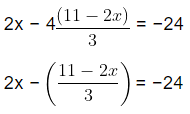
Example 8: The difference between the two numbers is 75 and on number is four times the other.
Sol:
Let the two numbers be x and y.
x > y
It is given that the difference between x and y is 75.
x - y = 75 → Eq 1
One number is four times the second number.
x = 4y →Eq 2
Substituting the value of x from Eq 2 in Eq 1, we get
4y - y = 75
3y = 75
y = 25
Substituting the value of y in Eq 2, we get
x = 4 × (25)
x = 100
The two numbers are 100 and 25.
Try yourself: Solve the system of equations using the substitution method:
2x + 3y = 9
x - y = 2
To solve this system of equations using the substitution method, we first solve one of the equations for one variable in terms of the other variable, and then substitute the expression into the other equation to obtain an equation in one variable. Then we can solve for the variable and back-substitute to obtain the value of the other variable.
Let's solve the second equation for x in terms of y: x - y = 2
x = y + 2
Now we substitute this expression for x into the first equation: 2x + 3y = 9
2(y + 2) + 3y = 9
Simplifying the equation, we get: 5y + 4 = 9
Solving for y, we get: y = 5/5 = 1
Now we back-substitute y = 1 into the expression for x that we obtained earlier: x = 1 + 2 = 3
Therefore, the solution to the system of equations is (x,y) = (3,1), which corresponds to option (c).
2. Elimination Method
Elimination Method is another method of eliminating one variable but in this method, one variable out of two variables is eliminated by making the coefficient of that variable equal in both the equations.
Now, we will consider some examples:
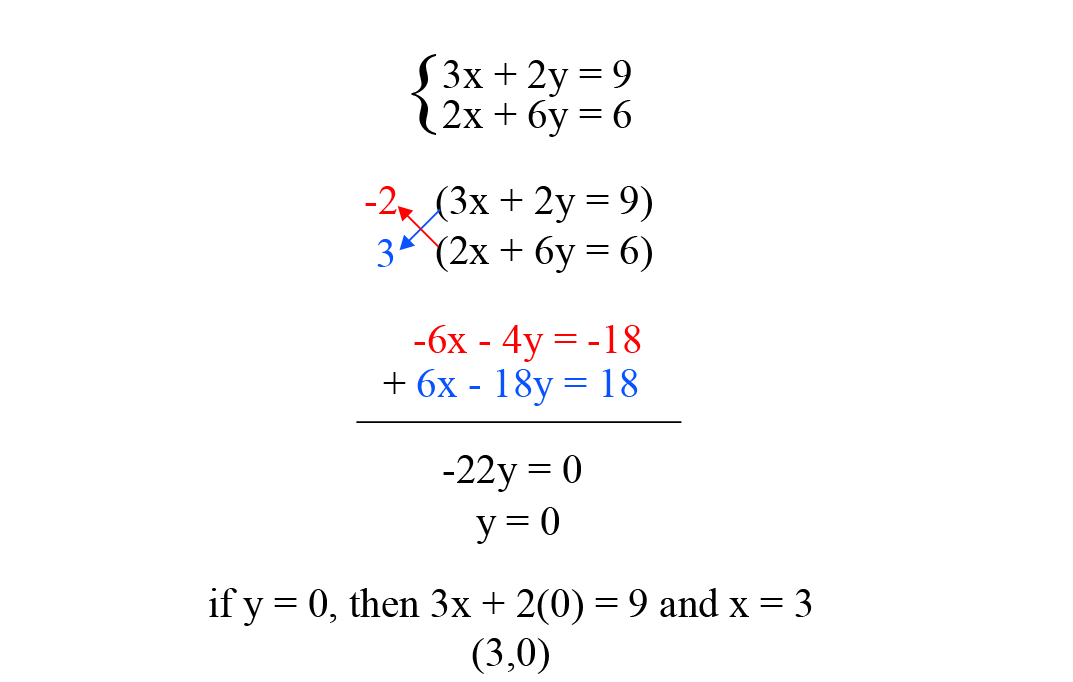 Example of Elimination Method
Example 9: Use the elimination method to find all possible solutions of the following pair of linear equations.
ax + by - a + b = 0 and bx - ay - a - b = 0
Sol:
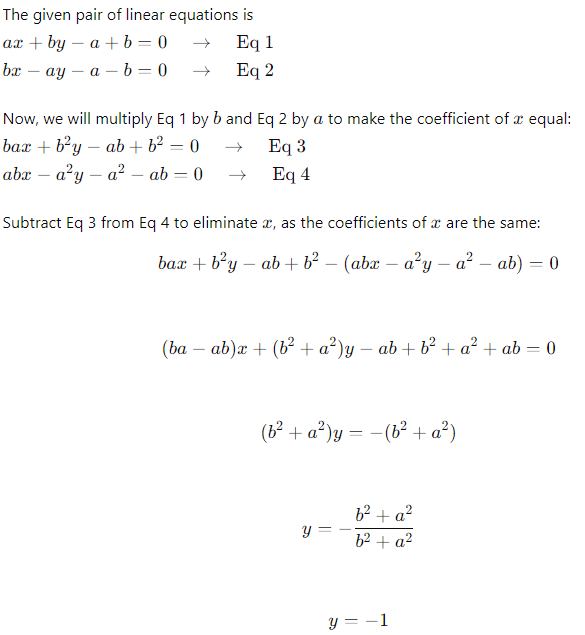
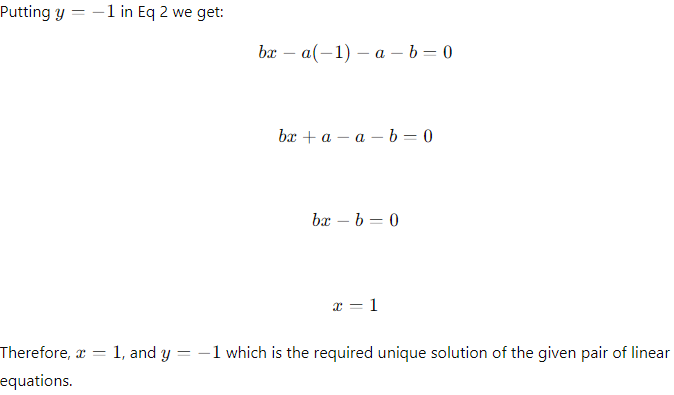
Example 10: The sum of the digits of a two-digit number is 6. Also, seventeen times this number is five times the number obtained by reversing the order of the digits. Find the number.
Sol:
Let the digit at the unit place be x and the digit at tens place be y.
The Original two-digit number is 10y + x
The sum of the digits of the original number = 6
∴ y + x = 6
x + y - 6 = 0 → Eq 1
On reversing the order of the two-digit number, we get y at units place and x at the tens place.
∴ The new two-digit number= 10x + y
Seventeen times of the original number is equal to five the reversed number
17(10y + x) = 5(10x + y)
170y + 17x = 50x + 5y
170y - 5y = 50x - 17x
165y = 33x
x = 5y
x - 5y = 0 → Eq 2
On subtracting Eq 2 from Eq 1, we get
x + y - 6 - (x - 5y) = 0x + y - 6 - x + 5y = 0
6y = 6
y = 1
Substituting y = 1 in Eq 1
x + 1 - 6 = 0
x = 5
Therefore, the required two-digit number = 10y + x = 10 × 1 + 5 = 15
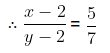
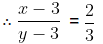
Example 11: A fraction becomes 5/7 , if 2 is subtracted to both the numerator and the denominator. If 3 is subtracted to both the numerator and denominator, it becomes 2/3. Find the fraction.
Sol:
Let the fraction be x/y
Subtracting 2 to both the numerator and denominator, we get new fraction
It is given that the new fraction obtained =5/7
7(x - 2) = 5(y - 2)7x - 14 = 5y - 10
7x - 5y = 14 - 10
7x - 5y = 4
7x - 5y - 4 = 0 → Eq 1
Next, we subtract 3 to both the numerator and denominator New fraction
It is given that the new fraction obtained = 2/3
3(x - 3) = 2(y - 3)
3x - 9 = 2y - 6
3x - 2y = 3
3x - 2y - 3 = 0 → Eq 2
7x - 5y - 4 = 0 → Eq 1
Multiplying Eq 1 by 3 and Eq 2 by 7 to make the coefficient of x equal, we get
21x - 15y - 12 = 0 → Eq 3
21x - 14y - 21 = 0 → Eq 4
Now, on subtracting, we get
21x - 15y - 12 - (21x - 14y - 21) = 0
21x - 15y - 12 - 21x + 14y + 21 = 0
-y + 9 = 0
y - 9 = 0
y = 9
Putting the value of y in Eq 1, we get
7x - 5(9) - 4 = 0
7x - 45 - 4 = 0
7x = 49
x = 7Therefore, the required fraction is 7/9 .


Example 12: The taxi charges in a city consist of a fixed charge together with the charge for the distance covered. For a distance of 10km, the charge paid is Rs. 110 and for a journey of 15 km the charge paid is Rs.160. What are the fixed charges and the charge per kilometer? How much does a person have to pay for traveling a distance of 25 km?
Sol:
Let fixed charge be Rs. x and charge per kilometer be Rs. y For 10 km distance, Fixed charge + charge per kilometer = Rs. 110
x + 10y = 110
x + 10y - 110 = 0 → Eq 1
For 15 km distance,
Fixed charge + charge per kilometer = Rs. 16
x + 15y = 160
x + 15y - 160 = 0 → Eq 2
Now subtracting Eq 2 from Eq 1 we get,
x + 15y - 160 - (x + 10y - 110) = 0
x + 15y - 160 - x - 10y + 110 = 0
15y - 10y - 50 = 0
5y - 50 = 0
y = 10
Substituting the value of y in Eq 1 we get,
x + 10y - 110 = 0
x + 10(10) - 110 = 0
x + 100 - 110 = 0
x = 10
Therefore, the fixed charge is Rs. 5 and the charge per kilometer is Rs. 10.
For 25 km distance,
Fixed charge + charge per kilometer = Rs. x + 25y
= Rs 10 + 25 (10)
= Rs 260
Try yourself: Solve the system of equations using the elimination method:
2x + 3y = 10
3x - 2y = 2
To solve the system of equations using the elimination method, we need to eliminate one variable by adding or subtracting the equations. In this case, we can eliminate y by multiplying the first equation by 2 and the second equation by 3, then subtracting the resulting equations:
(2x + 3y) x 2 = 10 x 2
(3x - 2y) x 3 = 2 x 3
Simplifying the resulting equations, we get:
4x + 6y = 20
9x - 6y = 6
Adding these equations, we get:
13x = 26
Dividing both sides by 13, we get:
x = 26/13 = 2
x = 2
Substituting this value of x in either of the original equations, we get:
2(2) + 3y = 10
3y = 10 - 4 = 6
Simplifying and solving for y, we get:
y = 2
Therefore, the solution to the system of equations is (x, y) = (2, 2). The correct answer is option (A).
Also read: NCERT Solutions: Pair of Linear Equations in Two Variables (Exercise 3.1, 3.2 & 3.3) |
Summary
1. Solving Linear Equations:
- Linear equations in two variables can be solved through:
(i) Graphical method
(ii) Algebraic methods
2. Graphical Method:
- Graphs of linear equations form lines.
- If lines intersect, there is a unique solution (consistent).
- If lines coincide, there are infinitely many solutions (dependent and consistent).
- If lines are parallel, there is no solution (inconsistent).
3. Algebraic Methods:
- Solutions can be found through:
(i) Substitution method
(ii) Elimination method
4. Pair of Linear Equations:
- For equations a1x + b1y + c1 = 0 and a2x + b2y + c2 = 0:
(i) If a1/a2 ≠ b1/b2, the equations are consistent.
(ii) If a1/a2 = b1/b2 ≠ c1/c2, the equations are inconsistent.
(iii) If a1/a2 = b1/b2 = c1/c2, the equations are dependent and consistent.
5. Mathematical Representation:
- Non-linear situations can be mathematically represented by transforming them into a pair of linear equations.
NCERT Solutions: Pair of Linear Equations in Two Variables (Exercise 3.1, 3.2 & 3.3)
Exercise 3.1
Q1. Form the pair of linear equations in the following problems, and find their solutions graphically.
(i) 10 students of Class X took part in a Mathematics quiz. If the number of girls is 4 more than the number of boys, find the number of boys and girls who took part in the quiz.
(ii) 5 pencils and 7 pens together cost 50, whereas 7 pencils and 5 pens together cost 46. Find the cost of one pencil and that of one pen.
Ans: (i)
Let number of boys = x
Number of girls = y
Given that total number of student is 10.
So, x + y = 10
Subtract y both side we get,
x = 10 - y
Putting y = 0 , 5, 10 we get,
x = 10 - 0 = 10
x = 10 - 5 = 5
x = 10 - 10 = 0
| x | 10 | 5 |
| y | 0 | 5 |
Given that If the number of girls is 4 more than the number of boys.
So, y = x + 4
Putting x = -4, 0, 4, and we get,
y = - 4 + 4 = 0
y = 0 + 4 = 4
y = 4 + 4 = 8
| x | -4 | 0 | 4 |
| y | 0 | 4 | 8 |
Graphical representation: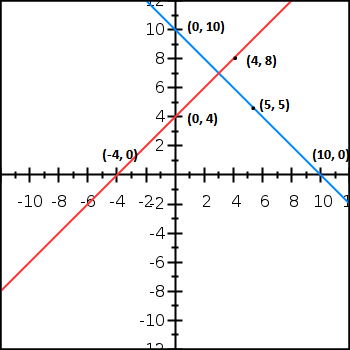 Therefore, number of boys = 3 and number of girls = 7
(ii) Let 1 pencil costs Rs.x and 1 pen costs Rs.y.
According to the question, the algebraic expression cab be represented as;
5x + 7y = 50
7x + 5y = 46
For, 5x + 7y = 50 or x = (50 - 7y) / 5, the solutions are;
| x | 3 | 0 |
| y | 5 | 7.14 |
For 7x + 5y = 46 or x = (46 - 5y) / 7, the solutions are;
| x | 6.57 | 3 |
| y | 0 | 5 |
Hence, the graphical representation is as follows: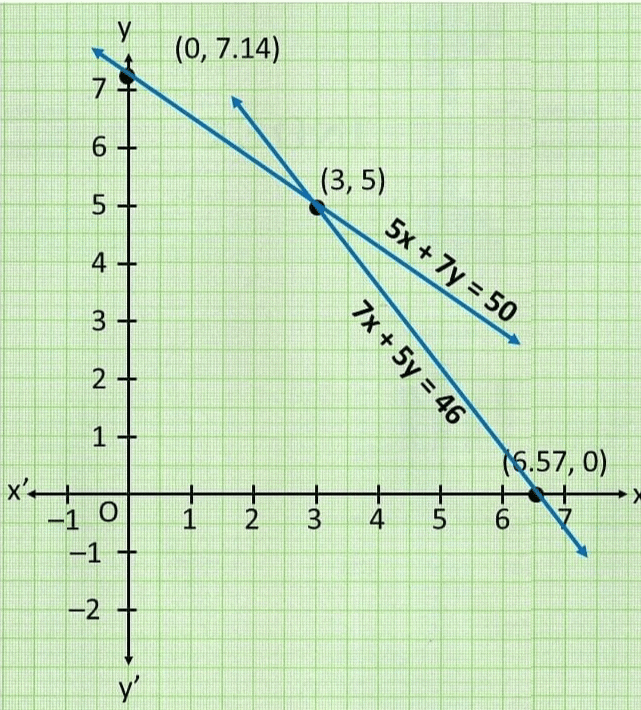
From the graph, it can be seen that the given lines cross each other at point (3, 5).So, the cost of a pencil is Rs. 3 and cost of a pen is Rs. 5.
Q2. On comparing the ratios a1 / a2 , b1 / b2 , c1 / c2 find out whether the lines representing the following pairs of linear equations intersect at a point, are parallel or coincident:
(i) 5x - 4y + 8 = 0
7x + 6y - 9 = 0
(ii) 9x + 3y + 12 = 0
18x + 6y + 24 = 0
(iii) 6x - 3y + 10 = 0
2x - y + 9 = 0
Ans: (i) Given expressions;
5x - 4y + 8 = 0
7x + 6y - 9 = 0
Comparing these equations with a1x + b1y + c1 = 0
And a2x + b2y + c2 = 0
We get,
a1 = 5, b1 = -4, c1 = 8
a2 = 7, b2 = 6, c2 = -9
(a1 / a2) = 5 / 7
(b1 / b2) = -4 / 6 = -2 / 3
(c1 / c2) = 8 / -9
Since, (a1 / a2) ≠ (b1 / b2)
So, the pairs of equations given in the question have a unique solution and the lines cross each other at exactly one point.
(ii) Given expressions;
9x + 3y + 12 = 0
18x + 6y + 24 = 0
Comparing these equations with a1x + b1y + c1 = 0
And a2x + b2y + c2 = 0
We get,
a1 = 9, b1 = 3, c1 = 12
a2 = 18, b2 = 6, c2= 24
(a1/ a2) = 9 / 18 = 1 / 2
(b1 / b2) = 3 / 6 = 1 / 2
(c1 / c2) = 12 / 24 = 1 / 2
Since (a1/ a2) = (b1 / b2) = (c1 / c2)
So, the pairs of equations given in the question have infinite possible solutions and the lines are coincident.
(iii) Given Expressions;
6x - 3y + 10 = 0
2x - y + 9 = 0
Comparing these equations with
a1x + b1y + c1 = 0
And a2x + b2y + c2= 0
We get,
a1 = 6, b1 = -3, c1 = 10
a2 = 2, b2= -1, c2= 9
(a1 / a2) = 6 / 2 = 3 / 1
(b1 / b2) = -3 / -1 = 3 / 1
(c1 / c2) = 10 / 9
Since (a1 / a2) = (b1 / b2) ≠ (c1 / c2)
So, the pairs of equations given in the question are parallel to each other and the lines never intersect each other at any point and there is no possible solution for the given pair of equations.
Q3. On comparing the ratio, (a1 / a2), (b1 / b2), (c1 / c2) find out whether the following pair of linear equations are consistent, or inconsistent.
(i) 3x + 2y = 5 ; 2x - 3y = 7
(ii) 2x - 3y = 8 ; 4x - 6y = 9
(iii) (3 / 2)x + (5 / 3)y = 7; 9x - 10y = 14
(iv) 5x - 3y = 11 ; - 10x + 6y = -22
(v) (4 / 3)x + 2y = 8 ; 2x + 3y = 12
Ans: (i) Given: 3x + 2y = 5 or 3x + 2y -5 = 0
and 2x - 3y = 7 or 2x - 3y -7 = 0
Comparing these equations with a1x + b1y + c1 = 0
And a2x + b2y + c2 = 0
We get,
a1 = 3, b1 = 2, c1 = -5
a2 = 2, b2= -3, c2= -7
(a1 / a2) = 3 / 2
(b1 / b2) = 2 / -3
(c1 / c2) = -5 / -7 = 5 / 7
Since, (a1 / a2) ≠ (b1 / b2)
So, the given equations intersect each other at one point and they have only one possible solution. The equations are consistent.
(ii) Given: 2x - 3y = 8 and 4x - 6y = 9
Therefore,
a1 = 2, b1 = -3, c1 = -8
a2= 4, b2= -6, c2 = -9
(a1 / a2) = 2 / 4 = 1 / 2
(b1 / b2) = -3 / -6 = 1 / 2
(c1 / c2) = -8 / -9 = 8 / 9
Since , (a1/ a2) = (b1/ b2) ≠ (c1 / c2)
So, the equations are parallel to each other and they have no possible solution. Hence, the equations are inconsistent.
(iii) Given: (3 / 2)x + (5 / 3)y = 7 and 9x - 10y = 14
Therefore,
a1= 3 / 2, b1= 5 / 3, c1 = -7
a2= 9, b2= -10, c2= -14
(a1/ a2) = 3 / (2 × 9) = 1 / 6
(b1/ b2) = 5 / (3× - 10)= -1 / 6
(c1 / c2) = -7 / -14 = 1 / 2
Since, (a1/ a2) ≠ (b1/ b2)
So, the equations are intersecting each other at one point and they have only one possible solution. Hence, the equations are consistent.
(iv) Given: 5x - 3y = 11 and - 10x + 6y = -22
Therefore,
a1= 5, b1 = -3, c1 = -11
a2= -10, b2 = 6, c2= 22
(a1/ a2) = 5 / (-10) = -5 / 10 = -1 / 2
(b1/ b2) = -3 / 6 = -1 / 2
(c1 / c2) = -11 / 22 = -1 / 2
Since (a1/ a2) = (b1/ b2) = (c1 / c2)
These linear equations are coincident lines and have infinite number of possible solutions. Hence, the equations are consistent.
(v) Given: (4 / 3)x + 2y = 8 and 2x + 3y = 12
a1= 4 / 3 , b1= 2 , c1 = -8
a2= 2, b2 = 3 , c2= -12
(a1/ a2) = 4 / (3 × 2)= 4 / 6 = 2 / 3
(b1/ b2) = 2 / 3
(c1 / c2) = -8 / -12 = 2 / 3
Since (a1/ a2) = (b1/ b2) = (c1 / c2)
These linear equations are coincident lines and have infinite number of possible solutions. Hence, the equations are consistent.
Q4. Which of the following pairs of linear equations are consistent/inconsistent? If consistent, obtain the solution graphically:
(i) x + y = 5, 2x + 2y = 10
(ii) x - y = 8, 3x - 3y = 16
(iii) 2x + y - 6 = 0, 4x - 2y - 4 = 0
(iv) 2x - 2y - 2 = 0, 4x - 4y - 5 = 0
Ans: (i) Given, x + y = 5 and 2x + 2y = 10
(a1/ a2) = 1 / 2
(b1/ b2) = 1 / 2
(c1 / c2) = 1 / 2
Since (a1/ a2) = (b1/ b2) = (c1 / c2)
∴The equations are coincident and they have infinite number of possible solutions.
So, the equations are consistent.
For, x + y = 5 or x = 5 - y
| x | 0 | 5 |
| y | 5 | 0 |
For 2x + 2y = 10 or x = (10 - 2y) / 2
| x | 0 | 5 |
| y | 5 | 0 |
So, the equations are represented in graphs as follows:
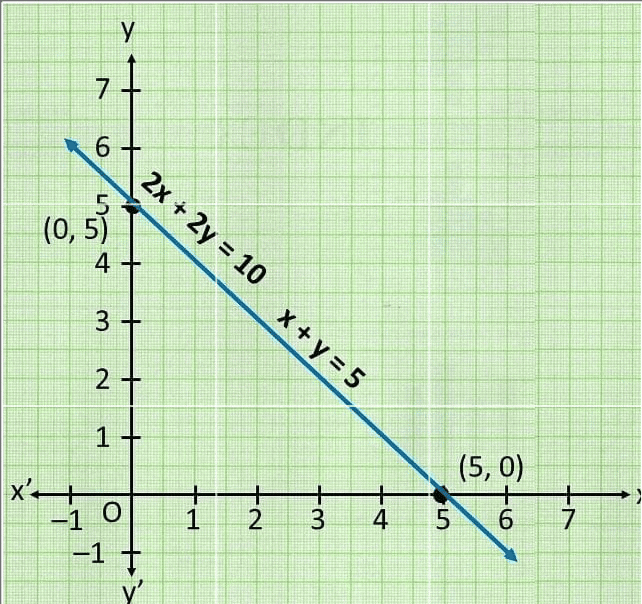 From the figure, we can see, that the lines are overlapping each other. Therefore, the equations have infinite possible solutions.
(ii) Given, x - y = 8 and 3x - 3y = 16
(a1/ a2) = 1 / 3
(b1/ b2) = -1 / -3 = 1 / 3
(c1 / c2) = 8 / 16 = 1 / 2
Since, (a1/ a2) = (b1/ b2) ≠ (c1 / c2)
The equations are parallel to each other and have no solutions. Hence, the pair of linear equations is inconsistent.
(iii) Given, 2x + y - 6 = 0 and 4x - 2y - 4 = 0
(a1/ a2) = 2 / 4 = 1 / 2
(b1/ b2) = 1 / -2
(c1 / c2) = -6 / -4 = 3 / 2
Since, (a1/ a2) ≠ (b1/ b2)
The given linear equations are intersecting each other at one point and have only one solution. Hence, the pair of linear equations is consistent.
Now, for 2x + y - 6 = 0 or y = 6 - 2x
| x | 0 | 3 |
| y | 6 | 0 |
And for 4x - 2y - 4 = 0 or y = (4x - 4) / 2
| x | 0 | 1 |
| y | -2 | 0 |
So, the equations are represented in graphs as follows:
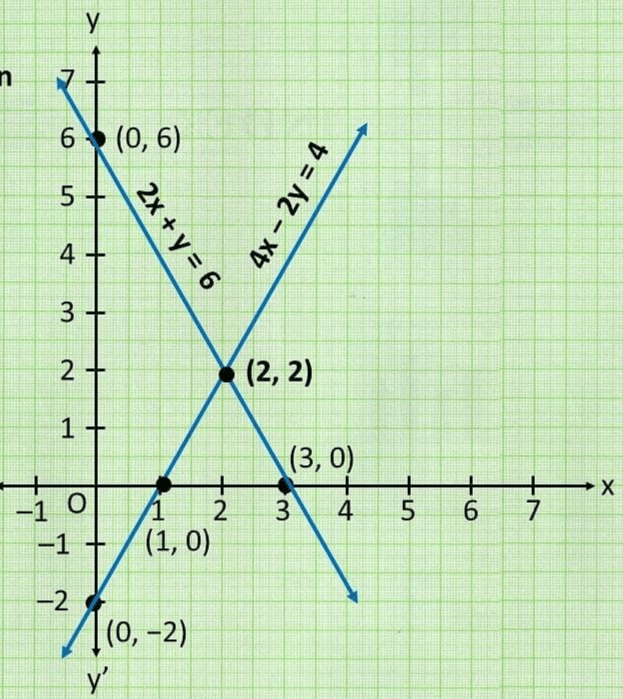 From the graph, it can be seen that these lines are intersecting each other at only one point (2,2).
(iv) Given, 2x - 2y - 2 = 0 and 4x - 4y - 5 = 0
(a1/ a2) = 2 / 4 = 1 / 2
(b1/ b2) = -2 / -4 = 1 / 2
(c1 / c2) = 2 / 5
Since, a1/ a2= b1/ b2≠ c1 / c2
Thus, these linear equations have parallel and have no possible solutions. Hence, the pair of linear equations are inconsistent.
Q5. Half the perimeter of a rectangular garden, whose length is 4 m more than its width, is 36 m. Find the dimensions of the garden.
Ans: Let us consider.
The width of the garden is y and length is x.
Now, according to the question, we can express the given condition as;
x - y = 4
and
y + x = 36
Now, taking x - y = 4 or x = y + 4
| x | 4 | 0 |
| y | 0 | -4 |
For y + x = 36, y = 36 - x
| x | 12 | 20 |
| y | 24 | 16 |
The graphical representation of both the equation is as follows: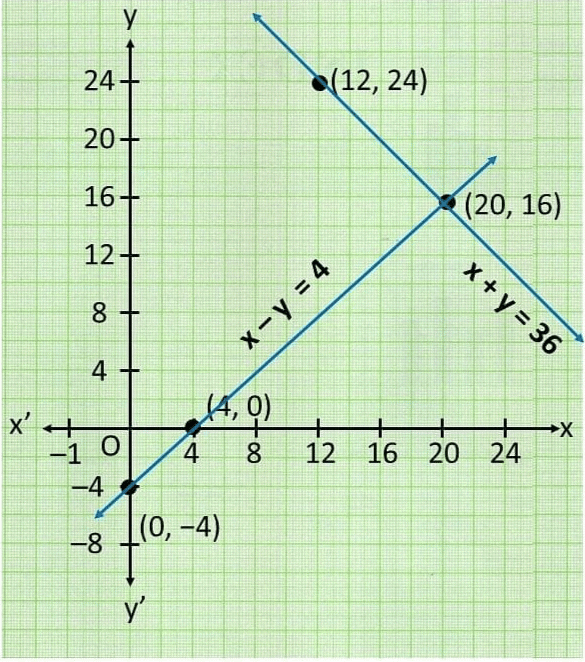 From the graph you can see, the lines intersects each other at a point(20, 16). Hence, the width of the garden is 16 and length is 20.
Q6. Given the linear equation 2x + 3y - 8 = 0, write another linear equation in two variables such that the geometrical representation of the pair so formed is:
(i) Intersecting lines
(ii) Parallel lines
(iii) Coincident lines
Ans: (i) Given the linear equation 2x + 3y - 8 = 0.
To find another linear equation in two variables such that the geometrical representation of the pair so formed is intersecting lines, it should satisfy below condition;
(a1/ a2) ≠ (b1/ b2)
Thus, another equation could be 2x - 7y + 9 = 0, such that;
(a1/ a2) = 2 / 2 = 1 and (b1/ b2) = 3 / -7
Clearly, you can see another equation satisfies the condition.
(ii) Given the linear equation 2x + 3y - 8 = 0.
To find another linear equation in two variables such that the geometrical representation of the pair so formed is parallel lines, it should satisfy below condition;
(a1/ a2) = (b1/ b2) ≠ (c1 / c2)
Thus, another equation could be 6x + 9y + 9 = 0, such that;
(a1/ a2) = 2 / 6 = 1 / 3
(b1/ b2) = 3 / 9= 1 / 3
(c1 / c2) = -8 / 9
Clearly, you can see another equation satisfies the condition.
(iii) Given the linear equation 2x + 3y - 8 = 0. To find another linear equation in two variables such that the geometrical representation of the pair so formed is coincident lines, it should satisfy below condition;
(a1/ a2) = (b1/ b2) = (c1 / c2)
Thus, another equation could be 4x + 6y - 16 = 0, such that;
(a1/ a2) = 2 / 4 = 1 / 2 ,(b1/ b2) = 3 / 6 = 1 / 2, (c1 / c2) = -8 / -16 = 1 / 2
Clearly, you can see another equation satisfies the condition.
Q7. Draw the graphs of the equations x - y + 1 = 0 and 3x + 2y - 12 = 0. Determine the coordinates of the vertices of the triangle formed by these lines and the x-axis, and shade the triangular region.
Ans: Given, the equations for graphs are x - y + 1 = 0 and 3x + 2y - 12 = 0.
For, x - y + 1 = 0 or y = 1 + x
| x | 0 | -1 |
| y | 1 | 0 |
For, 3x + 2y - 12 = 0 or x = (12 - 2y) / 3
| x | 0 | 4 |
| y | 6 | 0 |
Hence, the graphical representation of these equations is as follows:
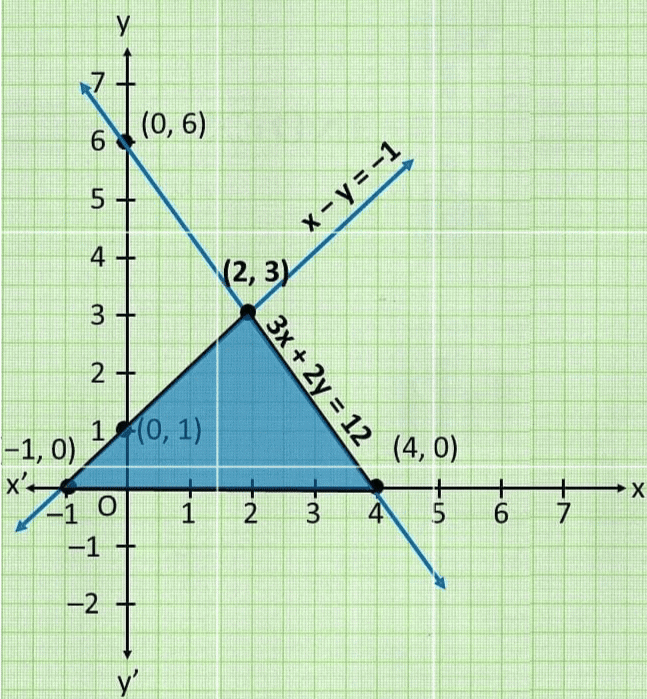
From the figure, it can be seen that these lines are intersecting each other at point (2, 3) and x-axis at (-1, 0) and (4, 0). Therefore, the vertices of the triangle are (2, 3), (-1, 0), and (4, 0).
Exercise 3.2
Q1: Solve the following pair of linear equations by the substitution method
(i) x + y = 14
x - y = 4
Sol: Given,
x + y = 14 and x - y = 4 are the two equations.
From 1st equation, we get,
x = 14 - y
Now, substitute the value of x in second equation to get,
(14 - y) - y = 4
14 - 2y = 4
2y = 10
Or y = 5
By the value of y, we can now find the exact value of x;
∵ x = 14 - y
∴ x = 14 - 5
Or x = 9
Hence, x = 9 and y = 5.
(ii) s - t = 3
(s/3) + (t/2) = 6
Sol: Given,
s - t = 3 and (s/3) + (t/2) = 6 are the two equations.
From 1st equation, we get,
s = 3 + t ________________(1)
Now, substitute the value of s in second equation to get,
(3+t)/3 + (t/2) = 6
⇒ (2(3+t) + 3t )/6 = 6
⇒ (6+2t+3t)/6 = 6
⇒ (6+5t) = 36
⇒5t = 30
⇒t = 6
Now, substitute the value of t in equation (1)
s = 3 + 6 = 9
Therefore, s = 9 and t = 6.
(iii) 3x - y = 3
9x - 3y = 9
Sol: 3x - y = 3 and 9x - 3y = 9 are the two equations.
From 1st equation, we get,
x = (3+y)/3
Now, substitute the value of x in the given second equation to get,
9(3+y)/3 - 3y = 9
⇒9 +3y -3y = 9
⇒ 9 = 9
Therefore, y has infinite values and since, x = (3+y) /3, so x also has infinite values.
(iv) 0.2x + 0.3y = 1.3
0.4x + 0.5y = 2.3
Sol: Given,
0.2x + 0.3y = 1.3 and 0.4x + 0.5y = 2.3are the two equations.
From 1st equation, we get,
x = (1.3- 0.3y)/0.2 _________________(1)
Now, substitute the value of x in the given second equation to get,
0.4(1.3-0.3y)/0.2 + 0.5y = 2.3
⇒ 2(1.3 - 0.3y) + 0.5y = 2.3
⇒ 2.6 - 0.6y + 0.5y = 2.3
⇒ 2.6 - 0.1 y = 2.3
⇒ 0.1 y = 0.3
⇒ y = 3
Now, substitute the value of y in equation (1), we get,
x = (1.3-0.3(3))/0.2 = (1.3-0.9)/0.2 = 0.4/0.2 = 2
Therefore, x = 2 and y = 3.
(v) √2 x + √3 y = 0
√3 x - √8 y = 0
Sol: Given,
√2 x + √3 y = 0 and √3 x - √8 y = 0
are the two equations.
From 1st equation, we get,
x = - (√3/√2)y __________________(1)
Putting the value of x in the given second equation to get,
√3(-√3/√2)y - √8y = 0 ⇒ (-3/√2)y- √8 y = 0
⇒ y = 0
Now, substitute the value of y in equation (1), we get,
x = 0
Therefore, x = 0 and y = 0.
(vi) (3x / 2) - (5y / 3) = -2
(x / 3) + (y / 2) = (13 / 6)
Sol: Given,
(3x/2)-(5y/3) = -2 and (x/3) + (y/2) = 13/6 are the two equations.
From 1st equation, we get,
(3/2)x = -2 + (5y/3)
⇒ x = 2(-6+5y)/9 = (-12+10y)/9 ...........................(1)
Putting the value of x in the given second equation to get,
((-12+10y)/9)/3 + y/2 = 13/6
⇒y/2 = 13/6 -( (-12+10y)/27 ) + y/2 = 13/6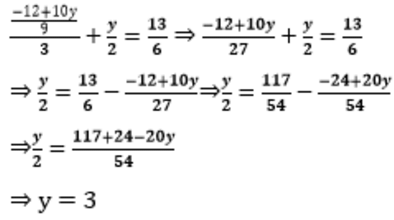
Now, substitute the value of y in equation (1), we get,
(3x/2) - 5(3)/3 = -2
⇒ (3x/2) - 5 = -2
⇒ x = 2
Therefore, x = 2 and y = 3.
Q2: Solve 2x + 3y = 11 and 2x - 4y = - 24 and hence find the value of 'm' for which y = mx + 3.
Sol: 2x + 3y = 11................................(I)
2x - 4y = -24.............................. (II)
From equation (II), we get
x = (11-3y)/2 ......................(III)
Substituting the value of x in equation (II), we get
2(11-3y)/2 - 4y = 24
11 - 3y - 4y = -24
-7y = -35
y = 5............................................(IV)
Putting the value of y in equation (III), we get
x = (11-3×5)/2 = -4/2 = -2
Hence, x = -2, y = 5
Also,
y = mx + 3
5 = -2m +3
-2m = 2
m = -1
Therefore the value of m is -1.
Q3: Form the pair of linear equations for the following problems and find their solution by substitution method.
(i) The difference between two numbers is 26 and one number is three times the other. Find them.
Sol: Let the two numbers be x and y respectively, such that y > x.
According to the question,
y = 3x .................. (1)
y - x = 26 ..............(2)
Substituting the value of (1) into (2), we get
3x - x = 26
x = 13 ................ (3)
Substituting (3) in (1), we get y = 39
Hence, the numbers are 13 and 39.
(ii) The larger of two supplementary angles exceeds the smaller by 18 degrees. Find them.
Sol: Let the larger angle by xo and smaller angle be yo.
We know that the sum of two supplementary pair of angles is always 180o.
According to the question,
x + y = 180o................ (1)
x - y = 18o .................(2)
From (1), we get x = 180o - y ............. (3)
Substituting (3) in (2), we get
180o - y - y =18o
162o = 2y
y = 81o .............. (4)
Using the value of y in (3), we get
x = 180o - 81o
= 99o
Hence, the angles are 99o and 81o.
(iii) The coach of a cricket team buys 7 bats and 6 balls for Rs.3800. Later, she buys 3 bats and 5 balls for Rs.1750. Find the cost of each bat and each ball.
Sol: Let the cost a bat be x and cost of a ball be y.
According to the question,
7x + 6y = 3800 ................... (I)
3x + 5y = 1750 ................... (II)
From (I), we get
y = (3800-7x)/6....................(III)
Substituting (III) in (II). we get,
3x+5(3800-7x)/6 =1750
⇒ 3x+ 9500/3 - 35x/6 = 1750
⇒ 3x- 35x/6 = 1750 - 9500/3
⇒ (18x-35x)/6 = (5250 - 9500)/3
⇒-17x/6 = -4250/3
⇒-17x = -8500
x = 500 ............................. (IV)
Substituting the value of x in (III), we get
y = (3800-7 ×500)/6 = 300/6 = 50
Hence, the cost of a bat is Rs 500 and cost of a ball is Rs 50.
(iv) The taxi charges in a city consist of a fixed charge together with the charge for the distance covered. For a distance of 10 km, the charge paid is Rs 105 and for a journey of 15 km, the charge paid is Rs 155. What are the fixed charges and the charge per km? How much does a person have to pay for travelling a distance of 25 km?
Sol: Let the fixed charge be Rs x and per km charge be Rs y.
According to the question,
x + 10y = 105 ................. (1)
x + 15y = 155 ................. (2)
From (1), we get x = 105 - 10y ................... (3)
Substituting the value of x in (2), we get
105 - 10y + 15y = 155
5y = 50
y = 10 ................. (4)
Putting the value of y in (3), we get
x = 105 - 10 × 10 = 5
Hence, fixed charge is Rs 5 and per km charge = Rs 10
Charge for 25 km = x + 25y = 5 + 250 = Rs 255
(v) A fraction becomes 9/11 , if 2 is added to both the numerator and the denominator. If, 3 is added to both the numerator and the denominator it becomes 5/6. Find the fraction.
Sol: Let the fraction be x/y.
According to the question,
(x+2) /(y+2) = 9/11
11x + 22 = 9y + 18
11x - 9y = -4 ................. (1)
(x+3) /(y+3) = 5/6
6x + 18 = 5y +15
6x - 5y = -3 ................... (2)
From (1), we get x = (-4+9y)/11 ................. (3)
Substituting the value of x in (2), we get
6(-4+9y)/11 -5y = -3
-24 + 54y - 55y = -33
-y = -9
y = 9 ..................... (4)
Substituting the value of y in (3), we get
x = (-4+9×9 )/11 = 7
Hence the fraction is 7/9.
(vi) Five years hence, the age of Jacob will be three times that of his son. Five years ago, Jacob's age was seven times that of his son. What are their present ages?
Solutions: Let the age of Jacob and his son be x and y respectively.
According to the question,
(x + 5) = 3(y + 5)
x - 3y = 10 ............................................ (1)
(x - 5) = 7(y - 5)
x - 7y = -30 .............................................. (2)
From (1), we get x = 3y + 10 ......................... (3)
Substituting the value of x in (2), we get
3y + 10 - 7y = -30
-4y = -40
y = 10 ..................... (4)
Substituting the value of y in (3), we get
x = 3 x 10 + 10 = 40
Hence, the present age of Jacob's and his son is 40 years and 10 years respectively.
Exercise 3.3
Q1. Solve the following pair of linear equations by the elimination method and the substitution method:
(i) x + y = 5 and 2x - 3y = 4
(ii) 3x + 4y = 10 and 2x - 2y = 2
(iii) 3x - 5y - 4 = 0 and 9x = 2y + 7
(iv) x / 2 + 2y / 3 = -1 and x - y / 3 = 3
Sol: (i) x + y = 5 and 2x - 3y = 4
By the method of elimination:
x + y = 5 ........................(i)
2x - 3y = 4 .....................(ii)
When the equation (i) is multiplied by 2, we get
2x + 2y = 10 ..................(iii)
When the equation (ii) is subtracted from (iii) we get,
5y = 6
y = 6 / 5 ..................(iv)
Substituting the value of y in eq. (i) we get,
x = 5 - 6 / 5 = 19 / 5
∴ x = 19 / 5, y = 6 / 5
By the method of substitution:
From the equation (i), we get:
x = 5 - y..................(v)
When the value is put in equation (ii) we get,
2(5 - y) - 3y = 4
-5y = -6
y = 6 / 5
When the values are substituted in equation (v), we get:
x = 5 - 6 / 5 = 19 / 5
∴ x = 19 / 5 ,y = 6 / 5
(ii) 3x + 4y = 10 and 2x - 2y = 2
By the method of elimination:
3x + 4y = 10..................(i)
2x - 2y = 2 .....................(ii)
When the equation (i) and (ii) is multiplied by 2, we get:
4x - 4y = 4 .....................(iii)
When the Equation (i) and (iii) are added, we get:
7x = 14
x = 2 ......................(iv)
Substituting equation (iv) in (i) we get,
6 + 4y = 10
4y = 4
y = 1
Hence, x = 2 and y = 1
By the method of Substitution:
From equation (ii) we get,
x = 1 + y........................(v)
Substituting equation (v) in equation (i) we get,
3(1 + y) + 4y = 10
7y = 7
y = 1
When y = 1 is substituted in equation (v) we get,
x = 1 + 1 = 2
Therefore, x = 2 and y = 1
(iii) 3x - 5y - 4 = 0 and 9x = 2y + 7
By the method of elimination:
3x - 5y - 4 = 0 ...........................(i)
9x = 2y + 7
9x - 2y - 7 = 0 ...........................(ii)
When the equation (i) and (iii) is multiplied we get,
9x - 15y - 12 = 0 ........................(iii)
When the equation (iii) is subtracted from equation (ii) we get,
13y = -5
y = -5 / 13 ..............................(iv)
When equation (iv) is substituted in equation (i) we get,
3x + 25 / 13 - 4 = 0
3x = 27 / 13
x = 9 / 13
∴ x = 9 / 13 and y = -5 / 13
By the method of Substitution:
From the equation (i) we get,
x = (5y + 4) / 3 ..............................(v)
Putting the value (v) in equation (ii) we get,
9(5y + 4) / 3 - 2y - 7 = 0
13y = -5
y = -5 / 13
Substituting this value in equation (v) we get,
x = (5(-5 / 13) + 4) / 3
x = 9 / 13
∴ x = 9 / 13, y = -5 / 13
(iv) x / 2 + 2y / 3 = -1 and x - y / 3 = 3
By the method of Elimination:
3x + 4y = -6 ............................... (i)
x - y / 3 = 3
3x - y = 9 .................................. (ii)
When the equation (ii) is subtracted from equation (i) we get,
5y = -15
y = - 3 ............................(iii)
When the equation (iii) is substituted in (i) we get,
3x - 12 = -6
3x = 6
x = 2
Hence, x = 2 , y = -3
By the method of Substitution:
From the equation (ii) we get,
x = (y + 9) / 3..............................(v)
Putting the value obtained from equation (v) in equation (i) we get,
3(y + 9) / 3 + 4y = -6
5y = -15
y = -3
When y = -3 is substituted in equation (v) we get,
x = (-3 + 9) / 3 = 2
Therefore, x = 2 and y = -3
Q.2. Form the pair of linear equations in the following problems, and find their solutions (if they exist) by the elimination method:
(i) If we add 1 to the numerator and subtract 1 from the denominator, a fraction reduces to 1. It becomes if we only add 1 to the denominator. What is the fraction?
Sol: Let the fraction be a / b
According to the given information,
(a + 1) / (b - 1) = 1
=> a - b = -2 .................(i)
a / (b + 1) = 1 / 2
=> 2a - b = 1........................(ii)
When equation (i) is subtracted from equation (ii) we get,
a = 3 ......................(iii)
When a = 3 is substituted in equation (i) we get,
3 - b = -2
-b = -5
b = 5
Hence, the fraction is 3/5.
(ii) Five years ago, Nuri was thrice as old as Sonu. Ten years later, Nuri will be twice as old as Sonu. How old are Nuri and Sonu?
Sol: Let us assume, present age of Nuri is x
And present age of Sonu is y.
According to the given condition, we can write as;
x - 5 = 3(y - 5)
x - 3y = -10...........................(1)
Now, x + 10 = 2(y +10)
x - 2y = 10.....................(2)
Subtract eq. 1 from 2, to get, y = 20 ..............................(3)
Substituting the value of y in eq.1, we get,
x - 3.20 = -10
x - 60 = -10
x = 50
Therefore,
Age of Nuri is 50 years
Age of Sonu is 20 years.
(iii) The sum of the digits of a two-digit number is 9. Also, nine times this number is twice the number obtained by reversing the order of the digits. Find the number.
Sol: 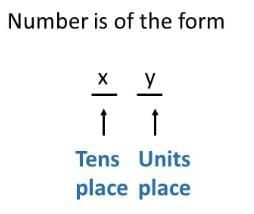
Let the number be 10x + y.
Given, x + y = 9 ...(i)
According to the question,
9(10x + y) = 2(10y + x)
∴ 90x + 9y = 20y + 2x
∴ 88x - 11y = 0
∴ 8x - y = 0 ...(ii)
On adding Eqs. (i) and (ii), we get
9x = 9
∴ x = 1
On substituting x = 1 in Eq. (i), we get
1 + y = 9
∴ y = 8
The number is 10x + y = 10 × 1 + 8 = 18
Therefore, x = 1 and y = 8 are the required digits and the number is 18.
(iv) Meena went to a bank to withdraw Rs.2000. She asked the cashier to give her Rs.50 and Rs.100 notes only. Meena got 25 notes in all. Find how many notes of Rs.50 and Rs.100 she received.
Sol: Let the number of Rs.50 notes be A and the number of Rs.100 notes be B
According to the given information,
A + B = 25 .....................(i)
50A + 100B = 2000 ........................(ii)
When equation (i) is multiplied with (ii) we get,
50A + 50B = 1250 ........................(iii)
Subtracting the equation (iii) from the equation (ii) we get,
50B = 750
B = 15
Substituting in the equation (i) we get,
A = 10
Hence, Meena has 10 notes of Rs.50 and 15 notes of Rs.100.
(v) A lending library has a fixed charge for the first three days and an additional charge for each day thereafter. Saritha paid Rs.27 for a book kept for seven days, while Susy paid Rs.21 for the book she kept for five days. Find the fixed charge and the charge for each extra day.
Sol: Let the fixed charge for the first three days be Rs.A and the charge for each day extra be Rs.B.
According to the information given,
A + 4B = 27 ........................ (i)
A + 2B = 21 ...........................(ii)
When equation (ii) is subtracted from equation (i) we get,
2B = 6
B = 3 .....................(iii)
Substituting B = 3 in equation (i) we get,
A + 12 = 27
A = 15
Hence, the fixed charge is Rs.15
And the Charge per day is Rs.3
A. Multiple Choice Questions
Q1: A pair of linear equations which have a unique solution x = 2, y = - 3 is:(a) 2x - 3y = - 5, x + y = - 1
(b) 2x + 5y + 11 = 0, 4x + 10y + 22 = 0
(c) x - 4y - 14 = 0, 5x - y - 13 = 0
(d) 2x - y = 1, 3x + 2y = 0
Ans: (c) x - 4y - 14 = 0, 5x - y - 13 = 0
Sol: option (a) and (d) donot justify the solution,
In Option (b),1. 2x + 5y + 11 = 0
2. 4x + 10y + 22 = 0
Substituting x = 2 and y = -3
Equation 1: 2(2) + 5(-3) + 11 = 4 - 15 + 11 = 0 (satisfied)
Equation 2: 4(2) + 10(-3) + 22 = 8 - 30 + 22 = 0 (satisfied)
a1/a2 = b1/b2 = c1/c2
Hence , have infinitely many solutions, so (b) is incorrect
Option (c),
Substitute x = 2, y = -3:1. x - 4y - 14 = 0,
2. 5x - y - 13 = 0
Substituting x=2 and y = -3,
Equation 1: 2 - 4(-3) - 14 = 2 + 12 - 14 = 0 (satisfied)
Equation 2: 5(2)- (-3) - 13 = 10 + 3 - 13 = 0 (satisfied)and a1/a2 ≠ b1/b2
Hence , have a unique solution.
So, The correct option is Option c
Q2: If a system of a pair of linear equations in two unknowns is consistent, then the lines representing the system will be
(a) parallel
(b) always coincident
(c) always intersecting
(d) intersecting or coincident
Ans: (d) intersecting or coincident
Sol: A consistent system of linear equations means that there is at least one solution. This can occur in two scenarios:
- Intersecting Lines: The lines intersect at exactly one point, meaning there is one unique solution.
- Coincident Lines: The lines lie on top of each other, meaning there are infinitely many solutions.
Q3: The pair of equations x = 0 and y = 0 has
(a) one solution
(b) two solutions
(c) infinitely many solutions
(d) no solution
Ans: (a) one solution
Sol: The equations x=0 and y=0 represent the x-axis and y-axis respectively.
The only point where these two lines intersect is at the origin, which is the point (0,0). Therefore, there is exactly one solution to this system of equations
Q4: A pair of system of equations x = 2, y = -2; x = 3, y = - 3 when represented graphically enclose
(a) Square
(b) Trapezium
(c) Rectangle
(d) Triangle
Ans: (c) Rectangle
Sol: The equations x=2 andx=3 represent vertical lines, while y=-2 and y=-3 represent horizontal lines.
The intersection points of these lines are (2,-2), (2,-3), (3,-2), and (3,-3).
These points form the vertices of a rectangle, making the shape enclosed by these lines a rectangle on the graph.
Q5: If two lines are parallel to each other, then the system of equations is
(a) consistent
(b) inconsistent
(c) consistent dependent
(d) (a) and (c) both
Ans: inconsistent
Sol: If two lines are parallel, they never intersect, meaning there is no solution to the system of equations. Thus, the system is inconsistent.
| Get additional INR 200 off today with EDUREV200 coupon. | Avail Offer |
B. Fill in the blanks
Q6: If in a system of equations corresponding to coefficients of member, equations are proportional then the system has ______________ solution (s).
Ans: infinitely many
Q7: A pair of linear equations is said to be inconsistent if its graph lines are ____________.
Ans: parallel
Q8: A pair of linear equations is said to be ____________ if its graph lines intersect or coincide.
Ans: Consistent
Q9: A consistent system of equations where straight lines fall on each other is also called _____________ system of equations.
Ans: Dependent
Q10: Solution of linear equations representing 2x - y = 0, 8x + y = 25 is ____________ .
Ans: x = 2.5, y = 5
Sol:
1. From 2x - y = 0, we can express y as:
y = 2x
2. Substitute y into the second equation 8x + y = 25:
8x + 2x = 25
10x = 25 → x = 25/10 = 2.5
3. Substitute x = 2.5 back into y = 2x:
y = 2(2.5) = 5
Thus, the solution is x = 2.5 and y = 5,
Also read: CBSE Previous Year Questions: Pair of Linear Equations in Two Variables |
C. Very Short Answer Questions
Q11: In Fig., ABCD is a rectangle. Find the values of x and y.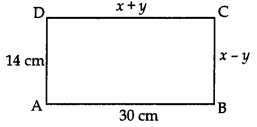
Sol: Since ABCD is a rectangle
⇒ AB = CD and BC = AD
x + y = 30 ................. (i)
x - y = 14 ................ (ii)
(i) + (ii) ⇒ 2x = 44
⇒ x = 22
Plug in x = 22 in (i)
⇒ 22 + y = 30
⇒ y = 8
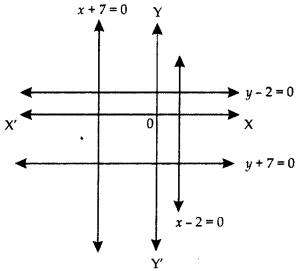
Q12: Name the geometrical figure enclosed by graph of the equations x + 7 = 0, y - 2 = 0 and x - 2 = 0, y + 7 = 0.
Sol: Clearly, a square of side 9 units is enclosed by lines.
Q13: If 51x + 23y = 116 and 23x + 51y = 106, then find the value of (x - y).
Sol: Given equations are:
51x + 23y = 116 ........... (i)
23x + 51y = 106 ............ (ii)
Subtracting (ii) from (i)
28x - 28y = 10
28(x - y) = 10
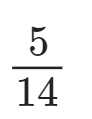
⇒ (x - y) ==
Q14: For what value of V does the point (3, a) lie on the line represented by 2x - 3y = 5?
Sol: Since (3, a) lies on the equation 2x - 3y = 5.
∴ (3, a) must satisfy this equation
⇒ 2(3) - 3(a) = 5
⇒ 6 - 3a = 5
⇒ - 3a = 5 - 6 = - 1
∴ a = 1/3
Q15: Determine whether the following system of linear equations is inconsistent or not.
3x - 5y = 20
6x - 10y = -40
Sol: Given
3x - 5y = 20 ......... (i)
6x - 10y = - 40 ............ (ii)Hence given pair of linear equations are parallel.∴ It is inconsistent.
| Attention! Sale expiring soon, act now & get EduRev Infinity at 40% off! | Claim Offer |
D. Short Answer Type Questions
Q16: The father's age is six times his son's age. Four years hence, the age of the father will be four times his son's age. Find the present ages of the son and the father.
Sol:
Let the father's age be y and the son's age be x.
First condition: y = 6x
Second condition: y + 4 = 4 (x + 4)
So, we have 6x + 4 = 4 x + 16
x = 6 and y = 36
Q17: If the lines x + 2y + 7 = 0 and 2x + ky + 18 = 0 intersect at a point, then find the value of k.
Sol: For a unique solution
Substituting the values

Q18: Find the value of k for which the system of equations x + 2y -3 = 0 and ky + 5x + 7 = 0 has a unique solution.
Sol: For a unique solution
Substituting the values


Q19: Find the values of a and b for which the following system of linear equations has an infinite number of solutions:
2x + 3 y = 7
2ax + (a + b) y = 28
Sol: We have
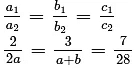
Solving this , we get a = 4 and b = 8
Q20: In a cyclic quadrilateral ABCD, Find the four angles.
a. ∠A = (2 x + 4), ∠B = (y + 3), ∠C = (2y + 10) , ∠D = (4x - 5) .
b. ∠A = (2 x - 1) , ∠ B = (y + 5) , ∠C = (2 y + 15) and ∠D = (4 x - 7)
Sol: a. ∠ A = (2 x + 4) , ∠B = (y + 3), ∠C = (2 y + 10), ∠D = (4 x - 5)
In a cyclic quadrilateral, Opposite angles are supplementary.
∠A + ∠C = 180° and ∠ B + ∠ D = 180°
So, 2x + 4 + 2y + 10 = 180
or x + y = 83 - (1)
y + 3 + 4 x - 5 = 180
or y + 4 x = 182 -(2)
Solving the equations (1) and (2)by Substitution method
x = 33 and y = 50
So Angles are 70°, 53°,110°,127°b. ∠A = (2 x - 1) , ∠B = (y + 5) , ∠C = (2 y + 15) and ∠D = (4 x - 7)
Solving similarly, we get
65°, 55°, 115°, 125°
Also read: CBSE Previous Year Questions: Pair of Linear Equations in Two Variables |
E. Long Answer Type Questions
Q21: Draw the graph of 2x + y = 6 and 2x - y + 2 = 0. Shade the region bounded by these lines and the x-axis. Find the area of the shaded region.
Sol: The given system of equations is
2x + y - 6 = 0 .......... (i)
2x - y + 2 = 0 ......... (ii)
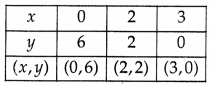
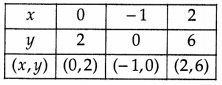
Let us write three solutions for each equation of the system in a table.
(i) ⇒ y = 6 - 2x
Table of solutions for 2x + y - 6 = 0Similarly (ii) ⇒ y = 2x + 2
Table of solutions for 2x - y + 2 = 0
Plotting these points of each table of solutions on the same graph paper and joining them with a ruler, we obtain the graph of two lines represented by equations (i) and (ii) respectively as shown in the graph below. Since, the two lines intersect at point P(1, 4). Thus x = 1, y = 4 is the solution of the given system of equations. In the graph, the area is bounded by the lines and the x-axis is ∆PAB which is shaded.Draw PM ⊥ x-axis
Clearly, PM = y-coordinate of P(1, 4) = 4 units
Also, AB = 1 + 3 = 4 units
∴ Area of the shaded region = Area of ∆PAB =× AB × PM=
× 4 × 4 = 8 sq. units.
Q22: Draw the graphs of the following equations:
2x - y = 1, x + 2y = 13
(i) Find the solution of the equations from the graph.
(ii) Shade the triangular region formed by lines and the y-axis.
Sol: 2x - y = 1 ................. (i)
x + 2y = 13 ................... (ii)
Let us draw a table of values for (i) and (ii)Plotting these points on the graph paper, we see that the two lines representing equations (i) and (ii) intersect at points (3, 5).
(i) Therefore, (3, 5) is the solution of a given system,
(ii) Also, two lines enclose a triangular region (∆ABC) with a y-axis shaded in the graph.
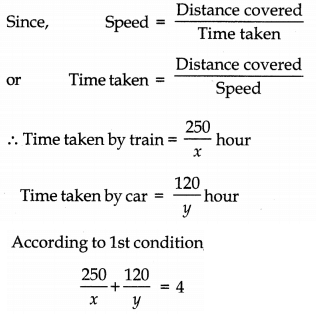
Q23: A man travels 370 km partly by train and partly by car. If he covers 250 km by train and the rest by car, it takes him 4 hours. But, if he travels 130 km by train and the rest by car, he takes 18 minutes longer. Find the speed of the train and that of the car.
Sol: Let the speed of the train= x km/ hour
Speed of the car = y km/hour
Case I:
Total distance travelled = 370 km
Distance traveled by train = 250 km
Distance travelled by car = (370 - 250) km = 120 km
or 250y + 120x = 4xy or 60x + 125y = 2xyCase II:
Total distance covered = 370 km
Distance covered by train = 130 km
Distance covered by car = (370 -130) km = 240
Time is taken by train =hour
Time is taken by car =hour
According to 2nd condition,= 4 hours 18 minutes
130x+240y=4310
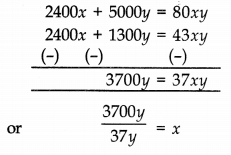
1300y + 2400x = 43xy
or 2400x + 1300y = 43xy
Multiplying equation (i) by 40, we get
or x = 100
From (i) and (iii), we get 60(100) + 125y = 2(100)y
6000 + 125y = 200y
or (200 - 125) y = 6000
or 75y = 6000
or y == 80
Hence, the speeds of the train and car is 100 km/hour and 80 km/hour respectively
Q24: The taxi charges in a city comprise a fixed charge together with the charge for the distance covered. For a journey of 10 km, the charge paid is ₹75 and for a journey of 15 km, the charge paid is ₹110. What will a person have to pay for traveling a distance of 25 km?
Sol: Let fixed charges for taxi be ₹x and charges for covering distance be ₹y per km.
Then, according to the question, we have
x + 10y = 75 ......... (i)
and x + 15y = 110
Subtracting (i) from (ii), we get
5y = 35 ⇒ y = 35 ÷ 5 = 7
Putting y = 7 in (i), we get
x + 10 (7) = 75
⇒ x = 75 - 70 = 5
∴ The person will have to pay for travelling a distance of 25 km = x + 25y = 5 + 25(7) = ₹180.
Q25: Solve the following system by drawing their graph:
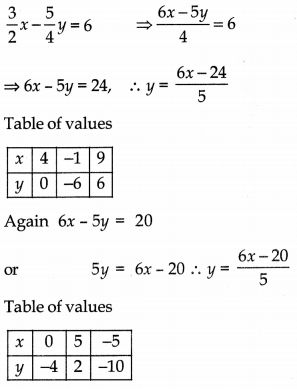
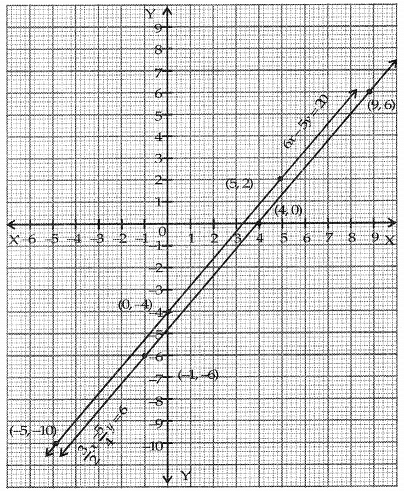
(3/2)x - (5/4)y = 6, 6x - 6y = 20.
Determine whether these are consistent, inconsistent, or dependent.
Sol:
Plotting the points and joining by a ruler in each case. Here, we see that the graph of given equations are parallel lines. The two lines have no point in common. The given system of equations has no solution and is, therefore, inconsistent.
Long Answer Questions: Pair of Linear Equations in Two Variables
Q1: For what value of p, the pair of linear equations px = 2y; 2x - y + 5 = 0 has unique solution?
Sol: We have: px = 2y
⇒ px- 2y = 0
2x - y + 5=0
⇒ 2x - y = - 5
Here, a1 = p, b1 = - 2,
c1 = 0
a2 = 2, b2 = - 1,
c2 = - 5
For a unique solution,
a1a2 ≠ b1b2
Substitute the values:
p2 ≠ -2-1
p2 ≠ 2
p ≠ 4
Q2: In a cyclic quadrilateral PQRS, ∠P = (2x + 4)°, ∠Q = (y + 3)°, ∠R = (2y + 10)° and ∠S = (4x - 5)°. Find its four angles.
Sol: In a cyclic quadrilateral, the sum of opposite angles is 180°.
1. From ∠P + ∠R = 180°
(2x + 4) + (2y + 10) = 180
2x + 2y + 14 = 180
2x + 2y = 166
x + y = 83 ...(1)
2. From ∠Q + ∠S = 180°
(y + 3) + (4x - 5) = 180
4x + y - 2 = 180
4x + y = 182 ...(2)
3. Solve the equations
From (1): y = 83 - x
Substitute in (2):
4x + (83 - x) = 182
3x + 83 = 182
3x = 99
x = 33
y = 83 - 33 = 50
4. Find the angles
∠P = 2x + 4 = 2(33) + 4 = 70°
∠Q = y + 3 = 50 + 3 = 53°
∠R = 2y + 10 = 2(50) + 10 = 110°
∠S = 4x - 5 = 4(33) - 5 = 127°
Ans: ∠P = 70°, ∠Q = 53°, ∠R = 110°, ∠S = 127°
Q3: Solve:
23x + 35y = 209
35x + 23y = 197
Sol: Add the equations:
(23x + 35y) + (35x + 23y) = 209 + 197
58x + 58y = 406
x + y = 7 ...(1)
Subtract first from second:
(35x + 23y) - (23x + 35y) = 197 - 209
12x - 12y = -12
x - y = -1 ...(2)
Add (1) and (2):
2x = 6 ⇒ x = 3
Substitute in (1):
3 + y = 7 ⇒ y = 4
Ans: x = 3, y = 4
Q4: Solve:
3x + 5y = 70 ...(1)
7x - 3y = 60 ...(2)
Sol: To solve the equations:
3x + 5y = 70
7x - 3y = 60
Step 1: Eliminate one variable
Multiply Equation (1) by 3 and Equation (2) by 5:
(9x + 15y = 210)
(35x - 15y = 300)
Add the two equations:
(44x = 510)
x = 51044 = 25522
Step 2: Substitute x into Equation (1)
Substitute x = 25522 into 3x + 5y = 70:
3 x 25522 + 5y = 70
76522 + 5y = 70
5y = 70 - 76522
5y = 154022 - 76522
5y = 77522
y = 775110 = 15522
Therefore, x = 25522, y = 15522
Q5: Without drawing the graphs, state whether the following pair of linear equations will represent intersecting lines, coinciding lines or parallel lines:
6x - 3y + 10 = 0
2x - y + 9 = 0
Sol: Here, the given set of equations is:
6x - 3y + 10 = 0 ...(1)
2x - y + 9 = 0 ...(2)
From (1) and (2), we have:
a1 = 6, b1 = - 3, c1 = 10
a2 = 2, b2 = - 1, c2 = 9
Now , a1a2 = 62 = 3
∴ We have: a1a2 = b1b2 ≠ c1c2
This condition represents parallel lines. Hence, the given pair represents parallel lines.
Q6: Check graphically whether the pair of equations
3x - 2y + 2 = 0
32 x - y + 3 = 0
is consistent. Also find the co-ordinates of the points where the graphs of the equations meet the y-axis.
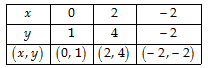
Sol: 3x - 2y + 2 = 0 ⇒ y = ..(1)
..(1)
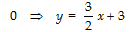
Also = 0 ⇒ y =  ...(2)
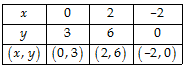
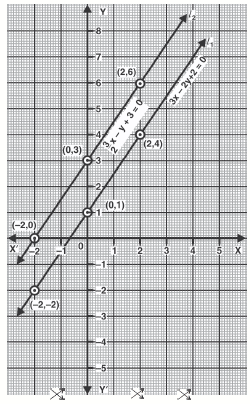
Plotting the points (0, 1), (2, 4), (- 2, - 2) and (0, 3), (2, 6), (-2, 0) we get two straight lines l1 and l2 which are parallel.
∴ The given equations are inconsistent.
From the graph, we observe that line l1 meets the y-axis at (0, 1) and line l2 meets the y-axis at (0, 3).
Q7: A fraction becomes 1/3 if 2 is added to both numerator and denominator. If 3 is added to both numerator and denominator, it becomes 2/5. Find the fraction.
Sol: Let the fraction be: xy
From the first condition: x + 2y + 2 = 13
Cross-multiplying:
3(x + 2) = y + 2
Simplify:
3x - y = -4 (1)
From the second condition: x + 3y + 3 = 25
Cross-multiplying:
5(x + 3) = 2(y + 3)
Simplify:
5x - 2y = -9 (2)
From Equation (1):
y = 3x + 4 (3)
Substitute y = 3x + 4 into Equation (2):
5x - 2(3x + 4) = -9
Simplify:
-x = -1 , x = 1
Substitute x = 1 into Equation (3):
y = 3(1) + 4 = 7
Thus, the fraction is: 17
Q8: Check graphically whether the pair of equations
3x + 5y = 15
x - y = 5
is consistent. Also, find the coordinates of the points where the graphs of equations meet the y-axis.
Sol: We have
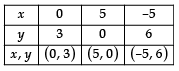
3x + 5y = 15
⇒ y = 15 - 3x5
∴ 
And from x - y = 5
⇒ y = x - 5
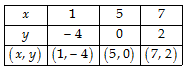
Plotting the above two sets of points we get two straight lines l1 and l2 which intersect at the point (5, 0).
Thus, the given system is consistent.
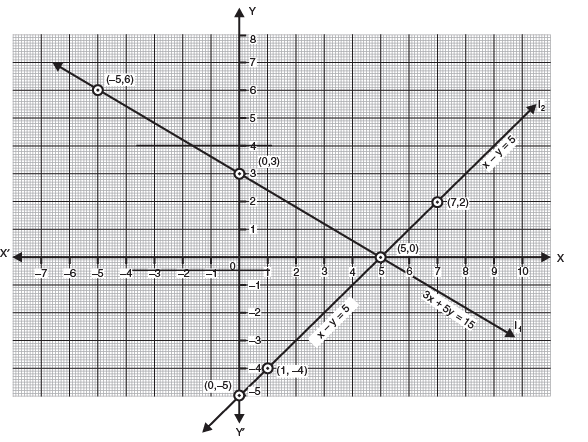
Obviously, line l1 meets the y-axis at (0, 3) and line l2 meets the y-axis at (0, - 5).
Q9: Places A and B are 160 km apart on the highway. One car starts from A and another from B at the same time. If the cars travel in the same direction at different speeds, they meet in 8 hours, but if they travel towards each other, they meet in 2 hours. What are the speeds of the two cars?
Sol: Let the car-I and car-II start from A and B at x km/hr and y km/hr respectively.
Case-I: [Cars are moving in the same direction]
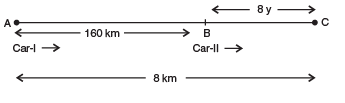
Let the two cars meet at C after 8 hours.
Distance covered:
by car-I = AC = 8x km
by car-II = BC = 8y km
∴ AB = AC - BC
⇒ 160 = 8x - 8y
⇒ x - y = 20 ...(1)
Case-II: [Cars are moving in opposite directions]
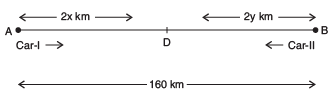
Let, after 2 hours, the cars meet at D.
∴ Distance cover after 2 hours,
by car-I = AD = 2x km
by car-II = BD = 2y km
⇒ AB = AD + BD
⇒ 160 = 2x + 2y
⇒ 80 = x + y
⇒ x + y = 80 ...(2)
Adding (1) and (2), we get
x + y = 80
x - y = 20
2x = 100
⇒ x = 100/2 = 50
⇒ Substituting x = 50 in (1), we get
x - y = 20 ⇒ 50 - y = 20
⇒ y = 50 - 20 = 30
⇒ Speed of car-I = 50 km/hr
Speed of car-II = 30 km/hr.
Q10: Solve for x and y:
axb - bya = a + b
ax - by = 2ab
Sol: We have:
= axb - bya = a + b ...(1)
ax - by = 2ab ...(2)
Dividing (2) by a, we have:
x - bya = 2b
⇒ bya = x - 2b ... (3)
From (1) and (3), we have:
axb - (x - 2b) = a + b
⇒ axb - x + 2b - a - b = 0
⇒ axb - x + b - a = 0
⇒ x ( ab - 1 ) = - (b - a)
⇒ x ( a - bb ) = - (b - a)
⇒ x = - (b - a) x b(a - b)
⇒ x = - (b - a) x b- (b - a) = b
From (2),
ab - by = 2ab
⇒ - by = 2ab - ab = ab
⇒ -y = abb = a
y = - a
Thus, x = b and y = - a.
Q11: The sum of two numbers is 8. Determine the numbers if the sum of their reciprocals is 8/15.
Sol: Let the two numbers be x and y.
According to the conditions:
x + y = 8 ...(1)
= 1x + 1y = 815 ... (2)
From (1), x = (8 - y)
Substituting x = (8 - y) in (2),
1(8 - y) + 1y = 815
⇒ y + 8 - y(8 - y)y = 815
⇒ 8 × 15 = 8 × y (8 - y)
⇒ 64y - 8y2 - 120 = 0
⇒- y2 + 8y - 15 = 0
⇒ y2 - 8y + 15 = 0
⇒ y2 - 5y - 3y + 15 = 0
⇒ y (y - 5) - 3 (y - 5) = 0
⇒ (y - 5) (y - 3) = 0
⇒ If y - 5 = 0 then y = 5
or if y - 3 = 0, then y = 3
Since x = 8 - y
⇒ when y = 5,
then x = 8 - 5 = 3
when y = 3, then
x = 8 - 3 = 5
⇒ The required numbers are (3, 5) or
(5, 3).
Q12: Solve the following pair of equations:
5x - 1 + 1y - 2 = 2
6x - 1 - 3y - 2 = 1
Sol: Let p = 1x - 1 and q = 1y - 2
⇒The given system of equations becomes:
5p + q = 2 ...(1)
6p - 3q = 1 ...(2)
Multiplying (1) by 3 and adding to (2),
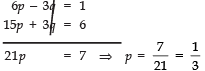
⇒21p = 7
⇒p = 721 = 13
⇒ p = 13
and 5p + q = 2
⇒ 5(13) + q = 2
⇒ 53 + q = 2
⇒ q = 2 - 53 = 13
⇒ q = 13
Since, p = 1x - 1
therefore 1x - 1 = 13 ⇒ x - 1 = 3
⇒ x = 4
Also, q = 1y - 2
⇒ y - 2 = 3 ⇒ y = 5
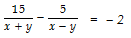
Q13: Solve the following pair of equations: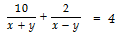
Sol: Let 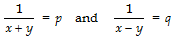
⇒ The given pair of equation is expressed as
10p + 2q = 4 ⇒ 5p + q = 2 ...(1)
15p - 5q = - 2 ...(2)
Multiplying (1) by 5 and adding to (2)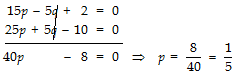
From (1), 
⇒1 + q = 2 ⇒ q = 2 - 1 = 1
Since, 
⇒ 
⇒ x + y = 5 ...(3)
And 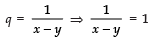
⇒ x - y = 1 ...(4)
Adding (3) and (4),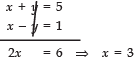
From (3), 3 + y = 5 ⇒ y = 2
Thus, x = 3 and y = 2.
Ques 14: Solve for x and y:
37x + 43y = 123
43x + 37y = 117
Sol: We have:
37x + 43y = 123 ...(1)
43x + 37y = 117 ...(2)
Adding (1) and (2)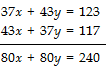
Dividing both sides by 80, we get
x + y = 3 ...(3)
Subtracting (2) from (1),
- 6x + 6y = 6 ⇒ - x + y = 1 ...(4)
Adding:
⇒ y = 4/2 = 2
Putting y = 2 in x + y = 3, we get
x + 2 = 3 ⇒ x = 3 - 2 = 1
Thus, x = 1 and y = 2.
Ques 15: Solve for 'x' and 'y':
(a - b) x + (a + b) y = a2 - 2ab - b2
(a + b) (x + y) = a2 + b2
Sol: We have:
(a - b) x + (a + b) y = a2 - 2ab - b2 ...(1)
(a + b) x + (a + b) y = a2 + b2 ...(2)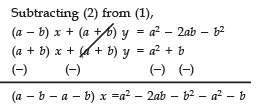
- 2b x = - 2ab - 2b2
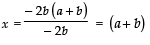
⇒ (- 2b) x = - 2b (a + b)
⇒ 
From (2),
(a + b) (a + b) + (a + b) y = a2 + b2
⇒(a + b)2 + (a + b) y = (a2 + b2)
⇒ (a + b) y = (a2 + b2) - (a + b)2
⇒ (a + b) y = a2 + b2 - (a2 + b2 + 2ab)
⇒ (a + b) y = a2 + b2 - a2 - b2 - 2ab
⇒ (a + b) y = - 2ab
⇒ 
Thus, x = (a + b) and
Q16: Represent the following pair of equations graphically and write the co-ordinates of points where the lines intersect y-axis:
x + 3y = 6, 2x - 3y = 12
Sol: We have:
x + 3y = 6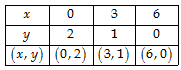
and 2x - 3y = 12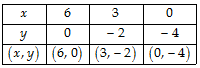
Plotting the above points, we get two straight lines l1 and l2 such that they intersect at (6, 0) as shown below: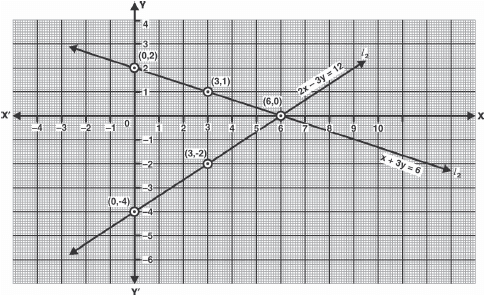
Obviously,
The line l1 meets the y-axis at (0, 2).
The line l2 meets the y-axis at (0, - 4).
Q17: Solve for x and y:
5x - 1 + 1y - 2 = 2
6x - 1 - 3y - 2 = 1
Sol: Given equations:
5x - 1 + 1y - 2 = 2
6x - 1 - 3y - 2 = 1
Substituting u = 1x - 1 and v = 1y - 2, we get:
5u + v = 2
6u - 3v = 1
Solving these equations:
From 5u + v = 2:
v = 2 - 5u
Substituting v = 2 - 5u into 6u - 3v = 1:
6u - 3(2 - 5u) = 1
6u - 6 + 15u = 1
21u = 7
u = 13
Finding v:
v = 2 - 5 × 13 = 13
Back-substituting to find x and y:
u = 1x - 1 ⇒ x - 1 = 3 ⇒ x = 4
v = 1y - 2 ⇒ y - 2 = 3 ⇒ y = 5
Solution:
x = 4, y = 5
Q18: For what values of 'a' and 'b' does the following pair of equations have an infinite number of solutions?
2x + 3y = 7
a (x + y) - b (x - y) = 3a + b - 2
Sol: We have:
2x + 3y = 7 ...(1)
a (x + y) - b (x - y) = 3a + b - 2 ...(2)
From (2), we have:
a (x + y) - b (x - y) = 3a + b - 2
⇒ ax + ay - bx + by = 3a + b - 2
⇒ ax - bx + ay + by = 3a + b - 2
⇒ (a - b) x + (a + b) y = 3a + b - 2
Now, A1 = 2, B1= 3,
C1 = - 7
A2 = (a - b), B2
= (a + b),
C2 = - [3a + b - 2]
For infinite number of solutions,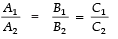
i.e., 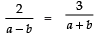
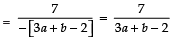
∴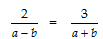
⇒ 2 (a + b) = 3 (a - b)
⇒ 2a + 2b - 3a + 3b = 0
⇒ - a + 5b = 0
⇒ a = 5b ...(3)
Also = 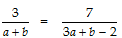
⇒ 3 (3a + b - 2) = 7 (a + b)
⇒ 9a + 3b - 6 = 7a + 7b
⇒ 9a - 7a + 3b - 7b = 6
⇒ 2a - 4b = 6
⇒ a - 2b = 3 ...(4)
From (3) and (4),
5b - 2b = 3
⇒ 3b = 3 ⇒ b = 1
Thus, a = 5 × b
⇒ a = 5 × 1 = 5
i.e., a = 5 and b = 1.
Q19: Solve the following pairs of equations for x and y: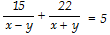

15x - y + 22x + y = 5
40x - y + 55x + y = 13 [x ≠ y and x ≠ -y]
Sol: We are given the equations:
15x - y + 22x + y = 5
40x - y + 55x + y = 13
Let us substitute:
u = 1x - y, v = 1x + y
The equations become:
15u + 22v = 5
40u + 55v = 13
From the first equation:
u = 5 - 22v15
Substitute this value into the second equation:
40 × 5 - 22v15 + 55v = 13
Multiply through by 15:
200 - 880v + 825v = 195
Combine like terms:
200 - 55v = 195
Simplify:
-55v = -5 → v = 111
Substitute v back into the first equation:
15u + 22 × 111 = 5
Simplify:
15u + 2 = 5 → 15u = 3 → u = 15
Now back-substitute:
x - y = 5, x + y = 11
Add the equations:
2x = 16 → x = 8
Subtract the equations:
2y = 6 → y = 3
Final Answer: x = 8, y = 3
Q20: Draw the graph of the pair of linear equations x - y + 2 = 0 and 4x - y - 4 = 0. Calculate the area of triangle formed by the lines so drawn and the x-axis.
Sol: To draw the graph of the given pair of equations, we have the table of ordered pairs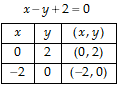
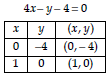
Plot the points A(0, 2), B(-2, 0); C(0, -4) and D(1, 0) on the graph paper and join the points to form the lines AB and CD :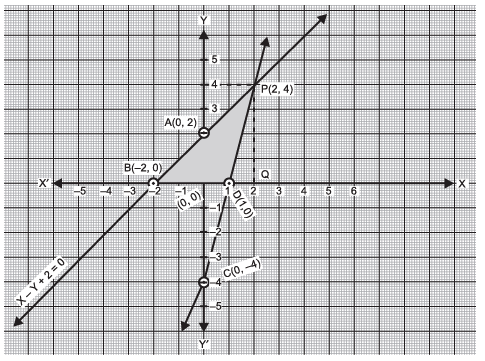
From the graph, we find that the points P(2, 4) is common to both the lines AB and CD.
These lines meet the x-axis at B(-2, 0) and D(1, 0).
Thus, the triangle BDP is formed by the lines and the x-axis.
The vertices of this Δ are
B(-2, 0), D(1, 0) and P(2, 4)
Now, the base of ΔBDP = BD
= (BO + OD)
= (2 + 1) units
= 3 units
Altitude of the ΔBDP = PQ
= 4 units
∴ Area of ΔBDP = 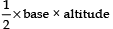
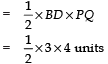
= 6 sq. units
Q21: It can take 12 hours to fill a swimming pool using two pipes. If the pipe of larger diameter is used for 4 hours and the pipe of smaller diameter for 9 hours, only half the pool can be filled. How long would it take for each pipe to fill the pool separately?
Sol: Let the time taken by the pipe of larger diameter to fill the pool separately = x hours.
The time taken by the pipe of smaller diameter to fill the pool separately = y hours.
∴ Part of the pool fill by a pipe of larger diameter in 1 hour = 1/x.
Part of fool filled by the pipe of larger diameter in 4 hours = 4/x.
Similarly, Part of the pool filled by the pipe of smaller diameter in 9 hours = 9/y.
∴We have =  ...(1)
Since the pool is filled by both the pipes together in 12 hours.
∴  ...(2)
To solve (1) and (2), multiplying (1) by 3 and subtracting (2) from it, we have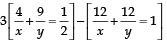
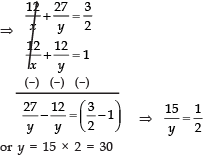
Substituting, y = 30 in (2), we have
⇒ 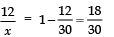
∴ 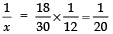
⇒ x = 20
⇒ Required time taken by pipe of larger diameter = 20 hours
Required time taken by pipe of smaller diameter = 30 hours
Unit Test (Solutions): Pair of Linear Equations in Two Variables
Time: 1 hour
M.M. 30
Attempt all questions.
- Question numbers 1 to 5 carry 1 mark each.
- Question numbers 6 to 8 carry 2 marks each.
- Question numbers 9 to 11 carry 3 marks each.
- Question number 12 & 13 carry 5 marks each.
Q1: Which of the following options represents a pair of linear equations in two variables? (1 Mark)
(a) 2x + 3y = 7
(b) x2 + y2 = 25
(c) 4x + 2y = 10
(d) 3x + 2y2 = 8
Ans: (a)
A pair of linear equations in two variables must be of the form ax + by = c, where a, b, and c are constants. Option a) fits this form, while the other options involve either quadratic terms (b) or variable terms with exponents other than 1 (d), which do not represent linear equations.
Q2: The number of solutions for a pair of linear equations in two variables can be: (1 Mark)
(a) One
(b) Two
(c) Three
(d) None
Ans: (a)
A pair of linear equations in two variables can have one of the following types of solutions:
- Unique Solution (a single point of intersection)
- Infinitely Many Solutions (coincident lines)
- No Solution (parallel lines)
Q3: If two lines represented by a pair of linear equations are parallel, then: (1 Mark)
(a) They intersect at one point
(b) They do not intersect
(c) They intersect at two points
(d) None of the above
Ans: (b)
If two lines are parallel, they do not intersect at any point. For a pair of linear equations to represent parallel lines, their slopes must be equal, and their y-intercepts may differ.
Q4: Solve the pair of equations: 2x - 3y = 7 and 4x - 6y = 14. (1 Mark)
Ans: Dividing the second equation by 2, we get:
2x - 3y = 7
This is exactly the same as the first equation.
So, the given pair of equations are dependent (consistent) and have infinitely many solutions.
Q5: Check the consistency of the pair of linear equations and solve them graphically: (1 Mark)
4x - 3y = 9
8x - 6y = 18
Ans: To check the consistency of the equations, we can compare their slopes. Both equations are equivalent, which means they represent the same line. As a result, they have infinitely many solutions and are consistent.
To solve them graphically, we plot the line represented by 4x - 3y = 9 (or 8x - 6y = 18 since they are equivalent). The graph is a straight line passing through points (0, -3) and (9/2, 0) on the coordinate plane.
Q6: Solve the pair of linear equations: (2 Marks)
x - y = 4
2x + 3y = 10
Ans: To solve the pair of linear equations, we can use the method of substitution or elimination.
Substituting the value of x from the first equation into the second equation:
x = 4 + y
2(4 + y) + 3y = 10
Simplify the equation:
8 + 2y + 3y = 10
5y = 2
y = 2/5
Now, substitute the value of y into the first equation to find x:
x - (2/5) = 4
x = 4 + 2/5
x = 22/5
So, the solution to the pair of linear equations is x = 22/5 and y = 2/5.
Q7: Find the value of 'k' for which the following system of equations has no solution: (2 Marks)
2x + 3y = 5
4x + ky = 10
Ans: For a system of equations to have no solution, the lines represented by the equations must be parallel, i.e., they have the same slope. Therefore, we need to find the value of 'k' for which the slopes of the two equations are equal.
The slopes of the equations are given by the coefficients of y:
For the first equation: Slope_1 = 3/2
For the second equation: Slope_2 = k/4
For both lines to be parallel, Slope_1 must be equal to Slope_2:
3/2 = k/4
Now, cross-multiply to find the value of 'k':
3 * 4 = 2 * k
12 = 2k
k = 12/2
k = 6
Now check the ratios of the constants:
2/4 = 3/6 = 5/10
Since all three ratios are equal, the two equations represent the same line. Therefore, the system has infinitely many solutions, not no solution.
Hence, there is no value of k for which the system has no solution.
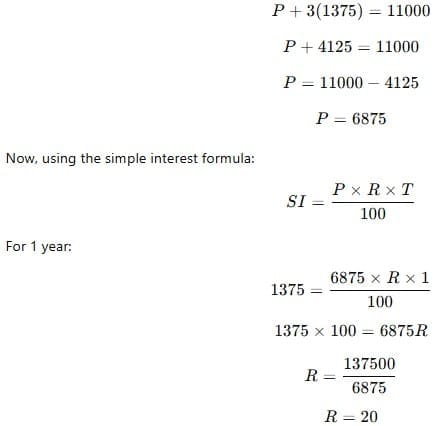
Q8: A sum of money amounts to Rs. 11,000 after 3 years and Rs. 13,750 after 5 years, when it is invested at a certain rate of simple interest. Calculate the rate of interest using a pair of linear equations in two variables. (2 Marks)
Ans: 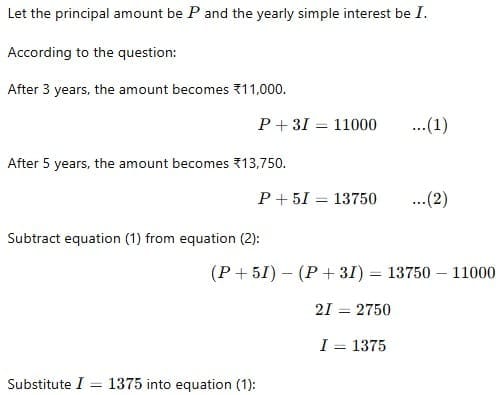
Q9: The sum of the digits of a two-digit number is 9. If we add 9 to the number, the digits get reversed. Find the number using a pair of linear equations in two variables. (3 Marks)
Ans: Let the tens digit of the two-digit number be x, and the units digit be y.
The number can be represented as 10x + y.
According to the first condition, the sum of the digits is 9:
x + y = 9 ... (Equation 1)
According to the second condition, if we add 9 to the number, the digits get reversed:
10x + y + 9 = 10y + x
Simplifying this equation:
10x - x = 10y - y - 9
9x = 9y - 9
x = y - 1 ... (Equation 2)
Now, we can solve the system of equations (Equation 1 and Equation 2) to find the values of x and y, which will give us the required two-digit number.
Q10: Solve the following system of equations using any appropriate method: (3 Marks)
3x - 2y = 8
6x - 4y = 16
Ans: Divide the second equation by 2:
3x - 2y = 8
3x - 2y = 8
Since the equations are the same, they represent the same line and are dependent. Therefore, there are infinitely many solutions.
Q11: Solve the pair of linear equations: (3 Marks)
2x + y = 7
x - 3y = -4
Ans: To solve the pair of linear equations, we can use the substitution or elimination method.
Using the elimination method:
Multiply the first equation by 3:
3(2x + y) = 3(7)
6x + 3y = 21
Now, add the two equations:
(6x + 3y) + (x - 3y) = 21 - 4
7x = 17
Divide by 7:
x = 17/7
Now, substitute the value of x into any equation to find y. Using the first equation:
2(17/7) + y = 7
34/7 + y = 7
Subtract 34/7 from both sides:
y = 7 - 34/7
y = (49 - 34)/7
y = 15/7
So, the solution to the pair of linear equations is x = 17/7 and y = 15/7.
Q12: Vijay invested certain amounts of money in two schemes A and B, which offer interest at the rate of 8% per annum and 9% per annum, respectively. He received ₹1,860 as the total annual interest. However, had he interchanged the amounts of investments in the two schemes, he would have received ₹ 20 more as annual interest. How much money did he invest in each scheme? (5 Marks)
Ans: Let the amount invested in scheme A be ₹x and in scheme B be ₹y respectively.
According to question,

⇒ 8x + 9y = 186000 ....(i)

⇒ 9x + 8y = 188000 ....(ii)
On solving equations (i) and (ii), we get
17y = 170000 ⇒ y = 10000
Substituting the value of y in equation (i), we get
8x + 9(10000) = 186000
⇒ 8x = 186000 - 90000
⇒ 8x = 96000
⇒ x = 96000/8
⇒ x = 12000
∴ Vijay invested ₹12000 in scheme A and ₹10000 in scheme B.
Q13: Three years ago, Rashmi was thrice as old as Nazma. Ten years later, Rashmi will be twice as old as Nazma. How old are Rashmi and Nazma now? (5 Marks)
Ans: Let the age of Rashmi = x years
and the age of Nazma = y years
Three years ago,
Rashmi's age = (x - 3) years
Nazma's age = (y - 3) years
According to the question,
(x - 3) = 3(y - 3)
⇒ x - 3 = 3y - 9
⇒ x = 3y - 6 ...(i)
Ten years later,
Rashmi's age = x + 10
Nazma's age= y + 10
According to the question,
(x + 10) = 2(y + 10)
x + 10 = 2y + 20
x = 2y + 10 ...(ii)
From eq. (i) and (ii), we get
3y - 6 = 2y + 10
y = 16
Substituting the value of y in eq. (i), we get
x = 3 × 16 - 6 = 48 - 6 = 42
Thus, Rashmi is 42 years old, and Nazma is 16 years old.
Infographics: Solving Linear Equation

Mind Map: Linear Equations in Two Variables
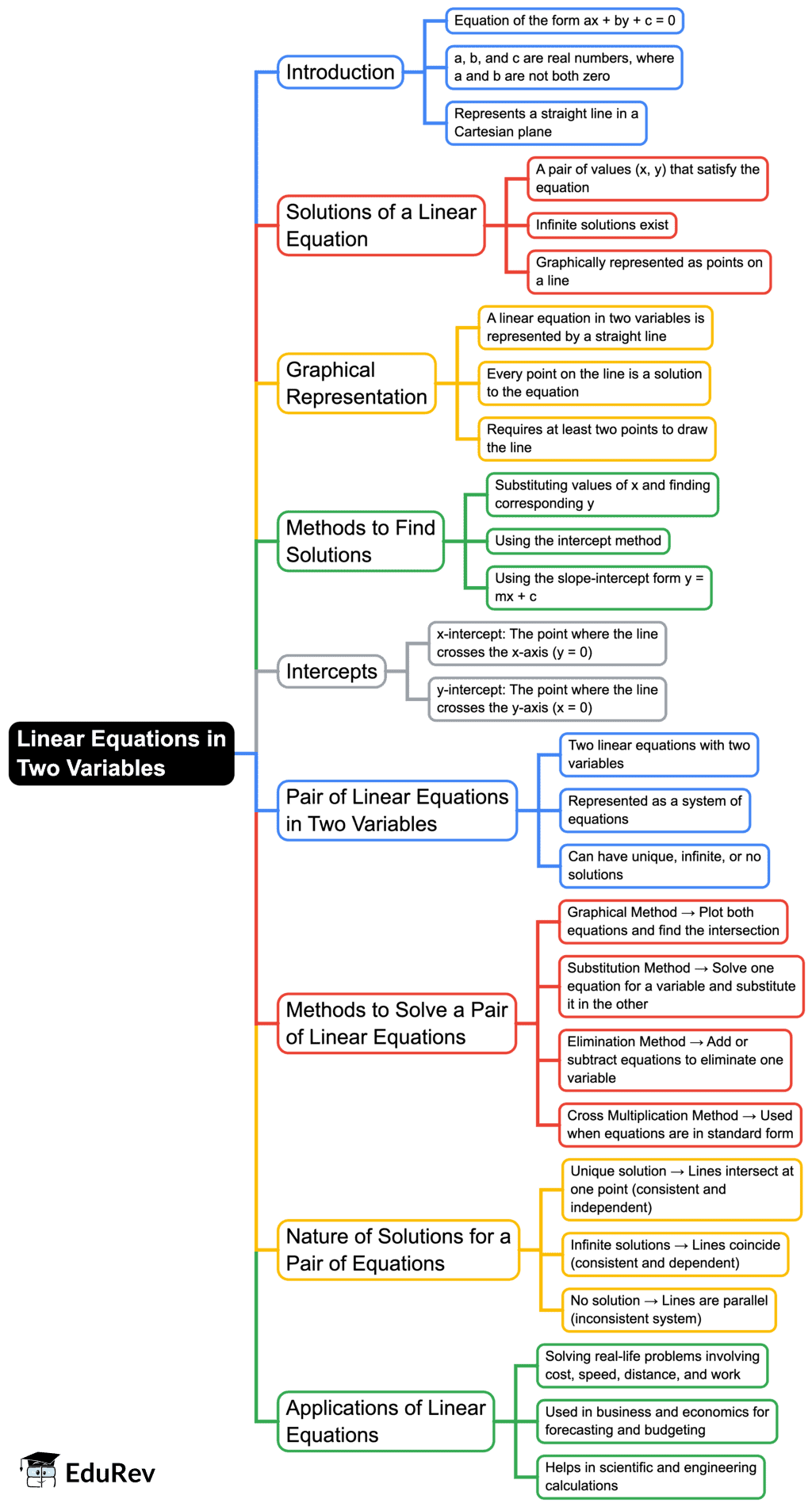
Important Definitions
1. Equation: An equation is a statement that two mathematical expressions having one or more variables are equal.
2. Algebraic Equation: In algebra, an equation can be defined as a mathematical statement consisting of an equal symbol between two algebraic expressions that have the same value.
3. Linear Equation in Two Variables: The word 'Linear' means single degree equation i.e. the maximum powers of all the variables involved are one. The word 'Two Variables' means that the mathematical statement will be having two variables i.e. two mathematically unknown quantities.
The general form of a linear equation in two variables is ax+by+c=0, where a and b cannot be zero simultaneously.
Example: 2x+4y-8=0
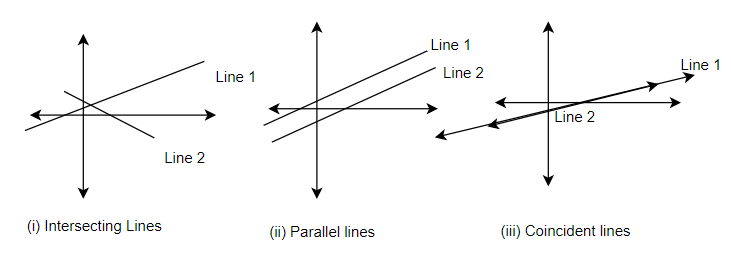
| Get additional INR 200 off today with EDUREV200 coupon. | Avail Offer |
Important Methods and Formulas
Also read: Case Based Questions: Pair of Linear Equations in Two Variables |
1. Algebraic Methods to solve Pair of Linear Equations in Two Variables
We have three algebraic methods of solution for a pair of linear equations in two variables:
(a) Substitution Method
Let's solve the system of equations:
Step 1: Express y in terms of x from one of the equations.
From the first equation , solve for y:
y=5-2x
Step 2: Substitute this expression for y into the second equation.
3x Substitute y=5-2x into the second equation 3x-y=4:3x-(5-2x)=4
Simplify the equation:
3x-5+2x=4
5x-5=4
5x=9
x = 9/5
Step 3: Substitute the value of x back into the expression for y.
Substitute x = 9/5 into y = 5 - 2x
y = 5 - 2(9/5) = 5 - 18/5
= 25/5 - 18/5
= 7/5
Thus, the solution to the system of equation is:
x = 9/5, y = 7/5
(b) Elimination Method or Method of Elimination by Equating the Coefficients
Let's solve the system of equations:
- 3x+2y=11
- 2x+3y=4
Step 1: Make the coefficients of one variable equal.
We will eliminate x by making the coefficients of x equal in both equations. Multiply the first equation by 2 and the second equation by 3, so that the coefficients of x become equal:
(Equation 1')
(Equation 2')
Step 2: Subtract one equation from the other to eliminate x.
Now subtract Equation 1' from Equation 2':
Step 3: Solve for y.
From , solve for y: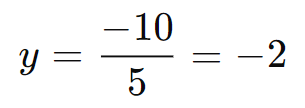
Step 4: Substitute the value of y into one of the original equations to find x.
Substitute into the first equation 3x+2y=11:
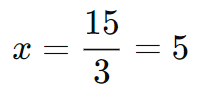
Solution:
Thus, the solution to the system of equations is:
| Attention! Sale expiring soon, act now & get EduRev Infinity at 40% off! | Claim Offer |
2. Conditions for Consistency/Inconsistency
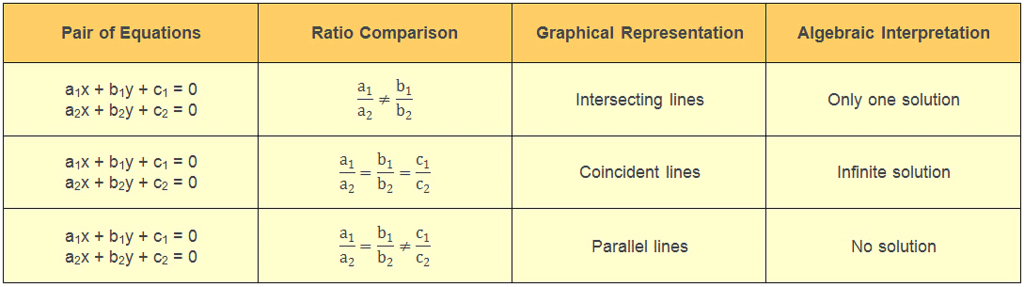 A pair of linear equations in two variables, which has a solution, is called consistent and a pair of linear equations in two variables, which has no solution is called inconsistent.
Also read: Case Based Questions: Pair of Linear Equations in Two Variables |
3. Steps to solve Word Problems
- Step 1: Read the statement carefully and identify the unknown quantities.
- Step 2: Represent the unknown quantity by x, y, z, a, b, c, etc.
- Step 3: Formulate the equations in terms of the variables to be determined and solve the equations to get the values of the required variables.
- Step 4: Finally, verify with the conditions of the original problem. The problems are stated in words, for this reason, often refers to word problems.
: