

Introduction
In a vibrant democracy like India, social diversity is not merely a characteristic - it is a fundamental principle of the nation's identity. The expression of social differences can enrich political discourse and strengthen democratic institutions.

This chapter examines three major kinds of social differences that shape the Indian socio-political landscape: gender, religion and caste. For each we ask how these differences affect politics, whether their public expression is healthy for democracy, and what measures exist to address inequalities.
Gender and Politics
Gender divisions are widely present in society and are often treated as if they were natural and fixed. In fact, many gender roles arise from social expectations and stereotypes rather than biological necessity.

Public and Private Division
- Gender roles and division of labour: Boys and girls are socialised to accept that household chores and child-rearing are primarily women's responsibilities. This shapes expectations about who belongs in the public sphere and who belongs in the private sphere.
- Paid and unpaid work: When household tasks are converted into paid work, men often perform them (for example, tailors and cooks). Unpaid domestic work, however, remains undervalued and largely invisible in public life and policy discussions.
- Women's work outside the home: Women in rural and urban areas undertake diverse paid and unpaid tasks: fetching water, agricultural work, labour in factories, domestic work, and office work. Much of this work is poorly recognised and low paid.
- Impact on public participation: The undervaluation of women's labour and the concentration of household responsibilities restrict women's time and opportunities to participate in public and political life.
- Feminist movements and challenges: Movements for women's rights have campaigned for equality in education, employment and within the family. Persistent challenges include lower female literacy rates in some regions, fewer girls pursuing higher education, unequal pay for equal work, and practices such as sex-selective abortions in parts of the country.
 Sexual division of labour
- Women are raised with the belief that their primary responsibilities are household chores and child-rearing, which leads to the division of labor within families.
- Despite men being capable of household chores, they often consider such tasks as women's duties.
- This unequal division of labor results in women's limited participation in public life and politics across most societies.
- Therefore, the primary factor that contributes to the limited participation of women in public life and politics is social expectations and stereotypes.
Women's Political Representation
- Importance: Political representation by women is vital to bring attention to women's issues and to influence decision-making.
- Current status: The percentage of women in the Lok Sabha stands at 14.36%, and representation in many state assemblies remains low (as less than 5% in several states).
- Comparative position: India ranks poorly in female legislative representation compared with many developing countries in Africa and Latin America.
- Leadership and cabinets: Women have served in top offices such as Chief Minister and Prime Minister, yet most government cabinets remain predominantly male.
- Panchayati Raj and local representation: The Panchayati Raj system reserves one-third of seats for women in local government bodies. As a result, there are more than 10 lakh elected women representatives in local bodies across India.
- Reservation demand for legislatures: Women's groups have long demanded 33% reservation in the Lok Sabha and State Legislative Assemblies. Consensus among political parties took time to build.
- Recent law: The Nari Shakti Vandan Adhiniyam (Women's Reservation Act, 2023) provides a 33% reservation for women in the Lok Sabha, State Legislative Assemblies and the Delhi Assembly.


 | Get additional INR 200 off today with EDUREV200 coupon. | Avail Offer |
Religion, Communalism and Politics
- Religion and politics: Religious divisions exist globally and can affect politics. Even within a single faith, practices and beliefs vary, producing different political outcomes.
- Religious influence on ethical politics: Leaders like Mahatma Gandhi argued that moral principles derived from religion should inform political life, while recognising the need for tolerance and equal treatment.
- Minorities and protection: Human rights organisations point out that religious minorities sometimes suffer disproportionately from communal violence, and they call for stronger protection by the state.
- Family laws and gender bias: Women's movements have highlighted gender bias in different religious family laws and urged reforms to ensure equality.
- State role: Political authorities are expected to oversee religious practices where necessary to prevent discrimination and to ensure equal treatment for all religions.
 Religion and politics should never be mixed
Communalism
- Definition: Communalism emerges when religion is treated as the primary basis of political community and when religion is politicised to obtain social or state power.
- Beliefs behind communalism: Communal politics assumes that followers of the same religion form a single community with identical interests, and that followers of different religions cannot belong to the same political community.
- Consequences: Political communalism can produce bias, exclusion, inter-group tensions, communal violence and the misuse of state power to favour one group.
- Extremes: In extreme forms, communalism leads to claims that people of different religions cannot be equal citizens in one nation and must either dominate or separate into different nations.
- Flawed assumptions: The idea that a single religion implies unified interests is false; members of the same religion can differ widely by class, region, language and political views.

Try yourself: What is the significance of women's political representation?
b) It addresses social inequalities and benefits disadvantaged groups. Women's political representation is significant because it helps address social inequalities and benefits disadvantaged groups. When women participate in politics, their unique perspectives and concerns are considered in decision-making processes, leading to more inclusive policies that promote gender equality. This representation helps to reduce inequalities in the political sphere, ensures that the interests of marginalized and disadvantaged groups are addressed, and inspires future generations of women to take part in politics and fight for their rights.
Forms of Communalism and Political Mobilisation
- Everyday communalism: Prejudices, stereotypes and claims of superiority for one's religion appear in routine social interactions.
- Political mobilisation on religious lines: Political actors may use religious symbols, emotional appeals and fear to mobilise voters from one religious community.
- Violence and conflict: Communalism can result in riots, massacres and long-term polarisation; India and Pakistan experienced such violence during and after Partition.

Secular State
- Secularism and the Constitution: India's Constitution does not recognise any official state religion. It guarantees freedom of religion and prohibits discrimination on religious grounds.
- State intervention: The Constitution allows some state intervention in religious matters to secure equality (for example, laws against untouchability and discriminatory practices).
- Secularism as a foundational principle: Secularism is a core value meant to protect national unity and democratic rights by ensuring equal treatment of all faiths and those with no religious belief.
- Limits of constitutional secularism: Constitutional provisions alone cannot eliminate communal prejudices and propaganda. Active measures in everyday life, education and politics are necessary to challenge communalism.

Also read: Short Answer Questions: Gender, Religion & Caste |
Caste and Politics
In India, caste is a long-standing form of social division that affects economic life, social status and political mobilisation. Caste has both positive and negative dimensions in politics: it can help marginalised groups to claim power but can also deepen divisions and distract from broader developmental issues.
- The belief in one's religion's superiority is another form of communalism, where individuals or communities consider their religion to be superior to others.
- Political mobilization on religious grounds involves using religion as a tool to gain political dominance or create a separate political entity for a specific religious community.
- Therefore, all of the above options are correct as they represent different forms of communalism in politics.
Caste Inequalities
- Nature of the caste system: Caste is a hereditary social ordering traditionally associated with occupation, endogamy (marrying within the caste) and social segregation.
- Economic impact: Historically, 'upper' castes have had better economic opportunities, while Dalits (Scheduled Castes), Adivasis (Scheduled Tribes) and many backward classes faced exclusion and poverty.
- Untouchability and exclusion: The caste system sanctioned practices of exclusion and untouchability against certain groups.
- Changes over time: Urbanisation, economic development and increases in literacy have weakened some traditional caste boundaries, though caste continues to shape social and economic life.
- Legal protections: The Indian Constitution prohibits caste-based discrimination and provides affirmative measures to address historical injustices.
- Persistence: Despite legal provisions, practices such as caste-endogamy and social discrimination persist in many regions.

Social and Religious Diversity of India
- Census and religion: The Census of India records the religion stated by every person. It also records those who state they have 'no religion' or are 'atheist', providing reliable data on religious distribution.
- Population trends: While the absolute numbers of all major religious communities have grown since Independence, their relative proportions have remained fairly stable.
- Trends since 1961: The relative share of Hindus, Jains and Christians has shown slight decreases since 1961, while the shares of Muslims, Sikhs and Buddhists have seen small increases.
- Future projections: Expert projections suggest the Muslim population may increase by only about 3-4 percent over the next 50 years, indicating no dramatic change in the overall demographic balance.

Significance of Scheduled Castes and Scheduled Tribes
- Classification: The Census and official schedules classify many communities as Scheduled Castes (SCs) and Scheduled Tribes (STs). These lists identify groups that have faced historical disadvantage.
- Scheduled Castes (Dalits): Dalits were historically marginalised within the Hindu social order and faced untouchability and exclusion.
- Scheduled Tribes (Adivasis): Adivasis traditionally live in more isolated regions, including forests and hills, with distinct cultures and limited integration with mainstream society.
- Population shares: In 2011, Scheduled Castes formed about 16.6% of India's population and Scheduled Tribes about 8.6%. Together with Other Backward Classes (OBCs), these groups represent a substantial portion of the population - estimated in some surveys as nearly two-thirds of the total population and about three-fourths of the Hindu population in mid-2000s estimates.
- Efforts of social reformers like Jotiba Phule, Gandhiji, B.R. Ambedkar, and Periyar Ramaswami Naicker have worked to eliminate caste inequalities.
- The Constitution of India prohibits caste-based discrimination and aims to reverse the injustices of the caste system.
- Therefore, all of the above factors have led to changes in the caste system in modern India.
Caste in Politics
- Caste identity and political claims: Casteism is the idea that caste should be the main basis of political community. In practice, caste identities influence candidate selection, party strategies and voter mobilisation.
- Political calculations: Political parties take caste demographics into account when selecting candidates and when forming cabinets, aiming for representation that helps win elections.
- Electoral appeals: Appeals to caste sentiments are common during elections as parties and candidates seek support from specific caste groups.
- Universal adult franchise: With universal suffrage, castes that were previously excluded have become politically active; mobilisation around caste has been a way for marginalised groups to demand rights and resources.

Caste Influence in Elections and Political Behaviour
- Multiple factors: Elections are influenced by caste but are not determined by it alone. Economic interests, leadership, ideology, local issues and candidate qualities also matter.
- No single-caste dominance: Most constituencies have diverse caste mixes, so candidates must seek support across communities.
- Voting behaviour: Voters within the same caste may differ - for example rich and poor, men and women - and may vote for different parties for different reasons.
 | Attention! Sale expiring soon, act now & get EduRev Infinity at 40% off! | Claim Offer |
Caste Inequality Today
- Caste and economic disparities: Caste continues to shape access to land, education and employment, contributing to contemporary economic inequality.
- Historical inequality: Earlier practices denied land and education to 'untouchable' castes, while higher castes had advantages in resources and opportunities.
- Changing dynamics: Over time some members of disadvantaged castes have advanced economically and educationally, even as many others remain disadvantaged; caste and class interact in complex ways.
- While caste may be considered when selecting candidates or forming cabinets, it is not the only factor that influences political decisions.
- Elections are not solely about caste, and candidates often need to appeal to diverse groups to win votes.
- The electorate's political allegiance often overrides caste considerations.
- Moreover, the correlation between caste and economic standing has evolved, with individuals from diverse castes now observed across the economic spectrum.
- Therefore, while caste does have some influence in politics, it is not the most important aspect.
National sample surveys and other research show that economic well-being still broadly mirrors the traditional caste hierarchy: upper castes generally have higher economic status, Dalits and Adivasis face higher rates of poverty, and backward classes occupy intermediate positions. Although poverty exists across castes, extreme poverty disproportionately affects historically marginalised groups.

Politics and the Politicisation of Caste
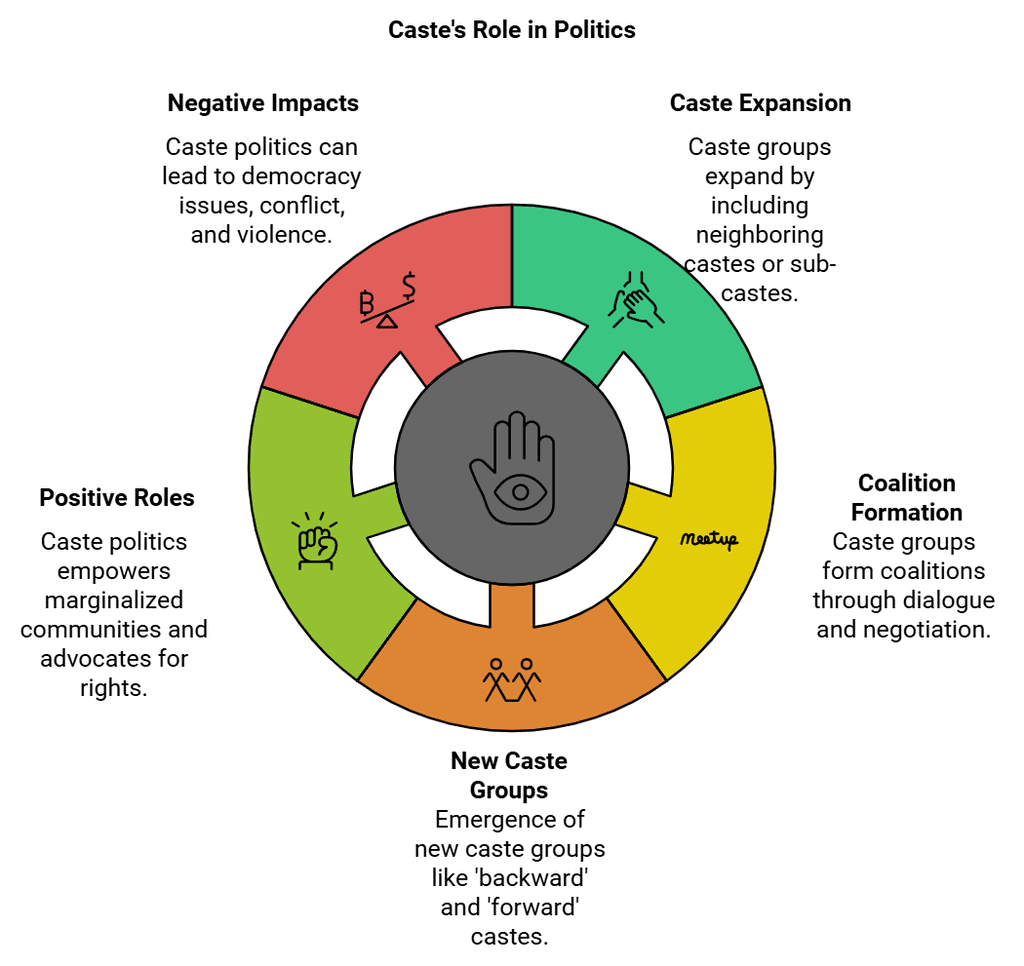
- Mutual influence: Caste shapes politics, and politics reshapes caste identities by bringing caste into public negotiation, alliance formation and policy making.
- Forms of politicisation: Caste groups may try to enlarge their influence by including allied castes or sub-castes; they form coalitions and negotiate power-sharing with other groups.
- Positive roles: Caste-based politics has enabled marginalised communities (for example, Dalits and many OBC groups) to claim a share of power, improve access to decision-making, and press for dignity, land and opportunities.
- Negative impacts: Overemphasis on caste identity can undermine attention to broader issues such as poverty reduction, development, governance and corruption. Caste polarisation can also provoke tensions and violence.
Also read: Short Answer Questions: Gender, Religion & Caste |
Conclusion
Gender, religion and caste are powerful social divisions that shape Indian politics. Each division can be mobilised to strengthen democratic participation and to secure rights for excluded groups. At the same time, when these differences are politicised to exclude, dominate or polarise, they damage democratic values. The Constitution's guarantees, legal protections and affirmative measures provide essential tools to promote equality, but active social engagement, political will and public education are also necessary to reduce prejudice, combat violence and ensure that diversity remains a democratic strength.
Short Answer Questions: Gender, Religion & Caste
Q.1. How can religion influence politics?
Ans.
- Gandhiji believed that politics must be guided by ethics drawn from all religions.
- Ideas, ideals and values drawn from different religions can play a role in politics.
- People should have the freedom to express in politics their needs, interest and demands as a member of a religious community.
- People who hold political power should see that discrimination and oppression does not take place due to religion.
Q.2. What is communal politics?
OR
How does communalism create problems in politics?
Ans.
(i) When one uses religion in politics, it is communal politics. It creates problems when one sees religion as the basis of the nation.
(ii) When one religion considers itself superior to other religions.
(iii) When there is discrimination against the followers of the other religion.
(iv) When state power is used to help one religion to dominate other religious groups and
(v) When the demands of one religious group are in opposition to others.
Q.3. What are the effects of communalism on politics?
Ans.
(i) Political parties are formed on communal basis - Muslim League, Akali Dal, the Hindu Mahasabha, the DMK are some examples.
(ii) Religion rather than ability becomes the criteria to choose candidates for elections.
(iii) People prefer to cast votes in favour of candidates of their own religion.
(iv) Communalism can turn ugly and lead to violence, massacre and riots.
Q.4. What is secularism? Mention any four provisions of the Indian Constitution which makes it a secular state.
Ans. Secularism means all religions are given the same respect and there is no state religion.
(i) No religion has a special status.
(ii) Freedom to practice, profess and propagate one's religion is allowed by the Constitution.
(iii) No discrimination of any kind is allowed on religious grounds.
(iv) 'Untouchability' is banned.
Q.5. Has caste disappeared from India?
Ans. No. The following points prove the fact
(i) Even now people marry in their own caste.
(ii) Untouchability is still practised in many parts of India.
(iii) The caste groups which had better education are still ahead of other caste groups.
Q.6. Why is it necessary to have secularism in India?
Ans. India is a land of many religions and it has led to communalism in India. In fact, one of the results of communalism was partition of India into two nations. It was a challenge for Indian democracy and they chose a secular state as a model. Several constitutional provisions were made to secure secularism in India. It was not just an ideology of some party or people. Secularism is the basis, one of the foundations, of our country. To avoid the threat of communalism, secularism was chosen.
Q.7. When does the problem of communalism begin?
Ans. The problem of communalism begins when religion is seen as the basis of a nation. The problem becomes more acute when religion is expressed in politics in exclusive and partisan terms, when one religion and its followers are pitted against another. This happens when the beliefs of one religion are presented as superior to those of other religions, and when the state power is used to establish domination of one religious group over the rest.
Q.8. Which factors have led to weakening of caste hierarchy in India?
Ans. Caste hierarchy in India is weakening due to number of reasons :
(i) Efforts of social reformers like Gandhiji, Periyar, Jyotiba Phule etc. did the starting part of establishing a society in which caste inequalities are absent.
(ii) It has also weakened due to economic development, large-scale urbanisation, growth of literacy and education, occupational mobility, and the weakening of the position of landlords in the villages.
Q.9. Do you agree with the view that casteism has not disappeared from Indian society? Discuss.
Ans. Although the old barriers of caste system are breaking down, but still casteism continues to be there in the Indian society.
(i) Even now most people marry within their own caste or tribe
(ii) Untouchability has not ended completely.
(iii) Effects of centuries of advantages and disadvantages continue to be felt today.
Q.10. Do the 'caste' and 'vote bank' factors completely control the elections in India?
Ans. There is an impression that elections in India are all about caste and nothing else. But it is also true that 'caste' and 'vote bank' factors alone cannot determine elections in India due to the following reasons :
(i) No single caste is ever elected with a clear majority in any parliamentary constituency. So votes of more than one caste is required to win the election for any candidate or party.
(ii) Many political parties may put up candidates from the same caste. Some voters have more than one candidate from their caste, while many voters have no candidate from their caste.
(iii) No party wins the votes of all the voters of a caste or community.
: