

Previous Year Questions 2026
Q1. Explain any two Constitutional provisions that make India a secular nation. [2 Marks]
Ans:
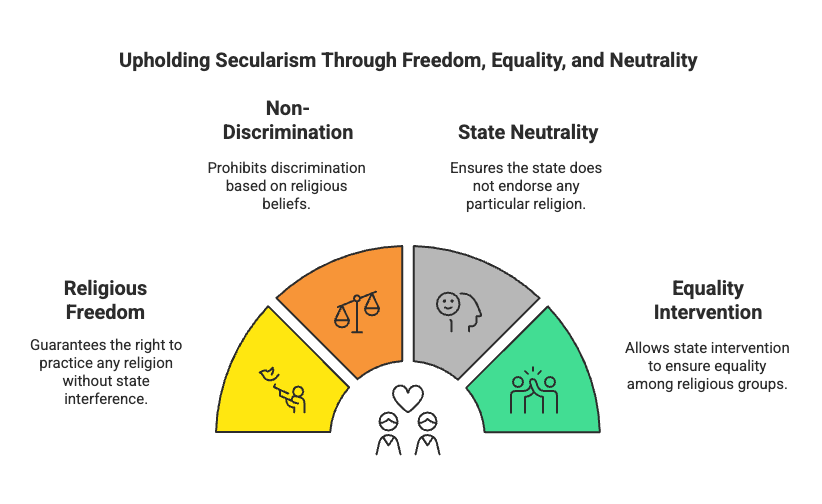
- There is no official religion for the Indian state.
- The Constitution provides to all individuals and communities freedom to profess, practise and propagate any religion.
- The Constitution prohibits discrimination on grounds of religion.
- The Constitution allows the state to intervene in the matters of religion in order to ensure equality within religious communities. For example, it bans untouchability.
(Any two points to be explained)
Q2. Which one of the following countries has a high level of women's participation in public life? [Marks: 1]
(A) Sweden
(B) Canada
(C)Brazil
(D) India
Ans: (A)
Explanation: Sweden, along with other Scandinavian countries, is known for having a very high level of women's participation in public life and politics compared to many other nations.
Q3. Suggest measures to increase the political representation of women in India. [Marks: 2]
Ans:
- Make it legally binding to have a fair proportion of women in the elected bodies.
- More seats should be reserved for women in the elected bodies.
- Encourage women to participate actively in public life.
(Any two points to be explained)
Q4. Suggest any two ways to promote Women's Entrepreneurship in the economy. [2 Marks]
Ans:
- Providing easy loans at low interest rates empowers women to become entrepreneurs.
- Providing vocational training may encourage women to run and grow their own businesses.
- The government should introduce women-focused start-up schemes.
- The government should introduce subsidies and tax benefits to encourage women entrepreneurs.
(Any two points to be explained)
Q5. Suggest two ways to improve womens' participation in sports leadership roles. [2 Marks]
Ans:
- Women from the very beginning should be encouraged to participate in sports-related events in school and college.
- Educational institutions and the government should organise regular sports-related training programmes.
- Women should be provided with a nutritious diet.
- Equal salaries for women along with that of men in any sport should be promoted.
[Any two suggestions to be explained.]
Previous Year Questions 2025
Q1: Suggest any two measures to remove gender inequality. (2 Marks)
Ans:
- Providing equal education opportunities for girls so they can participate equally in all areas of life and employment. This includes ensuring access to schools, scholarships, safe transport and a learning environment that encourages continuation to higher studies, which increases their choices and independence.
- Ensuring adequate political representation for women through reservations in elected bodies like Panchayati Raj institutions and legislatures (as in the Nari Shakti Vandan Adhiniyam, 2023). Greater representation helps bring women's concerns into law-making and public policy.
Q2: Suggest any two measures to increase the number of women in legislatures of India. (2 Marks)
Or
Suggest any two measures to ensure participation of women in public life. (2 Marks)
Ans:
- Reservation of seats: Implementing and enforcing legal provisions and policies that reserve seats for women in legislative bodies and local governments (for example, the reservations in Panchayats). Reserved seats create space for women leaders and encourage more women to enter politics.
- Encouraging women's participation: Political parties should nominate more women candidates, provide training and campaign support, and promote women's leadership within party structures. Public awareness and mentorship programmes help women contest elections and perform effectively once elected.
Q3: Suggest any two measures to prevent violence against women. (2 Marks)
Ans:
- Strict enforcement of laws: Proper implementation of laws against domestic violence, sexual harassment and assault (for example, the Protection of Women from Domestic Violence Act) and measures to ensure equal pay under the Equal Remuneration Act (1976) reduce economic vulnerability. Effective policing, timely legal aid and speedy trials deter offenders.
- Raising social awareness: Programmes in schools, communities and workplaces to change patriarchal attitudes, teach respect and gender equality, and encourage bystander intervention help prevent violence. Support services such as helplines, shelters and counselling are also important.
Q4: Suggest any two measures to promote secularism as mentioned in the Indian Constitution. (2 Marks)
Ans:
- No official religion: The state does not endorse or favour any religion. This ensures that government policies and institutions remain neutral and treat all religions equally.
- Freedom of religion: The Constitution guarantees every individual the right to profess, practise and propagate any religion or to follow none. Protecting this freedom for all communities is central to promoting secularism.
Q5: How did the feminist movements help to enhance the role of women in public life? Explain. (2 Marks)
Ans:
- They demanded equal political and legal rights, leading to laws and policies that removed some legal barriers to women's participation in public life.
- They worked for better educational and career opportunities, which helped women enter professions earlier dominated by men.
- They challenged social norms and campaigned for equality in personal and family life, enabling women to take up public roles as leaders, officials and professionals.
 | Get additional INR 200 off today with EDUREV200 coupon. | Avail Offer |
Previous Year Questions 2024
Q1: "Role of women is gradually enhancing in the politics of the country." Examine the statement. (CBSE 2024)Ans:
- In India, the number of women involved in politics has increased over recent years.
- More women are standing for office, holding elected positions at local, state and national levels, and taking part in decision-making.
- Measures like reservations in local bodies and growing social awareness have significantly helped.
- More women now occupy roles as legislators, party leaders and administrators.
- While representation is still not perfectly equal, these changes show a gradual enhancement in women's political role.
Previous Year Questions 2023
Q2: Two statements are given below as Assertion (A) and Reason (R). Read the statements and choose the appropriate option. (2023)Assertion (A): Women in different parts of the world organised themselves and agitated for equal rights.
Reason (R): Women's movement aimed at equality in personal and family life as well.
(a) Both (A) and (R) are true and (R) is the correct explanation of (A).
(b) Both (A) and (R) are true, but (R) is not the correct explanation of (A).
(c) (A) is true but (R) is false.
(d) (A) is false, but (R) is true.
Ans: (a)
Explanation:
(i) Assertion: Women in many parts of the world organised and agitated for equal rights; this is true because collective movements pushed for political, legal and social reforms.
(ii) Reason: The women's movement also aimed at equality in personal and family life; this is true because activists campaigned for changes in marriage, property and family laws to secure equal status within households.
(iii) Justification: Reason (R) explains Assertion (A) since the demand for equality in private and family life was an important part of the broader struggle for equal rights, and this helped shape the goals and actions of women's movements worldwide.
Q3: "Women face discrimination in various ways in our society" Explain any two ways. (CBSE 2023)
Ans:
- Limited access to education: A smaller proportion of girls pursue higher studies compared to boys. Social and cultural norms often limit investment in girls' education, which reduces their future opportunities for work and public participation.
- Occupational segregation: Women are concentrated in lower-paid and traditionally female-oriented jobs. They are underrepresented in high-paying and decision-making positions, which restricts their economic independence and career advancement.
Q4: Which one of the following matters do not deal with the 'Family Laws?' (2023)
(a) Marriage
(b) Adoption
(c) Inheritance
(d) Finance
Ans: (d)
Explanation: Family laws govern personal matters such as marriage, adoption and inheritance which regulate relationships and rights within families. Finance relates to general economic and monetary matters and is not a subject specifically dealt with under family law, so option (d) is correct.
Q5: How has caste system in modern India undergone great change? Explain. (2023)
Ans:
- Economic development, urbanisation, greater literacy and occupational mobility have weakened rigid caste hierarchies and traditional occupations.
- In many urban settings, everyday interactions between people of different castes have become normal; caste matters less in public spaces such as markets and public transport.
- The Constitution prohibits caste-based discrimination and provides measures, including reservations, to address historical injustices.
- Partly due to the efforts of political leaders and social reformers like Jotiba Phule, Mahatma Gandhi, and B.R. Ambedkar, awareness regarding social equality has increased.
Despite these changes, caste has not disappeared entirely and some older aspects persist in social life and politics.
Also read: Key Concepts: Gender, Religion & Caste |
Previous Year Questions 2020
Q6: Suggest any one way to protect women from domestic oppression. (2020)
Ans: Women can seek assistance from NGOs or the Mahila Aayog to protect themselves from domestic oppression. These agencies can provide legal advice, shelter, counselling and help in accessing government services.
Q7: Suggest any one way to pay equal wages to women in all areas of work as men. (2020)
Ans: Better implementation of the Equal Remuneration Act, 1976, which requires equal wages for equal work, together with active monitoring and penalties for non-compliance, will help ensure equal pay for women.
Q8: What percentage of reservations is given to women in local administration in India? (2020)
Ans: 33% or one-third reservation is given to women in local administration in India. This helps ensure women's representation in Panchayats and Municipalities and promotes their participation in grassroots decision-making.
Q9: Suggest any one way to increase the participation of women in the legislative domain of India. (2020 C)
Ans: One way to increase participation is to make it compulsory for political parties to field a fair proportion of women candidates for elections and to adopt internal policies that promote women leaders. Legal measures or party-level quotas can ensure more women are elected or nominated.
Q10: Describe the problems of low representation of women in Indian legislature. (2020)
Ans:
- Political parties often do not give enough tickets to women candidates, limiting their chance to contest elections.
- Without adequate representation, issues specific to women may not receive sufficient attention in legislatures.
- Compared to many other developing countries, India's representation of women in national legislatures remains relatively low, placing it among the lower performing nations in this regard.
Q11: Describe the ways of discrimination faced by women in India. (2020)
OR
\"Women still lag much behind men in India despite some improvements since independence\" Analyse the statement. (Delhi 2019)
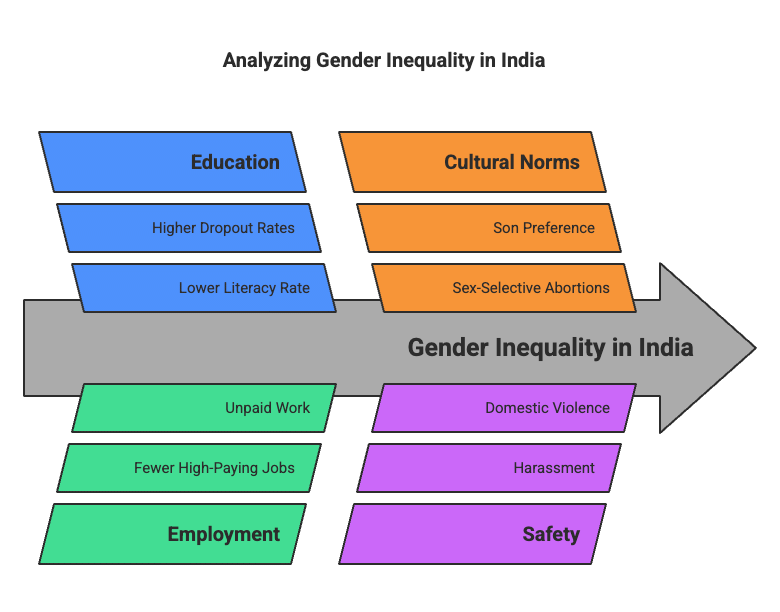
Ans: In India, women continue to face significant disadvantages and discrimination despite some progress since Independence.
The following points highlight the various forms of inequality:
- The literacy rate for women stands at only 64.60%, compared to 80.90% for men (2011 Census data).
- A smaller number of girls pursue higher education. Although many perform well at school, families often prioritise boys when investing in higher studies.
- Women occupy a minority of high-paying jobs and leadership positions. Much of women's work, especially domestic work, remains unpaid and undervalued.
- In some regions, son preference has led to sex-selective abortions and a declining child sex ratio.
- Women frequently face harassment, exploitation and violence, particularly within the home, affecting their safety and freedom.
Q12: Suggest any one way to create communal harmony among various communities of India. (2020)
Ans: Spread awareness about unity and national integrity through education, inter-community dialogues, cultural exchanges and public campaigns that emphasise common citizenship and mutual respect.
Q13: Suggest any one way to change the 'family laws' of all religions. (CBSE 2020)
Ans: Strict enforcement of laws like the Dowry Prohibition Act and reforms to ensure equal rights within family laws can bring important changes across different religious communities.
Q14: Fill in the blank: The Indian Constitution provides to all individuals and communities the freedom to profess, practice and propagate any religion because of ____ . (2020)
Ans: secularism
The Indian Constitution provides to all individuals and communities freedom to profess, practise and propagate any religion because of secularism. Secularism ensures the state remains neutral in religious matters and treats all religions equally.
Q15: Describe any three problems of communalism in Indian politics. (2020)
Ans:
- Religious prejudices: Communalism spreads biases and negative stereotypes about other religious groups, increasing distrust and division.
- Desire for separation: Minority groups may feel alienated and seek separate political units, harming national unity.
- Communal violence: Communal tensions can escalate into riots and massacres, causing loss of life and deep social scars.
Q16: Mention any three features of 'secularism' described in the Indian Constitution. (2020)
OR
Secularism is not an ideology of some political parties, but it is one of the foundations of a country. Examine the statement. (2018)
Ans: The makers of our Constitution were aware of religion-related challenges. That is why they chose the model of a secular state. The important provisions that make India a secular state are:
- There is no official religion for the Indian state.
- The Constitution grants every individual freedom to profess, practise and propagate any religion or to follow none.
- The Constitution prohibits discrimination on grounds of religion.
- The Constitution allows the state to intervene in matters of religion to ensure equality within religious communities, for example by banning untouchability.
Q17: 'Communalism can take various forms in politics'. Explain. (2020)
OR
What form does communalism take in politics? (2015)
Ans:
- The most common expression is everyday religious prejudice and stereotypes, which shape attitudes and behaviour towards other communities.
- It can lead to a quest for political dominance by one community, producing majoritarian rule and marginalisation of minorities.
- Political mobilisation on religious lines often uses sacred symbols and emotional appeals to gather support, turning religion into an electoral tool.
- In extreme cases, communalism results in communal violence, riots and large-scale conflict.
Q18: "The caste system is still prevalent in Indian society." Suggest any one measure to abolish it. (2020)
Ans: One effective measure to reduce the caste system is to improve and expand literacy and education for all, since education promotes social mobility, awareness of rights and reduces prejudice.
Q19: "Sometimes elections are all about caste in India." How can this situation be avoided? (2020)
Ans: Proper laws should be passed to separate elections from casteism.
- Implement strict regulations to limit caste-based campaigning.
- Encourage political parties to focus on issues and policies rather than caste affiliations.
- Promote awareness about the harmful effects of casteism in politics.
- Support candidates based on their qualifications and integrity, not caste.
Q20: Fill in the blank: Castes and Caste system in modern India have undergone a great change because____ . (2020)
Ans: occupational mobility and implementation of laws
Castes and the caste system in modern India have undergone a great change because of:
- Occupational mobility: Individuals can change occupations and move away from traditional caste-linked work, reducing the hold of hereditary jobs.
- Implementation of laws: The Indian Constitution prohibits caste-based discrimination and provides legal measures to protect equal rights, which undermines caste privilege.
Q21: Describe the influence of Politics in the Caste system. (2020 C)
Ans: Politics significantly influences the caste system, though it interacts with other social and economic factors.
- Caste affects electoral strategies and voting behaviour; parties often consider caste arithmetic when selecting candidates.
- Economic status and gender also shape political behaviour within caste groups; not all members of a caste have the same interests.
- Caste groups sometimes form coalitions, leading to new political categories like 'backward' and 'forward' castes.
- Political mobilisation can both challenge and reinforce caste identities, depending on how leaders work with caste groups.
In brief, politics can deepen caste divisions or help address inequalities, depending on the policies and choices of leaders and parties.
Q22: Mention the problem of 'Casteism' in Indian politics. (2020)
Ans:
- Persistent discrimination exists between upper and lower castes, creating social inequality.
- Upper castes continue to enjoy social advantages and influence in many areas.
- Political leaders sometimes contest elections by appealing to caste loyalties to build vote banks, which deepens divisions.
Previous Year Questions 2019
Q23: "Gender division is not based on biology but on social expectations and stereotypes." Support the statement. (2019 C, 2015)
Ans:
- Gender division is a hierarchical social division based on expectations and stereotypes rather than biology.
- Boys and girls are socialised into roles: girls are often expected to do housework and child-rearing while boys are encouraged to work outside the home.
- There is a sexual division of labour in many families where women do most household chores and men do paid work outside the home.
- Many women also do paid work alongside domestic labour, but their work is often undervalued and receives little recognition.
Q24: Explain any five methods to raise the political representation of women in India. (AI 2019)
Ans:
- Improve literacy rates: Increasing education among women raises political awareness and confidence to participate in public life.
- Ensure equal pay: Economic independence gained from equal pay strengthens women's capacity to engage in politics.
- Amend inheritance laws: Laws like the Hindu Succession (Amendment) Act, 2005 that grant daughters equal inheritance rights improve women's social and economic standing.
- Increase representation in politics: Political parties should nominate more women candidates and support their campaigns to improve their numbers in legislatures.
- Expand reservation in local bodies: Increasing the reserved seats for women in panchayats and municipalities beyond one-third would further boost grassroots representation.
Q25: "Politics and social divisions should not be allowed to mix." Justify the statement. (AI 2019)
Ans: It is important that politics does not exploit social divisions because:
- Mixing social divisions into politics can turn social differences into political conflicts and violence.
- Examples such as prolonged ethno-political conflicts show how mixing identity with politics leads to instability (for instance, Northern Ireland, Yugoslavia and Sri Lanka).
- Allowing politics to be driven by social divisions undermines equality and harms national unity.
Q26: Examine the different forms of 'Casteism' in Indian politics. (2019 C)
Ans:
- Candidate selection: Parties choose candidates based on the caste composition of constituencies to gain electoral advantage.
- Government formation: Efforts are made to include representatives from various castes and tribes when forming governments.
- Campaigning: Appeals are often made to caste loyalties during campaigns, and some parties are seen as representing particular castes.
- Electoral mobilisation: Universal adult franchise has encouraged parties to address caste-based issues to attract votes, which has also raised political awareness among marginalised castes.
Q27: What does the term 'Scheduled' denote in 'Scheduled castes' and 'Scheduled tribes' ? (CBSE 2019)
Ans: These groups include hundreds of castes or tribes whose names are listed in an official Schedule in the Constitution of India. Hence, they are called Scheduled.
Q28: Read the following information and write a single term for it. The Constitution of India provides freedom to profess and practice any religion to all its citizens. The Constitution of India prohibits discrimination on religious grounds.
Ans: secularism
The Constitution of India promotes secularism in the following ways:
- It grants freedom to all citizens to profess and practise any religion.
- Discrimination based on religion is prohibited.
- There is no official religion for the Indian state.
- The Constitution allows the state to intervene to ensure equality among religious communities.
Q29: "The caste system is still prevalent in Indian society." Suggest any one measure to abolish it. (CBSE 2019)
Ans:
- Providing equal educational opportunities to all.
- Ensuring fair employment access without discrimination.
- Offering equal health facilities to every citizen.
Q30: ''Sexual division of labour is not based on biology but on social expectations and stereotypes.'' Support the statement. (CBSE 2019)
Ans: Sexual division is not based solely on biology. This is shown by:
- Women are expected to handle housework and childcare while being considered 'too emotional' for leadership, although such traits are social stereotypes.
- Men and women have successfully taken on roles traditionally assigned to the opposite sex when social circumstances and incentives change, showing such roles are not biologically fixed.
- Stereotypes limit women's participation in politics and public life by presenting them as weak or unsuitable for stressful roles.
- Historically, public affairs were restricted to men by social norms rather than biological reasons.
- Therefore, cultural norms and social expectations play a larger role than biology in determining labour and responsibilities.
Q31: "In India, women still lag behind men despite some improvement since Independence." Support the statement with examples. (CBSE 2019, 13, 11)
Ans: In India, women lag behind men in many areas despite progress:
- Women's representation in parliament and state legislatures remains low compared with many other democracies.
- Literacy and awareness of civic rights are lower among women than men.
- Women face discrimination in employment and economic opportunities.
- Fewer women hold influential positions in major companies and institutions.
- Wage gaps persist: women are often paid less than men for similar work.
 | Attention! Sale expiring soon, act now & get EduRev Infinity at 40% off! | Claim Offer |
Previous Year Questions 2018
Q32: Women face disadvantage, discrimination, and oppression in various ways even today. Assess the statement by giving five suitable arguments. (CBSE 2018)
Ans:
- Education: Women often have less access to education; historically female literacy has been much lower than male literacy. Fewer girls go for higher studies because families may prioritise sons' education.
- Under-representation: Women are under-represented in well-paid and influential jobs.
- Wage gap: Despite the Equal Remuneration Act, 1976, many women are paid less than men for similar work.
- Son preference: Son preference in some areas has caused sex-selective abortions and a declining child sex ratio.
- Exploitation and violence: Women face exploitation, sexual assault and various forms of domestic violence, and many do not feel safe while travelling at night.
Q33: What is a secular state? Explain factors that make India a secular state. (CBSE 2016-17)
Or
"Secularism is not an ideology of some political parties or persons, but it is one of the foundations of our country." Examine the statement. (CBSE 2018)
Ans:
- A secular state is one in which the state is officially neutral in matters of religion and grants equal status to all religions. It neither favours nor discriminates against any religion.
- There is no official religion in India.
- The Constitution grants every individual freedom to profess, practise and propagate their religion.
- The Constitution prohibits discrimination on the grounds of religion.
- The Constitution allows the state to intervene to ensure equality within religious communities, for example by banning untouchability.
Thus, the makers of the Constitution chose secularism as a foundation of the country.
Q34: Describe any three factors that are responsible for breaking down the caste system in India. (CBSE 2018)
Ans:
- Reformers: Social reformers like Mahatma Gandhi and B.R. Ambedkar campaigned against caste discrimination and promoted social equality.
- Socio-economic changes: Urbanisation, increased literacy and wider educational and employment opportunities have reduced the hold of caste on people's lives.
- The Constitution of India: It prohibits caste-based discrimination and provides policies such as reservations to address historical injustices.
Q35: Describethe solutionprovided by the Constitution framers of India to meet the challenge of communalism. (CBSE 2018)
Ans: The framers of our Constitution recognised the challenge posed by communalism and chose the model of a secular state to prevent such conflicts. This choice is reflected in constitutional provisions such as:
- There is no official religion for the Indian state.
- The Constitution guarantees freedom to profess, practise and propagate any religion or to follow none.
- The Constitution prohibits discrimination on religious grounds.
- The state may intervene in religious matters to ensure equality within communities, for example by banning untouchability.
Previous Year Questions 2017
Q36: 'Gender division is not based on biology but on social expectations and stereotypes.' Support the statement. (CBSE 2016-17)Or
What is Gender division? How is it practised? What are its consequences?
Ans: Gender division is a social system that assigns roles and status to men and women based on expectations and stereotypes rather than biology.
- Domestic roles: Women are commonly expected to do household tasks and childcare.
- Public roles: Men are typically seen as breadwinners and decision-makers in public life.
- Paid work: When household tasks are paid, men may take them up, showing such roles are socially defined.
- Urban dynamics: Although women in cities may work outside the home, their contributions are often undervalued.
Consequences:
- Low representation of women in politics.
- Rise of feminist movements demanding equal rights and opportunities.
- Increased demands for better education and careers for women.
Q37: How can communalism take various forms in politics? Explain. (CBSE 2016-17)
Ans:
- Majoritarian dominance: A majority community may seek political dominance, which can marginalise minorities.
- Religious appeals: Political actors may use religious symbols and leaders to mobilise voters on communal lines.
- Communal violence: Communalism can lead to riots and massacres, causing deep social harm and instability.
Q38: Explain the reasons for the decline of the caste system in India. (CBSE 2016-17)
Or
Assess the circumstances prevalent in contemporary India which are responsible for bringing about a change in the caste system.
Ans:
- Urban living and shared public spaces encourage people to ignore caste distinctions in daily life.
- Improved economic conditions for lower castes have reduced social distance from upper castes in cities.
- Occupational mobility allows individuals to take up different professions based on skills and qualifications rather than caste.
- The Constitution bans caste discrimination and untouchability, promoting equality under law.
- Social reformers such as Jyotiba Phule, Mahatma Gandhi and B.R. Ambedkar played key roles in challenging caste hierarchy.
Q39: Discuss various forms of caste in politics. (CBSE 2016-17)
Ans:
- Parties select candidates considering the caste composition of a constituency to win votes.
- When forming governments, efforts are made to include representatives from different castes and tribes.
- Campaigning often appeals to voters to support candidates of their own caste.
- Universal adult franchise has encouraged leaders to mobilise caste groups to secure electoral support.
- Some political parties are formed around caste interests, for example the BSP in Uttar Pradesh and regional parties in South India.
Also read: Key Concepts: Gender, Religion & Caste |
Previous Year Questions 2015
Q40: Suggest any three measures to enhance the participation of women in politics. (CBSE 2015)Ans:
- Educate women and raise their awareness about rights and responsibilities as citizens.
- Promote economic self-reliance so women can participate independently.
- Encourage and mentor women for leadership positions and support them during elections.
Q41: Suppose a politician seeks your vote on religious grounds. Why is his act considered against the norms of democracy? Explain. (CBSE 2015)
Ans: His act goes against democratic norms and the Constitution because:
- It exploits social and religious differences for political gain.
- It can create social discord and deepen divisions among communities.
- It violates the principle of equality by favouring one religious group over others.
Previous Year Questions 2012
Q42: How can the relationship between politics and religion be beneficial and problematic at the same time? Explain. (CBSE 2012)Ans: The relationship between politics and religion can have both benefits and drawbacks:
Benefits:
- Religion can encourage ethical behaviour and moral values in politics.
- Religious communities can voice their needs and interests through political channels.
- Politics can protect the freedom and equality of religious groups.
- Political authorities can intervene to prevent religious oppression and protect minorities.
Problems:
- Religion can foster nationalist or exclusivist sentiments that lead to conflict.
- Political parties may exploit religion for electoral gains, favouring some groups over others.
- State power can be misused to dominate one religious group, harming social harmony.
: