

Flora and Fauna in India
Humans and other living organisms form a complex web of ecological systems. We depend on these systems for food, oxygen, clean water, medicines and many raw materials. Forests are central to these systems because they act as primary producers - they convert solar energy into biomass on which all other living organisms depend.
- Forests maintain ecological balance by regulating climate, conserving soil, recharging groundwater and maintaining the quality of air and water.
- India is one of the world's richest countries in biological diversity and accounts for nearly 8% of the total number of species recorded globally.
- At least 10% of India's recorded wild flora and 20% of its mammals are on the threatened list.
- Based on the classification used by the International Union for Conservation of Nature and Natural Resources (IUCN), species can be placed in categories such as Normal, Endangered, Vulnerable, Rare, Endemic and Extinct (these categories indicate the relative risk faced by species).
- The greatest damage to Indian forests was caused during the colonial period, driven by the expansion of railways, the spread of agriculture, commercial and scientific forestry, and mining activities.
- Large-scale development projects, urban expansion and changes in land use in recent decades have further contributed to the loss and fragmentation of forests.
- The destruction of forests and wildlife is not only a biological or ecological problem but is also linked to the loss of cultural diversity and traditional practices that sustained biodiversity.

 | Get additional INR 200 off today with EDUREV200 coupon. | Avail Offer |
Conservation of Forest and Wildlife in India
Because wildlife populations and forest cover have declined rapidly in many regions, conservation has become essential. Conservation aims to preserve ecological diversity and the life-support systems on which human societies depend, such as water, soil and air.
- The Indian Wildlife (Protection) Act was enacted in 1972. It provided legal protection to wildlife and their habitats, banned hunting of endangered species, restricted wildlife trade and provided for the establishment of national parks and wildlife sanctuaries.
- Conservation approaches have evolved from protecting only a few species to focusing on biodiversity - the variety of life at genetic, species and ecosystem levels.
- Conservation efforts now also include many lesser-known groups such as butterflies, moths, beetles, dragonflies and numerous plant species, recognising their ecological importance.
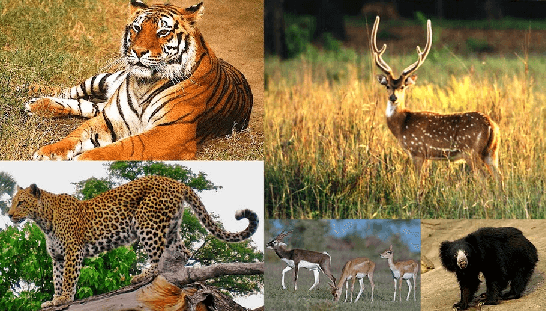
- Project Tiger was launched in 1973 to halt the decline of the tiger population. Other focused conservation programmes have targeted the one-horned rhinoceros, Asiatic lion, snow leopard, Indian elephant, gharial and great Indian bustard.
- Some important tiger reserves and protected areas in India include Corbett National Park (Uttarakhand), Sundarbans National Park (West Bengal), Bandhavgarh National Park (Madhya Pradesh), Sariska Wildlife Sanctuary (Rajasthan), Manas Tiger Reserve (Assam) and Periyar Tiger Reserve (Kerala).
Also read: Extra Questions: Forest & Wildlife Resources |
Types and Distribution of Forest and Wildlife Resources
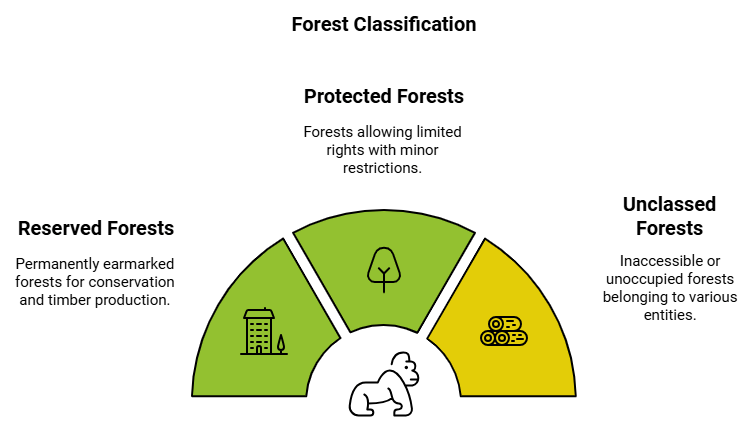
For administrative and management purposes, forests in India are classified into broad categories. This classification helps in law enforcement, conservation planning and resource use.
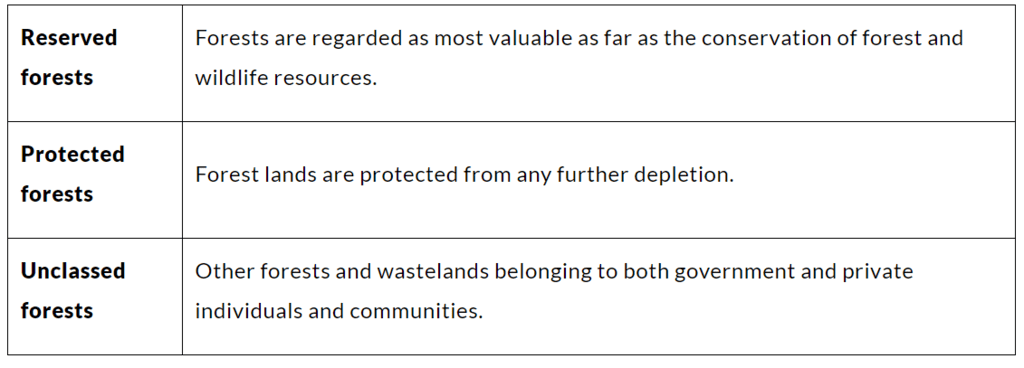
- Reserved Forests are regarded as the most strictly protected category. Activities such as hunting, grazing and resource extraction are highly restricted or prohibited to conserve biodiversity.
- More than half of India's recorded forest land has been declared as reserved forests, reflecting their importance in national conservation planning.
- Protected Forests are areas where the state affords protection against further degradation. Certain rights and regulated use may be permitted, but the aim is to prevent further loss of forest cover.
- Almost one-third of India's forest area falls under protected forests.
- Unclassed Forests include inaccessible forests, unoccupied wastelands and areas belonging to government, private individuals or communities that have not been formally classified. These areas may be less regulated and often contain important pockets of biodiversity.
 | Attention! Sale expiring soon, act now & get EduRev Infinity at 40% off! | Claim Offer |
Community and Conservation
Forests in India are often intimately linked with the lives, culture and livelihoods of traditional and local communities. These communities have frequently been the custodians of local biodiversity through customary rules and practices.
- Local communities have played an important role in conserving forests and wildlife. For example, villagers around Sariska Tiger Reserve opposed mining activities to protect wildlife habitats.
- In Alwar district of Rajasthan, the inhabitants of five villages declared around 1,200 hectares of forest as the Bhairodev Dakav 'Sonchuri' and protected it through community rules and management.
- Sacred Groves are patches of forest conserved in a pristine state because of religious beliefs and traditional taboos. These groves (often dedicated to local deities) have preserved many species and genetic resources over centuries.
- Many tribal communities worship trees such as Mahua, Kadamba, Tamarind, Mango, Peepal and Banyan, which has helped protect these trees and associated biodiversity.
- Springs, mountain peaks, particular plants and animals are often considered sacred in local belief systems and are therefore closely protected by communities.
- The Bishnoi community of Rajasthan is known for protecting species such as blackbuck, nilgai and peacocks as part of long-standing conservation traditions.
- Social movements have also played a major role. The Chipko Movement in the Himalayas resisted deforestation by embracing trees and mobilising communities. Farmer and citizen groups such as Beej Bachao Andolan (Save the Seeds Movement) in Tehri and the Navdanya initiative have promoted diversified, chemical-free agriculture and the conservation of seed diversity.
- These movements have demonstrated the success of community participation, afforestation using indigenous species and sustainable use of local resources.
- The Joint Forest Management (JFM) programme is a prominent example of involving local communities in restoration and management of degraded forests. JFM was formally introduced in Odisha in 1988. Under JFM, village communities protect degraded forests and, in return, receive benefits such as access to non-timber forest products and a share in timber harvests in a regulated manner.
Summary
India's forests and wildlife are invaluable for ecological stability, cultural identity and economic needs. Legal measures such as the Indian Wildlife (Protection) Act, 1972 and programmes like Project Tiger and JFM, together with community initiatives and conservation movements, aim to protect biodiversity. Continued community participation, habitat protection and sustainable management are essential to safeguard these resources for future generations.
Extra Questions: Forest & Wildlife Resources
Q1. Write any three measures to conserve the ecosystem?
Ans: Three measures to conserve the ecosystem are:
- Reserve forests and plant more trees, especially in areas affected by deforestation.
- Protect wildlife through laws and public awareness campaigns.
- Initiate projects aimed at saving endangered species of plants and animals.
Q2. Explain any three methods of forest conservation adopted by the government after independence.
Ans: The government has adopted several methods to conserve forests after independence:
- Forests are classified into three types: Reserved forests, Protected forests, and Unclassed forests. This classification clarifies which activities are permitted in each type.
- To protect wildlife, various laws have been enacted, such as the Indian Wildlife (Protection) Act of 1972. Many national parks and wildlife sanctuaries have also been established by central and state governments.
- The government has initiated programs like Van Mahotsava to raise awareness about the importance of forests among the public.
Q3. Give three reasons why we need to save the biodiversity of our planet?
Ans: We must conserve or save the biodiversity of our planet because:
- If we do not protect forests, entire wildlife populations will be at risk, disrupting the vital food cycle.
- The loss of biodiversity is linked to a decline in cultural diversity, which can marginalise and impoverish many tribal and forest communities.
- Women are particularly affected by biodiversity loss, as they often gather food, fuel, and water for their families.
Q4. What has been the contribution of the Indian Wildlife (Protection) Act in protecting habitats in India. Explain.
Ans: The Indian Wildlife (Protection) Act, enacted in 1972, plays a crucial role in safeguarding habitats in India. Its key contributions include:
- Establishing a comprehensive list of protected species across the country.
- Implementing a ban on hunting to help endangered species recover.
- Providing legal protection to vital habitats.
- Restricting trade in wildlife to prevent exploitation.
As a result, both central and state governments have:
- Created numerous national parks and wildlife sanctuaries.
- Launched projects aimed at protecting endangered animals, such as the tiger and the one-horned rhinoceros.
- Extended legal protection to various species, including the Asiatic lion and the Indian elephant.
Q5. Write any three effective practices towards conserving forests and wildlife.
Ans: Effective Practices for Conserving Forests and Wildlife are as follows:
- Establishing National Parks and Wildlife Sanctuaries: These areas are legally protected, prohibiting activities like hunting and deforestation.
- Launching Conservation Projects: Initiatives like Project Tiger focus on protecting endangered species and their habitats.
- Community Involvement: Engaging local communities in conservation efforts, such as the Chipko and Beej Bachao movements, has proven highly effective.
Q6. Write a brief note on 'Project Tiger'.

Ans: Project Tiger was launched in 1973 to protect the declining tiger population in India. Key points include:
- Initial success saw the tiger population rise from 1,827 in 1973 to 4,334 in 1989.
- By 1993, the population decreased to 3,600 due to threats like poaching and habitat loss.
- India has 27 tiger reserves covering 37,761 sq km.
- Notable reserves include Corbett National Park, Sunderbans National Park, and Bandhavgarh National Park.
Tiger conservation also helps preserve diverse ecosystems and supports biodiversity.
Q7. Why is conservation of forest and wildlife necessary? In what way have conservation projects changed in recent years?
Ans:
- Conservation of forests and wildlife is essential for sustainable development, as it protects vital ecosystems.
- It helps maintain ecological diversity and supports our life systems, including water, air, and soil.
- Conservation also safeguards the genetic diversity of plants and animals, promoting species growth and breeding.
In recent years, conservation projects have shifted focus to biodiversity as a whole, rather than just a few species. There is now a greater emphasis on finding diverse conservation methods, including the protection of insects.
Q8. With the help of three examples show how communities have carried out conservation of flora and fauna in India.
Ans:
In Sariska Tiger Reserve, Rajasthan, villagers have successfully opposed mining activities by referencing the Wildlife Protection Act. They actively protect their forests.
In Alwar district, residents of five villages have designated 1,200 hectares of forest as the Bhairodev Dakav Sanctuary. They established their own rules to prohibit hunting and safeguard wildlife.
The Chipko movement in the Himalayas has effectively halted deforestation and promoted community-led afforestation using native species.
Q9. Explain any two famous movements for the protection of forests.
Ans: The Chipko movement in the Himalayas has effectively resisted deforestation in Uttarakhand. It has demonstrated that community-led afforestation using native species can thrive. Groups like the Beej Bachao Andolan and Navdanya have shown that diverse crop production is possible without synthetic chemicals.
The Joint Forest Management (JFM) programme, established in 1988, encourages local communities to manage and restore degraded forest areas. This initiative relies on forming local groups that collaborate with the forest department to protect these lands.
Q10. What is bio-diversity? Why is bio-diversity important for human life?
Ans: Biodiversity refers to the variety of life on Earth, including all wildlife and cultivated species. It encompasses a wide range of forms and functions, all interconnected through various interdependencies.
Its importance for human life includes:
- Providing essential resources such as food, clean air, and water.
- Supporting ecosystems that regulate our environment.
- Maintaining the health of our planet, which is vital for our survival.
Without biodiversity, human life would be unsustainable.
Short Answer Questions: Forest & Wildlife Resources
Q1. Write a short note on India's biodiversity. What are main factors responsible for India's biodiversity?
India is one of the world's richest countries in terms of its vast array of biological diversity. India has nearly 8 percent of the total number of species in the world which is estimated to be 1.6 million. A large number of species are yet to be discovered. Over 81,000 species of fauna (animals) and 47,000 species of flora (plants) are found in India.
A variety of topographical or physical features and differences in climatic conditions found in India have provided a wide variety of habitats and influenced the survival of different species of plants and animals in different parts of India. Vast biodiversity with plants and animals unique to different areas is a consequence of the variety of physical and climatic conditions prevailing in India.
Q2. Distinguish between extinct species and endangered species. Give examples.
Extinct species are those species which are not found after searches of known or likely areas where they may occur. A species may be extinct from a local area, region, country, continent or the entire earth. Examples of such species are the Asiatic cheetah, pink-headed duck. Endangered species are those species which are in danger of extinction. The survival of such species is difficult if the negative factors that have led to a decline in their population continue to operate. The examples of such species are black buck, crocodile, Indian rhino, Indian wild ass, lion-tailed, a macaque, sangai, etc. Special measures are taken to protect endangered species, for example, hunting of such animals is banned under Wildlife Protection Act.
Endangered Species
Q3. Differentiate between endemic species and rare species. Give examples.
Endemic species are found in some particular areas, usually isolated by natural or geographical barriers, for example, islands. The examples of birds and animals belonging to such species are the Andaman teal, Andaman wild pig, Nicobar pigeon and mithun in Arunachal Pradesh. Uncommon species which are seldom found are called rare species. These species are small in number and are found scattered in some distant areas because their number has depleted due to negative factors. The small population of rare species may soon fall in the category of endangered or vulnerable species if the negative factors are not controlled. Examples of rare species are the Himalayan brown bear, wild Asiatic buffalo, desert fox, hornbill, etc.
Q4. What steps have been adopted under the Indian Wildlife Act to protect the endangered species of animals?
Under the Indian Wildlife (Protection) Act, implemented in 1972 several programmes were adopted to protect the remaining population of certain endangered species.
The steps taken in this regard include:
- banning hunting and poaching,
- giving legal protection to the habitats of the endangered species and
- restricting trade in wildlife
Subsequently, central and many states, governments established national parks and wildlife sanctuaries. The central government has undertaken several projects for protecting specific animals that are gravely threatened like the tiger, the one-horned rhinoceros, the Asiatic lion, the Kashmir stag or hangul and three types of crocodile.
Q5. Large-scale development projects and mining have contributed significantly to the loss of forests. Give reasons to support this statement.
Large scale development projects and mining have contributed significantly to the loss of forests.
Since 1951, over 5000 sq. km. of forests have been cleared for river valley projects. Clearing of the forest is still continuing with projects like the Narmada Sagar Project in Madhya Pradesh, which would inundate 40,000 hectares of forest. Mining for the purpose of industrial development is another major factor behind deforestation. The Buxa Tiger Reserve in West Bengal is seriously threatened by the ongoing dolomite mining. It has disturbed the natural habitat of many species and blocked the migration route of several others, including the great Indian elephant.
NCERT Solutions: Forest & Wildlife Resources
Q1. Multiple choice questions
(i) Which of the following conservation strategies do not directly involve community participation?
(a) Joint forest management
(b) Beej Bachao Andolan
(c) Chipko Movement
(d) Demarcation of Wildlife sanctuaries
Ans: (d) Demarcation of Wildlife sanctuaries
Explanation: Wildlife sanctuaries are established and maintained by the government to protect endangered species and their natural habitats. On the other hand, strategies like Joint Forest Management, the Beej Bachao Andolan, and the Chipko Movement are prime examples of active community participation in conservation efforts.
Q2. Match the following.
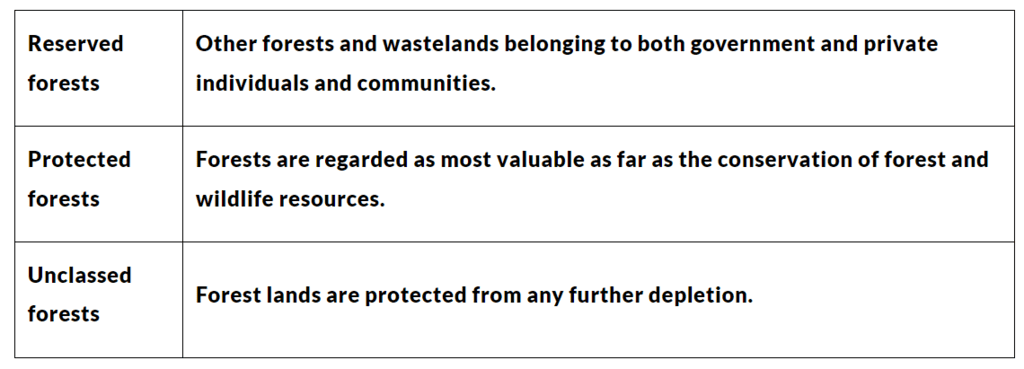
Ans:
Q3. Answer the following questions in about 30 words.
(i) What is biodiversity? Why is biodiversity important for human lives?
(ii) How have human activities affected the depletion of flora and fauna? Explain.
Ans:
(i) Biodiversity refers to the immense variety of living organisms, species, and ecosystems on Earth. It is crucial for human life because humans and all other living beings form a complex web of ecological systems. We depend entirely on this system for our survival, such as plants producing the oxygen we breathe and microorganisms maintaining soil fertility.
(ii) Human activities have significantly contributed to the depletion of flora and fauna through extensive habitat destruction, overexploitation of resources, hunting, and poaching. Additionally, environmental pollution, poisoning, and frequent forest fires have further accelerated the loss of India's biological diversity.
Q4. Answer the following questions in about 120 words.
(i) Describe how communities have conserved and protected forests and wildlife in India.
(ii) Write a note on good practices towards conserving forests and wildlife.
Ans:
(i) Communities across India have played a vital role in conserving forests and wildlife by integrating traditional beliefs with active protection measures:
- In the Sariska Tiger Reserve in Rajasthan, villagers have actively opposed mining activities by citing the Wildlife Protection Act.
- In the Alwar district of Rajasthan, the inhabitants of five villages have declared 1,200 hectares of forest as the Bhairodev Dakav Sonchuri. They have established their own set of rules and regulations strictly banning hunting and protecting the wildlife from outside encroachments.
- Nature worship, an age-old tribal belief, has preserved several virgin forests in pristine form, commonly known as sacred groves.
- Various tribal communities worship specific trees. For instance, the Mundas and Santhals of the Chota Nagpur region worship the Mahua and Kadamba trees, while the tribals of Odisha and Bihar worship the Tamarind and Mango trees during weddings.
- In many villages, animals like monkeys and langurs are fed around temples, and the Bishnoi villages in Rajasthan strictly protect herds of blackbuck, nilgai, and peacocks as an integral part of their community.
- Movements such as the Chipko Movement in the Himalayas and Joint Forest Management (JFM) further highlight successful community efforts in forest conservation.
(ii) Good conservation practices in India combine legal measures and traditional knowledge to protect ecological diversity:
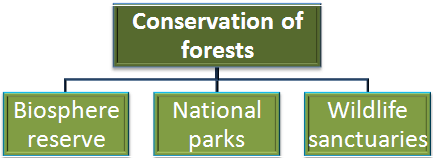
- Establishing National Parks, Wildlife Sanctuaries, and Biosphere Reserves helps protect endangered species and their natural habitats.
- The Bishnoi community in Rajasthan shows deep cultural respect for wildlife by protecting animals like the blackbuck, nilgai, and peacocks from hunting.
- Movements such as the Beej Bachao Andolan in Tehri and Navdanya promote organic farming and the preservation of indigenous crop varieties without the use of synthetic chemicals.
- Awareness campaigns like Van Mahotsav encourage mass tree plantation and raise public consciousness about forest conservation.
- The Joint Forest Management (JFM) programme involves local communities in restoring and managing degraded forests. In return, the members are entitled to non-timber forest benefits and a share in the timber harvested by successful protection efforts.
Key Questions
Q1: What is biodiversity? Why is it important?
Q2: Explain the major causes of depletion of flora and fauna.
Q3: What are endangered species? Give examples.
Q4: Differentiate between endangered species and extinct species.
Q5: What are the different categories of existing plants and animal species?
Q6: What are endemic species? Give examples.
Q7: Explain the importance of forests in maintaining ecological balance.
Q8: What is Project Tiger? Why was it launched?
Q9: Explain the role of local communities in forest conservation.
Q10: What is Joint Forest Management Programme?
Q11: Explain the Chipko Movement.
Q12: Why are conservation projects necessary in India?
Q13: What are biosphere reserves? Name any two biosphere reserves in India.
Q14: Explain the effects of deforestation.
Q15: How can forests and wildlife be conserved?
Long Answer Questions: Forest & Wildlife ResourcesQ1. Why was Project Tiger launched? What are its objectives? What are its effects on the conservation of wildlife? Ans: The tiger is a keystone species in many forest ecosystems. By 1973 the tiger population in India had fallen dramatically from an estimated 55,000 at the start of the century to about 1,827. The main causes of this decline were:
Because India and Nepal together harboured a large share of the world's tigers, these countries became central to global tiger conservation. Project Tiger was launched in 1973 to reverse the decline. Its principal objectives were to:
Effects of Project Tiger on wildlife conservation:
In summary, Project Tiger made an important and necessary start by securing habitats, strengthening protection and raising awareness. Its success shows that focused conservation works, but long-term survival of tigers needs an integrated approach that combines protected areas, connected landscapes, community involvement and continued law enforcement. Q2. Discuss the role of local communities in the conservation of forests with the help of examples. Ans: Local communities are often the stewards of nearby forests and play a vital role in conserving them. Their knowledge, customary rules and daily use of forest resources make them essential partners in conservation. Ways in which communities help include patrolling and protecting forest land, reviving traditional conservation practices, and creating local rules to prevent over-exploitation. Examples from India:
Thus, when communities are given rights, responsibilities and benefits, they become effective protectors of forests. Their local knowledge and vested interest in sustainable resources are key to long-term conservation. Q3. What are 'sacred groves'? Give examples of some species of flora which are worshipped by the tribals. How has the 'sacredness' ascribed to plants and animals helped in protecting them? 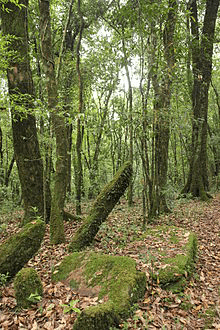 Sacred Grooves Sacred GroovesAns: Sacred groves are small patches of forest or woodland that communities protect because they are associated with religious beliefs, rituals or local deities. These areas are left undisturbed and are often governed by customary rules that forbid cutting trees, grazing or hunting. As a result, sacred groves act as refuges for native plants and animals and help conserve local biodiversity. Examples of flora worshipped by tribal and rural communities include:
How sacredness helps protection:
In short, cultural and religious values can translate into powerful, low-cost conservation measures that protect both plants and animals while maintaining local customs. Q4. Write a short note on Joint Forest Management. What have been the effect of Beej Bachao Andolan towards conservation of forests? Ans: Joint Forest Management (JFM) is a participatory approach initiated in India in the late 1980s to involve local communities in the protection and regeneration of degraded forests. Key features include:
Effects and outcomes of JFM:
The Beej Bachao Andolan (Save the Seed Movement) has had a strong, positive influence on biodiversity and forest conservation by:
Overall, Beej Bachao Andolan helped revive traditional knowledge, strengthened farmers' control over seed resources and supported landscape-level biodiversity conservation which complements forest protection efforts. Q5. Write a note on the programmes accepted for conserving forest and wildlife in India. Ans: Conserving forests and wildlife is essential for maintaining ecological stability and supporting livelihoods. Major national policies and programmes include:
Additional approaches that support these programmes include community participation (for example, Joint Forest Management), captive breeding and rehabilitation, wildlife corridors to reduce fragmentation, conservation education and scientific research and monitoring. These combined efforts aim to protect biodiversity while balancing the needs of people who depend on forests and wildlife. Unit Test: Forest & Wildlife ResourcesTime: 1 hour M.M. 30 Attempt all questions.
Q1: Which one of the following is a direct threat to wildlife? (1 Mark) Q2: A state government is planning to protect a large forest that contains several endangered species. The Forest Department wants this area to receive the highest level of protection so that commercial activities are not allowed. Q3: Assertion (A): Local communities play an important role in conserving forests. Q4: Which statement is true regarding the 'Chipko Movement'? (1 Mark) Q5: A forest area has suffered from illegal tree cutting for many years. The Forest Department now wants local villagers to protect and restore the degraded forest while allowing them to share certain benefits from it. (a) Wildlife Protection Act Q6: State any two reasons for the depletion of wildlife. (2 Marks) Q7: A forest village has successfully reduced illegal tree cutting after local people started working with the Forest Department to protect nearby forests. Explain two ways in which this partnership can help conserve forests. (2 Marks) Q8: Two villages adopted different approaches to protect forests. One village prevented the cutting of trees by peacefully resisting deforestation, while the other worked with the Forest Department to restore degraded forests. Q9: Explain the causes and consequences of deforestation. (3 Marks) Q10: Explain the concept of biodiversity and why it is important for the survival of species. (3 Marks) Q11: What are the consequences of the extinction of species? (3 Marks) Q12: Describe the major factors responsible for the depletion of the tiger population in India. Suggest measures to protect and conserve tigers effectively. (5 Marks) Q13: A district administration is preparing a conservation programme for a forest where illegal tree cutting, hunting and habitat destruction have increased. The officials decide that the programme should involve local communities instead of relying only on government action. Justify this decision by explaining how community participation has helped conserve forests and wildlife in different parts of India. Support your answer with suitable examples. (5 Marks) Very Short Questions: Forest and Wildlife ResourcesQ1: What is biodiversity?
Q14: Mention any wildlife protection program. Worksheet: Forest and Wildlife ResourcesMultiple Choice Questions Q2: Which of the following conservation strategies does not directly involve community participation? Q3: The forest cover in our country has recently increased due to : Q4: Substantial parts of the tribal belts in north -eastern India have been deforested by: Q5: Forest and wastelands belonging to both private individuals and government are known as: Q6: Which one of the following is an endangered species of Manipur? Q7: In which year the Indian Wildlife protection Act was implemented? Q8: In which one the following states Periyar tiger reserves located? Q9: What was the aim of the Chipko movement? Q10: The Buxar tiger reserve is situated in which of the following states? Q12: Which species are called normal species? Q13: Which species are considered vulnerable? Q14: What is rare species? Q15: What are endemic species? Q16: How were forest depleted by tribal people of India? Q17: Which forest are protected forest? Q18: Which forest is categorized as unclassed forest? Q19: What do you know about Chipko movement? Q20: What do you understand by joint forest management programme? Q22: What were the provisions of India wildlife act of 1972? Q23: How the villagers of Alwar district of Rajasthan are are struggling to conserve their forest and wild life? Q24: Grazing and fuel wood collection are not responsible for deforestation in India. Support the statement with suitable reason. Q25: Nature worship is an age old belief. Explain how it helped in forest and wildlife conservation. Q27: Explain any five different categories of existing plant and animal species based on the international union for conservation of nature and natural resource with example Q28: What are endemic species? Q29: What is bio-diversity? Why is bio-diversity important for human lives? Analyse. Q30: Asiatic cheetah belongs to which of the following types of species? Q31: 'Large-scale development projects have also contributed significantly to the loss of forests'. Q32: Explain the two famous programmes which have resisted deforestation and involved local communities. Q33: How does deforestation affect eco system? Give two reasons. Q34: Depletion of forests leads to disappearance of wild life as well as many wild varieties of plants. How is Afforestation helpful in maintaining ecological balance? Q35: What is a National Park? Name any two national parks of India? Q36: What is Wildlife Sanctuary? How is it different from National Park? Q37: What are Biosphere Reserves? Q38: Why is the Himalayan Yew in trouble? Q39: What steps have been adopted under the Indian Wildlife Act to protect endangered species of animals? Q40:What are the three types of forests as identified by Forest Department? Q41: Large scale development projects have significantly to the loss of forests. Give reasons to support this statement. |
: