

Previous Year Questions 2026
Q1. Identify the state related with the Chipko Movement : [1 Mark]
(A) Arunachal Pradesh
(B) Madhya Pradesh
(C) Uttarakhand
(D) Bihar
Ans: (C) Uttarakhand
Q2. Which one of the following pairs is correctly matched ? [1 Mark]
Ans: (B) Manas - Assam
Q3. (a) Describe the role of communities in the conservation of forests in India. [2 Marks]
Ans (a):
(i) In India, forests are home to some of the traditional communities.
(ii) The inhabitants of five villages in the Alwar district of Rajasthan have declared 1200 hectares of forest as "Bhairodev Dakav Sonchuri" declaring their own set of rules and regulations.
(iii) Communities are protecting wildlife against any outside encroachment.
(iv) Movements like Chipko, Beej Bachao Andolan and Navdanya played an important role in conserving the forests.
(Any two points to be explained)
Q3. (b) Describe any two steps taken by the Government of India to protect forests and wildlife. [2 Marks]
Ans (b):
(i) The Indian Wildlife (Protection) Act was implemented in 1972.
(ii) An all-India list of protected species was published.
(iii) Hunting was banned.
(iv) In 1973, Project Tiger was launched.
(v) Various Tiger reserves were established.
(vi) In 1988, Odisha passed the First resolution for 'Joint Forest Management'.
(Any two points to be explained)
Q4. Read the given source carefully and answer the questions that follow:
Joint Forest Management
In India the Joint Forest Management (JFM) programme furnishes a good example for involving local communities in the management and restoration of degraded forests. The programme has been in formal existence since 1988 when the state of Odisha passed the first resolution for joint forest management. JFM depends on the formation of local (village) institutions that undertake protection activities mostly on degraded forest land managed by the forest department. In return, the members of these communities are entitled to intermediary benefits like non-timber forest produces and share in the timber harvested by 'successful protection'.
The clear lesson from the dynamics of both environmental destruction and reconstruction in India is that local communities everywhere have to be involved in some kind of natural resource management. But there is still a long way to go before local communities are at the centre-stage in decision-making. Accept only those economic or developmental activities, that are people centric, environment-friendly and economically rewarding.
(a) Why is conservation of forests necessary? [Marks: 1]
Ans:
(i) To maintain ecological balance.
(ii) To conserve wildlife.
(Any one point to be explained)
(b) Which type of forests are protected under the 'Joint Forest Management' programme? [Marks: 1]
Ans: Degraded Forest.
(c) Explain the role of local communities in forest conservation. [Marks: 2]
Ans:
(i) In India, forests are home to some of the traditional communities.
(ii) The inhabitants of five villages in the Alwar district of Rajasthan have declared 1200 hectares of forests as 'Bhairavodev Dakav Sonchuri' declaring their own set of rules and regulations.
(iii) Local communities and the government can join hands in the conservation of forest.
(iv) Local communities can suggest methods of forest conservation.
(v) Local communities can organize protests and movements to sensitize public about the need of forest conservation viz. Chipko and Navdanya movement.
(Any Two points to be explained)
Q5. Match Column I with Column II and choose the correct option : [1 Mark] Options :
(A) a-ii, b-i, c-iv, d-iii
(B) a-i, b-iii, c-ii, d-iv
(C) a-iv, b-ii, c-iii, d-i
(D) a-ii, b-iv, c-i, d-iii
Ans: (D) a-ii, b-iv, c-i, d-iii
Q6. In which of the following States of India, has the largest area under permanent forests ? [1 Mark]
(A) Uttar Pradesh
(B) Madhya Pradesh
(C) Gujarat
(D) Maharashtra
Ans: (B) Madhya Pradesh
Q7. Match Column-I with Column-II and choose the correct option : [1 Mark]

Options :
(A) a-iii, b-ii, c-i, d-iv
(B) a-iv, b-ii, c-iii, d-i
(C) a-iv, b-iii, c-ii, d-i
(D) a-ii, b-iv, c-iii, d-i
Ans: (C) a-iv, b-iii, c-ii, d-i
Previous Year Questions 2025
Q1: Which of the following characteristics of the Indian Wildlife (Protection) Act are correct? (1 Mark)
Characteristics:
I. To make provisions for habitat for wild animals.
II. To publish list of protected species.
III. To ban hunting to save endangered species.
IV. To include important subjects like forests and wildlife in the Union List.
(a) Only I, II and III are correct.
(b) Only I, II and IV are correct.
(c) Only II, III and IV are correct.
(d) Only I, III and IV are correct.
Ans: (a)
Explanation: The Indian Wildlife (Protection) Act, 1972 aims to protect wild animals by providing legal protection for their habitats, publishing an all-India list of protected species and prohibiting hunting of endangered species. It does not make forests and wildlife subjects of the Union List; those constitutional arrangements are outside the Act.
Q2: Choose the correctly matched pair from the following: (1 Mark)
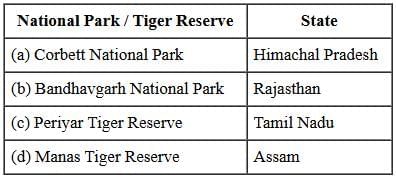
Ans: (d)
Explanation:
Manas Tiger Reserve is located in Assam.The other pairs are incorrectly matched:
- Corbett National Park → Uttarakhand
- Sunderban National Park → West Bengal
- Bandhavgarh National Park → Madhya Pradesh
Or
Choose the correctly matched pair: (1 Mark)
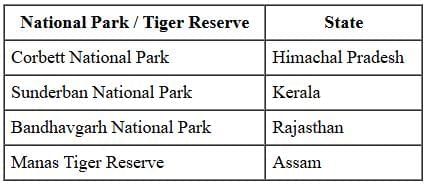
Ans: (d)
Explanation: Manas Tiger Reserve belongs to Assam, so option (d) is the correct match.
Q3: Match Column I with Column II and choose the correct option: (1 Mark)
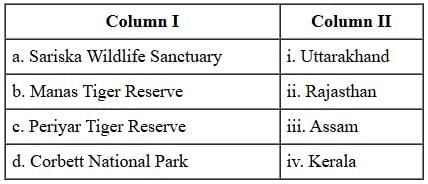
(a) a-i, b-ii, c-iii, d-iv
(b) a-ii, b-iii, c-iv, d-i
(c) a-iv, b-i, c-iii, d-ii
(d) a-ii, b-i, c-iv, d-iii
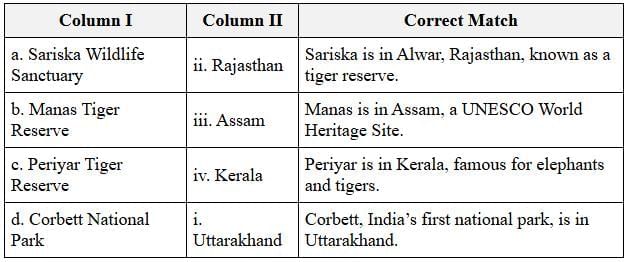
Ans: (b)
Explanation:
Q4: Read the given source and answer the questions that follow: (4 Marks)
Sacred Groves - a wealth of diverse and rare species
Nature worship is an age-old tribal belief based on the premise that all creations of nature have to be protected. Such beliefs have preserved several virgin forests in pristine form called Sacred Groves (the forests of God and Goddesses). These patches of forest or parts of large forests have been left untouched by the local people and any interference with them is banned. Certain societies revere a particular tree which they have preserved from time immemorial. The Mundas and the Santhal of Chota Nagpur region worship mahua (Bassia latifolia) and kadamba (Anthocaphalus cadamba) trees, and the tribals of Odisha and Bihar worship the tamarind (Tamarindus indica) and mango (Mangifera indica) trees during weddings. To many of us, peepal and banyan trees are considered sacred. Indian society comprises several cultures, each with its own set of traditional methods of conserving nature and its creations. Sacred qualities are often ascribed to springs, mountain peaks, plants, and animals which are closely protected. You will find troops of macaques and langurs around many temples. They are fed daily and treated as a part of temple devotees. In and around Bishnoi villages in Rajasthan, herds of blackbuck (chinkara), nilgai, and peacocks can be seen as an integral part of the community and nobody harms them.
(i) How do sacred groves show the inter-connectivity of spirituality and ecology? (1 Mark)
Ans: Sacred groves show the inter-connectivity of spirituality and ecology because communities treat parts of nature as sacred and divine, and this spiritual regard leads them to protect and preserve forests, trees, springs, plants and animals from human interference.
(ii) How do tribal practices promote conservation of forests? (1 Mark)
Ans: Tribal practices promote conservation by revering certain trees and forest patches-groups such as the Mundas, Santhals and other tribal communities worship trees like mahua, kadamba, tamarind and mango and therefore leave these areas undisturbed, banning any interference.
(iii) Why is conservation of wildlife important for all of us? Explain. (2 Marks)
Ans: Conservation of wildlife is important because it preserves ecological diversity and essential life-support systems such as clean air, water and soil. It also maintains genetic diversity among plants and animals, which supports agriculture, fisheries and other resources necessary for human survival and well-being.
Q5: Which state of India has the maximum area under permanent forest? (1 Mark)
(a) Haryana
(b) Himachal Pradesh
(c) Punjab
(d) Madhya Pradesh
Ans: (d)
Explanation: Madhya Pradesh has the largest area under permanent forests among the options. A very large proportion of the state's land remains under forest cover, making it the state with maximum permanent forest area.
 | Get additional INR 200 off today with EDUREV200 coupon. | Avail Offer |
Previous Year Questions 2024
Q1: Read the following passages and answer the questions that follow: (CBSE 2024)Nature worship is an age-old tribal belief based on the premise that all creations of nature have to be protected. Such beliefs have preserved several virgin forests in pristine form called Sacred Groves (the forests of God and Goddesses). These patches of forest or parts of large forests have been left untouched by the local people and any interference with them is banned. Certain societies revere a particular tree which they have preserved from time immemorial. The Mundas and the Santhal of Chota Nagpur region worship mahua (Bassia latifolia) and kadamba (Anthocaphalus cadamba) trees, and the tribals of Odisha and Bihar worship the tamarind (Tamarindus indica) and mango (Mangifera indica) trees during weddings. To many of us, peepal and banyan trees are considered sacred. Indian society comprises several cultures, each with its own set of traditional methods of conserving nature and its creations. Sacred qualities are often ascribed to springs, mountain peaks, plants and animals which are closely protected. You will find troops of macaques and langurs around many temples. They are fed daily and treated as a part of temple devotees. In and around Bishnoi villages in Rajasthan, herds of blackbuck, (chinkara), nilgai and peacocks can be seen as an integral part of the community and nobody harms them.
(i) How does the sacred grove relate to the belief in nature worship?
Ans: Sacred groves are physical expressions of nature worship: communities consider certain forest patches as sacred and therefore protect them, preserving biodiversity and keeping those areas undisturbed by human activity.
(ii) How do communities incorporate trees into their cultural practices? Explain with an example.
Ans: Communities include trees in ceremonies and rituals by assigning them sacred or symbolic roles. For example, tribal groups in Chota Nagpur worship trees such as mahua and kadamba, while people in Odisha and Bihar use tamarind and mango trees in wedding rituals; peepal and banyan trees are also commonly revered near temples.
(iii) Explain the cultural values that contribute to the coexistence of nature.
Ans: Cultural values that support coexistence include:
- Respect for specific natural sites (sacred groves) where rituals and taboos prevent damage and preserve ecosystems.
- Assigning symbolic importance to plants and animals so that they are protected and fed, as seen with macaques and langurs near temples.
- Community practices, such as those in Bishnoi villages, where animals like blackbuck, nilgai and peacocks are regarded as part of the community and therefore left unharmed.
Previous Year Questions 2023
Q2: Which of the following options represent potential measures that can be taken to mitigate the threats posed on the tiger population and biodiversity?(I) Banning hunting, giving legal protection to their habitats, and restricting trade in wildlife.
(II) Prohibiting the visit of public into forest area.
(III) Establishing wildlife sanctuaries and National Parks.
(IV) Converting forests into Reserved and Protected forests. (CBSE SQP 2023)
Options:
(a) Statements (I) and (II) are correct.
(b) Statements (II), (III) and (IV) are correct.
(c) Statement (II) is correct.
(d) Statements (I), (III), and (IV) are correct.
Ans: (d)
Explanation:
Statement (I) suggests banning hunting and protecting tiger habitats, which helps in conserving the tiger population and maintaining biodiversity.
Statement (III) about establishing wildlife sanctuaries and national parks provides safe areas for tigers and other wildlife to thrive, promoting biodiversity.
Statement (IV) on converting forests into reserved and protected forests ensures that these areas are safeguarded from exploitation and development.
Statement (II), which proposes prohibiting public visits to forest areas, might not be practical or beneficial for conservation efforts. Allowing controlled visits can raise awareness and support for wildlife protection.
Also read: Long Answer Questions: Forest & Wildlife Resources |
Previous Year Questions 2022
Q3: Which of the following descriptions of forest is NOT correct? (2022)(a) Reserved Forest - Reservation of more than half of forests
(b) Protected Forest - Reservation of 1/3 of the forests
(c) Unclassed Forest - Reservation of forest under government and private individuals.
(d) Permanent Forest - Reserved and unclassed forest for the production of timber.
Ans: (d)
Explanation: Option (d) is not correct as described. Reserved and protected forests are classifications used to conserve forest resources; permanent forests are maintained for sustained forest produce and ecological functions, not simply as a label meaning reserved and unclassed forests for timber production.
Q4: Match the items in Column A with those of Column B. (Delhi Gov. SQP 2022)
 (a) (A)-(II), (B)-(III), (C)-(I), (D)-(IV)
(b) (A)-(I), (B)-(II), (C)-(III), (D)-(IV)
(c) (A)-(III), (B)-(IV), (C)-(II), (D)-(I)
(d) (A)-(II), (B)-(I), (C)-(III), (D)-(IV)
(A) Jim Corbett National Park → (II) First national park of India
It is the oldest national park in India, established in 1936.
(B) Chipko Movement → (III) Movement to prevent cutting of trees
People hugged trees to stop them from being cut down.
(C) Sacred Groves → (I) Community-led forest protection system
These are forest patches protected by local communities due to religious beliefs.
(D) Project Tiger → (IV) Wildlife conservation programme for tigers
A government initiative launched to protect and increase tiger population.
Q5: How do human beings influence the ecology of a region? (Delhi Gov. SQP 2022)
Ans:
- Breathing: Humans inhale oxygen and exhale carbon dioxide, affecting gas exchange in ecosystems.
- Anthropogenic activities: Agriculture, grazing and industrial development change land use and permanently alter the ecology of a region.
- Consumption: Humans extract plants and animals for food, fuel, medicine and other needs, which affects species populations and ecosystem balance.
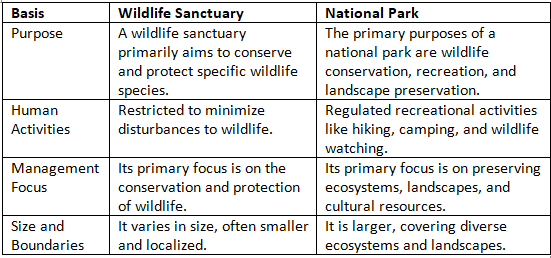
Q6: What is a wildlife sanctuary? How is it different from national parks? (Delhi Gov. SQP 2022)
Ans: A wildlife sanctuary is a protected area set aside for the preservation and conservation of wildlife and their habitats. Such areas are established by governments or authorised bodies to protect biodiversity, maintain ecological balance and give refuge to threatened species.
Difference between wildlife sanctuaries and national parks:
Q7: The destruction of forests and wildlife is not just a biological issue. The biological loss is strongly correlated with the loss of cultural diversity." Explain the statement by giving relevant examples. (Delhi Gov. SQP 2022)
Ans: The destruction of forests and wildlife affects societies and cultures that depend on them. This can be shown by:
- Marginalisation: Forest-dependent communities lose food, shelter and livelihoods when biodiversity declines, pushing them into poverty.
- Cultural impact: Many rituals, ceremonies and traditional knowledge are linked to specific plants, animals and forest spaces; loss of these resources erodes cultural identity and practices.
- Gender effects: Women, who collect fuel, fodder and water, face heavier burdens when resources shrink, affecting health and family roles.
- Generational loss: As people are forced to leave traditional occupations, cultural transmission to younger generations diminishes.
Previous Year Questions 2017
Q8: In which year was the 'Indian Wildlife Protection Act' implemented in India? Describe the main thrust area of this program. (2017)Ans: The Indian Wildlife (Protection) Act was enacted in 1972.
Main thrust areas:
- Creating an all-India list of protected species and giving them legal protection.
- Banning hunting and restricting trade in wildlife to prevent extinction of endangered species.
- Providing legal protection for wildlife habitats and encouraging the establishment of national parks and sanctuaries.
- Launching focused conservation projects such as Project Tiger (started in 1973) to protect specific species.
Q9: What is biodiversity? Why is biodiversity important for human lives? Analyse. (2017)
Ans: Biodiversity means the variety of plants, animals and other organisms in a given area. It is important because:
- It supplies essential goods-food, clean air, water and medicines-that humans rely on.
- High species diversity increases ecosystem productivity and stability, giving a wider range of crops and resources.
- Healthy ecosystems can better withstand and recover from disasters, supporting long-term human survival.
- Species interact in ways that support one another; losing species can disrupt these relationships and harm human well-being.
 | Attention! Sale expiring soon, act now & get EduRev Infinity at 40% off! | Claim Offer |
Previous Year Questions 2016
Q10: 'Forests and wildlife are vital to the quality of life and environment'. Justify the statement by giving three reasons. (2016)Ans:
- Loss of cultural diversity: Many communities depend on forests for their traditions, rituals and livelihoods; destruction of forests erodes these cultural practices.
- Impact on women: Women often collect fuel, fodder and water; depletion of forests increases their workload and affects health and family life.
- Poverty: When forest resources disappear, forest-dependent people must buy essentials, increasing economic strain and leading to poverty.
Q11: 'Large-scale development projects have also contributed significantly to the loss of forests'. Justify this statement with relevant examples. (2016)
Ans:
- Since 1951, over 5,000 sq km of forest was cleared for river valley and large hydro projects.
- The Narmada Sagar Project in Madhya Pradesh alone would inundate around 40,000 hectares of forest, illustrating how reservoirs remove forest land.
- Mining operations also cause deforestation and habitat destruction in many protected areas.
Previous Year Questions 2015
Q12: Analyse any four reasons for the depletion of forest resources in India. (2015)Ans:
- Extensive use of forest products: Wood, barks, leaves, rubber, medicines, dyes, fuel and fodder are taken in large quantities.
- Agricultural expansion and infrastructure: Clearing land for farming, railways and roads reduces forest area.
- Shifting cultivation: Practices such as jhumming in parts of the northeast lead to forest degradation.
- Large development projects and mining: Projects like the Narmada Sagar and mining in reserves (e.g. dolomite mining near Buxa Tiger Reserve) cause substantial loss of forest and wildlife habitat.
Q13: Describe the steps taken to conserve the flora and fauna of the country. (2015,2014)
Ans: Steps taken include:
- Implementation of the Indian Wildlife (Protection) Act, 1972.
- Controlling deforestation and promoting afforestation and social forestry programmes.
- Legal measures against hunting and poaching to protect animals.
- Raising public awareness about the importance of forests and biodiversity.
- Establishing biosphere reserves, national parks and wildlife sanctuaries; India has several such protected areas.
- Providing support to botanical gardens and conservation organisations.
- Implementing targeted projects like Project Tiger, Project Rhino and programmes for other threatened species.
Also read: Long Answer Questions: Forest & Wildlife Resources |
Previous Year Questions 2014
Q14: Explain any three factors responsible for the depletion of flora and fauna in India. (2014)Ans:
(i) Agricultural expansion: Since Independence, large areas of forest have been converted into farmland; between 1951 and 1980 over 26,200 sq km of forest were cleared for agriculture.
(ii) Mining: Mining activities (for example, dolomite mining near Buxa Tiger Reserve) destroy habitats and block migration routes of animals such as elephants.
(iii) Large-scale development projects: River valley and hydro projects have inundated extensive forest areas; since 1951, thousands of square kilometres were cleared for such projects.
: